Quick answer
The best Jackery power station for most UK buyers is the Explorer 1000 v2 at £499 at our September 2026 check: 1,070Wh of LiFePO4, 1,500W of output and 10.8kg, which Jackery claims as the smallest and lightest station in the 1kWh class. It was also Amazon UK's best seller in its category at our check. If you just need phones, lights and a laptop covered, the Explorer 240 v2 does it for £189 at 3.6kg; for home backup, the Explorer 3000 v2 brings 3,600W and 3,072Wh for £1,599.
Our pick: Jackery Explorer 1000 v2
- Best overall: Jackery Explorer 1000 v2 (~£499)
- Budget pick: Jackery Explorer 240 v2 (~£189)
- Power-cut cover: Jackery Explorer 2000 v2 (~£899)
- Big capacity: Jackery Explorer 3000 v2 (~£1,599)
Which Jackery power station should you buy?
The best Jackery power station for most UK buyers is the Explorer 1000 v2 at £499 at our September 2026 check: 1,070Wh of LiFePO4, 1,500W of output and 10.8kg, which Jackery claims as the smallest and lightest station in the 1kWh class. It was also Amazon UK's best seller in its category at our check, and the crowd has this one right. If you just need phones, lights and a laptop covered, the Explorer 240 v2 does it for £189 at 3.6kg; for home backup, the Explorer 3000 v2 brings 3,600W and 3,072Wh for £1,599.
Jackery is the biggest name in this market, and the v2 line earns much of the reputation: the lightest units in their class at every size, a simple four-model range and a 20ms UPS mode on every model. But two things need saying plainly before you buy, and both are covered below: nothing in the v2 line is expandable, and the headline charging claims need translating.
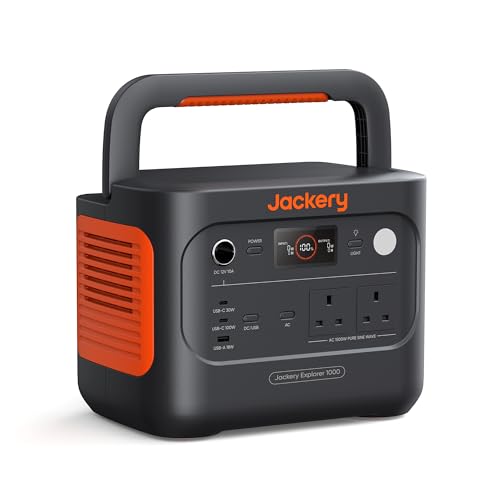
Here is the whole current range at a glance (tap a model name to jump to its full breakdown):
| Image | Product | Price | Buy |
|---|---|---|---|
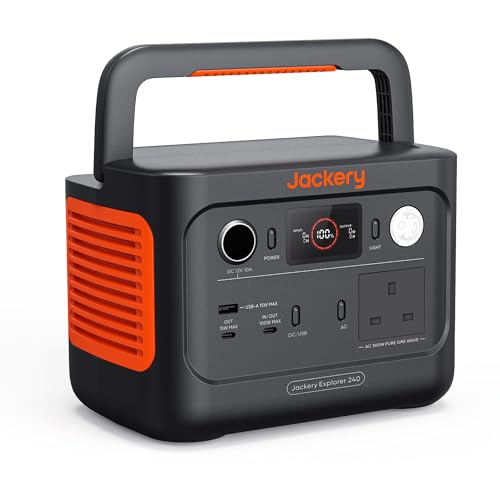 | Jackery Explorer 240 v2 | ~£189 | Buy now |
| 256Wh · 300W output · 3.6kg · up to 100W solar · mains 0–100% in 120 minBest for First power station, weekend devices | |||
| Jackery Explorer 1000 v2 | £469.00 | Buy now |
| 1,070Wh · 1,500W output · 10.8kg · up to 400W solar · mains 0–100% in 102 minBest for Family camping weekends, lightest 1kWh | |||
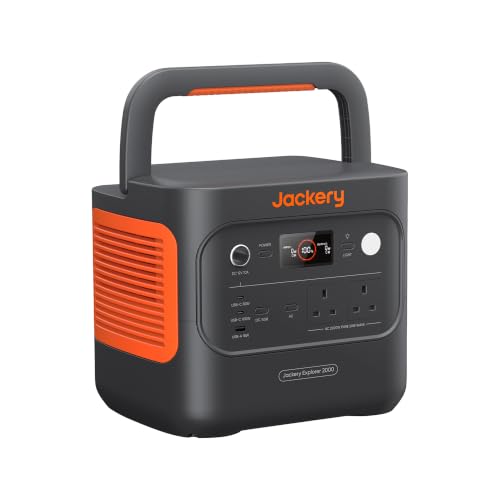 | Jackery Explorer 2000 v2 | ~£899 | Buy now |
| 2,042Wh · 2,200W output · 17.5kg · up to 400W solar · mains 0–100% in 102 minBest for Power-cut cover you can still carry | |||
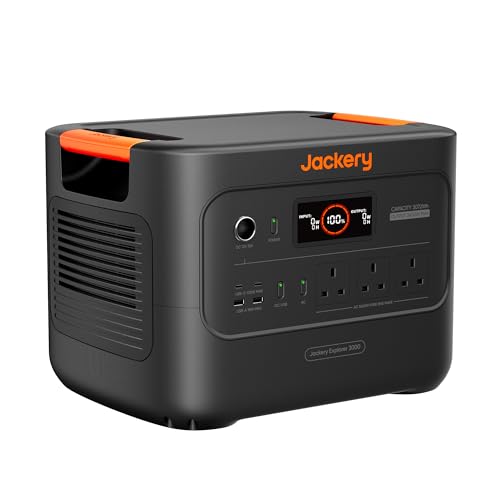 | Jackery Explorer 3000 v2 | ~£1,599 | Buy now |
| 3,072Wh · 3,600W output · 27kg · up to 1,000W solar · mains 0–100% in 108 minBest for Home backup and winter trips | |||
Weighing Jackery against the other brands? The complete buying guide ranks all 24 current models side by side, or let the finder choose for you.
How the Jackery range works
Four models, one naming rule: the number is roughly the watt-hours. The Explorer 240 v2 is 256Wh, the 1000 v2 is 1,070Wh, the 2000 v2 is 2,042Wh and the 3000 v2 is 3,072Wh, all current-generation LiFePO4 with app control. That simplicity is the range's real selling point: there is no bundle algebra or naming trap to decode, just four sizes of the same idea, each the claimed lightest in its class.
The structural thing to know is that nothing here expands. There are no expansion batteries anywhere in the v2 line; the Battery Pack 2000 Plus you will see on Jackery's site fits the separate Explorer 2000 Plus model, not these. So sizing is a one-time decision: if 1,070Wh is not enough in two years, it never will be, and that alone should push anyone with growing needs towards an expandable design from another brand.
The charging claims need decoding too. The "full in 1 hour" figures on the Explorer 240 v2 and 1000 v2 are app-enabled emergency charging modes, real and useful before a storm hits but not the everyday numbers. Standard mains charging is 2 hours on the 240 v2, 1.7 hours on the 1000 v2 and 2000 v2, and 1.8 hours on the 3000 v2. Fine figures for the capacities involved, just not the headlines.
The buying options are the base unit plus SolarSaga panels (40W to 200W, singly or in pairs) and the odd case bundle. The discounts were unusually deep at our September 2026 check, topping out at 43% off the Explorer 240 v2 with a 100W panel at £328, so compare the bundle price against the base unit plus a separate panel before assuming either way. And match the panel to the station's solar ceiling: 100W on the 240 v2, 400W on the 1000 v2 and 2000 v2, 1,000W on the 3000 v2. Those 400W caps are modest for the capacity, and they matter if panels are your main plan.
Not sure Jackery is even the right brand? Answer a few questions in our Power Station Finder and it will narrow every current model we cover down to a shortlist.
The Portable Power Station Finder
Which portable power station should you buy? Seven questions
1. What's it mainly for?
Recommendations are computed from our verified spec inventory of every current UK model from EcoFlow, Anker, Bluetti, Jackery and DJI, with prices checked 24 September 2026.
Every current Jackery model
Four models, from the 256Wh Explorer 240 v2 to the 3,072Wh Explorer 3000 v2, every one verified against Jackery's UK spec data with Amazon prices checked 24 September 2026.
Explorer 240 v2, from £189
The entry point: 256Wh at 3.6kg with a UK AC socket, 300W of output, a 100W two-way USB-C port and a built-in LED light. It charges fully from the mains in 2 hours as standard (the 1-hour figure is the app's emergency mode) and from a SolarSaga 100W panel in 3.3 hours, with a battery rated 3,000 cycles to 80-plus per cent capacity. At £189 at our September 2026 check it covers phones, lights, camera batteries and a laptop for a weekend, and nothing more, which at this price is exactly the deal.
Explorer 1000 v2, from £499
The pick of the range and Amazon UK's best seller in its category at our September 2026 check. 1,070Wh and 1,500W in a 10.8kg box that Jackery claims as the smallest and lightest 1kWh LiFePO4 station, 18% smaller than the original Explorer 1000. Standard mains charging takes 1.7 hours (1 hour in app emergency mode), solar tops out at 400W, and the battery carries a 4,000-cycle rating. Not expandable, so if 1,070Wh isn't enough in two years, it never will be. £499 at our check.
Read the full Explorer 1000 v2 guideExplorer 2000 v2, from £899
2,042Wh and 2,200W at 17.5kg, which Jackery claims as the lightest and smallest in the 2kWh class, with a GaN inverter and the same 20ms UPS mode as the rest of the line. Standard mains charging is 1.7 hours; the headline Super Fast Charge figure is the app's emergency mode. Solar input is capped at 400W, which is modest for this capacity and matters if panels are your plan. £899 at our September 2026 check, 15% off list. Not expandable.
Explorer 3000 v2, from £1,599
The big one: 3,072Wh, 3,600W across three AC sockets, 1,000W of solar input and a discharge rating down to -15C, wider than the smaller models' ratings and the reason it suits cold-weather use. Jackery quotes 95% charge retention after a year of standby, and standard mains charging takes 1.8 hours. It weighs 27kg and ships on a pallet. £1,599 at our September 2026 check. As with the whole v2 line there's no expansion, so this is the ceiling: if you'll ever need more than 3kWh, you need a different brand.
Is Jackery still worth it in 2026?
Yes, if weight and simplicity are your priorities, and the Explorer 1000 v2 is the proof: the claimed smallest and lightest 1kWh LiFePO4 station on the market, 18% smaller than the original Explorer 1000, at a £499 price that sits level with the best of its rivals. Every model in the line carries a 20ms UPS mode, ChargeShield protection and a 3-plus-2-year warranty, and the four-size range is the easiest in the market to choose from. For family camping, where every kilogram gets carried from the boot to the pitch, the weight advantage is worth real money.
Where Jackery has fallen behind is flexibility. Rivals at the same prices now offer expansion batteries, bigger solar ceilings and faster standard charging: the 400W solar cap on the 1000 v2 and 2000 v2 is half to a quarter of what same-price competitors accept, and the everyday mains recharge of 1.7 to 2 hours is roughly double the best in class. None of that matters if you charge at home and camp for weekends. All of it matters if you plan to live off panels or grow the system later.
So the verdict is narrower than the brand's fame: buy Jackery for the lightest, simplest unit at a given capacity, sized realistically for the whole life of the purchase. If expansion or solar-first running is the plan, spend the same money elsewhere.
FAQs
Are Jackery Explorer v2 power stations expandable?
Does the Jackery Explorer 1000 v2 really charge in 1 hour?
Which Jackery power station works best in cold weather?
Which Jackery is best for camping?
Is the Jackery Explorer 240 v2 worth buying?
How long do Jackery power stations last?
Can you use any solar panel with a Jackery power station?
Go deeper
If you are still weighing Jackery against the rest of the market, our complete portable power station buying guide compares all 24 current models across the five brands we cover, the Power Station Finder will shortcut the choice to a personal shortlist, and the power stations overview covers battery care and buying safely.
The other brands each have a page like this one: