


Quick verdict
The Jackery Explorer 2000 v2 is a 2kWh portable power station for UK buyers who want the biggest single-unit capacity that one person can still lift, at £899 at our September 2026 check: 2,042Wh of LiFePO4, 2,200W of output with a 4,400W surge, and 17.5kg in a case Jackery claims is the lightest and smallest in the 2kWh class. Buy it if you want a big battery for van life, off-grid weekends or home power cuts and you value portability over sockets. If you need more than two mains outlets, or capacity that can grow later, look at the Anker SOLIX C2000 Gen 2 or EcoFlow Delta 3 Max instead.
Jackery Explorer 2000 v2: 4.4/5
2,042Wh of LiFePO4 and 2,200W of output in a 17.5kg case Jackery calls the lightest 2kWh station on the market, for £899 at our September 2026 check.
The full review is below.
Should you buy the Jackery Explorer 2000 v2?
The Jackery Explorer 2000 v2 is a 2kWh portable power station for UK buyers who want the biggest single-unit capacity that one person can still lift, at £899 at our September 2026 check: 2,042Wh of LiFePO4, 2,200W of output with a 4,400W surge, and 17.5kg in a case Jackery claims is the lightest and smallest in the 2kWh class. Buy it if you want a big battery for van life, off-grid weekends or home power cuts and you value portability over sockets. If you need more than two mains outlets, or capacity that can grow later, look at the Anker SOLIX C2000 Gen 2 or EcoFlow Delta 3 Max instead.
The headline here is not speed, it is weight. At 17.5kg this unit holds twice the energy of a typical 1kWh station for only a few kilos more, and Jackery frames it as the lightest and smallest 2kWh LiFePO4 station on the market. That is what a 2kWh box is for: enough capacity to run a fridge, lights and devices across a long weekend off-grid, in a case one adult can still shift from the car to the pitch without a trolley.
Around that sits a spec sheet built for endurance rather than headline numbers: a GaN inverter, a UL1778-compliant UPS with a 20ms switchover, and a LiFePO4 pack rated for 4,000 charge cycles to 70% of its capacity, which Jackery frames as a ten-year life. Charging is the soft spot. Standard mains charging takes 102 minutes for a full 0 to 100%, and the fastest figure Jackery publishes is a 1.33-hour full recharge using the app's Emergency Super Charge mode.
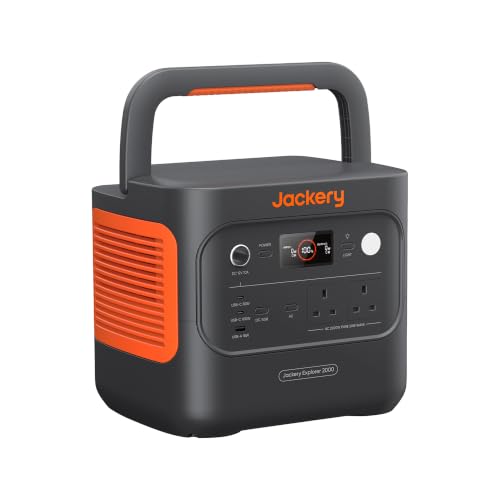
Jackery Explorer 2000 v2 specs and buying options
Every spec below is verified against Jackery's UK pages, with all five Amazon buying configurations and prices checked September 2026.
Explorer 2000 v2, from £899
2,042Wh and 2,200W at 17.5kg, which Jackery claims as the lightest and smallest in the 2kWh class, with a GaN inverter and the same 20ms UPS mode as the rest of the line. Standard mains charging is 1.7 hours; the headline Super Fast Charge figure is the app's emergency mode. Solar input is capped at 400W, which is modest for this capacity and matters if panels are your plan. £899 at our September 2026 check, 15% off list. Not expandable.
Five configurations, all the same unit with a different accessory in the box. The £899 version is the bare station, £919 adds a storage bag, and the other three bundle solar: two 100W panels (£1,109), a single 200W panel (£1,109) or two 200W panels (£1,399). The station accepts up to 400W of solar across its two DC inputs, so the twin-200W bundle is the one that fills that input, and Jackery claims a 6-hour solar recharge with four SolarSaga 200W panels feeding it at the 400W cap.
What can the Jackery Explorer 2000 v2 actually run?
The numbers below are calculated estimates, not lab tests: rated capacity multiplied by an 85% usable conversion efficiency, divided by each device's battery capacity, rounded down. On 2,042Wh that gives roughly 1,735Wh of usable energy.
- Phone (iPhone 17, 14.4Wh): around 120 full recharges
- LED lantern (4,800mAh, 17.8Wh): around 97 recharges
- Drone battery (DJI Mini 4 Pro, 19Wh): around 91 recharges
- Tablet (iPad 11-inch, 28.9Wh): around 60 recharges
- Laptop (MacBook Air 13-inch, 53.8Wh): around 32 recharges
For continuous loads, the same 1,735Wh estimate works as simple division: a steady 60W draw runs for around 28 hours, a fridge pulling an average 50W runs for well over a day, and a full 2,200W load for roughly 47 minutes. The output side is where a 2kWh unit earns its place. 2,200W of continuous output with a 4,400W surge covers full-size kettles, microwaves, most power tools and mains appliances rated at 2,200W or below, a higher ceiling than the 2,000W offered by the 1kWh Anker C1000 Gen 2. USB kit is more modest: one 100W USB-C port charges a laptop at full speed, alongside a 30W USB-C and an 18W USB-A, plus a 120W car socket on the 12V side.
The catch is the mains sockets. The UK version carries two AC outlets, verified from Jackery's port list. For a battery this big that is tight: run a fridge and a kettle at once and you have used both. If you plan to power several mains devices in parallel, count your plugs before you buy.
Check the Explorer 2000 v2 price on AmazonHow fast does the Jackery Explorer 2000 v2 charge?
This is the line that needs a decision from you before you buy. Standard mains charging takes 102 minutes for a full 0 to 100%, which is slow next to the 1kWh Anker C1000 Gen 2's 49 minutes, though that is a smaller battery. The fastest figure Jackery publishes is a 1.33-hour full recharge using Emergency Super Charge, a mode you enable in the app; standard AC without it runs at 1.7 hours by Jackery's own claim.
For most buyers of a 2kWh unit, charge speed matters less than it does on a small station you top up constantly. A battery this size is one you fill overnight or from solar over a day, not one you refill between uses. From solar it takes 6 hours with four SolarSaga 200W panels at the 400W input cap, 7.5 hours with two 200W panels, or 15 hours with a single 200W panel.
If fast mains charging is a priority at this capacity, the Anker SOLIX C2000 Gen 2 recharges its larger 2,048Wh in 58 minutes, and the EcoFlow Delta 3 Max is faster still. Jackery trades charge speed for weight here, and which of those you value more is the real question this unit asks.
Is the Jackery Explorer 2000 v2 expandable?
No. The Explorer 2000 v2 has no expansion input, so the 2,042Wh you buy is the 2,042Wh you keep. Jackery does sell a Battery Pack 2000 Plus, but that battery is for the separate Explorer 2000 Plus model, not this one, and the two are not compatible.
For most buyers at this size that matters less than it sounds, because 2kWh is already enough for a fridge-and-devices weekend or a run of home power cuts. It becomes a dealbreaker in one case: you can already see off-grid or whole-home backup in your future and you want a base unit that grows into it. Then buy an expandable platform instead. The Anker SOLIX C2000 Gen 2 doubles to 4,096Wh with a BP2000 battery, and the EcoFlow Delta 3 Max sits in the same 2kWh class. If a fixed 2kWh is all you will ever need, the missing port costs you nothing.
Jackery Explorer 2000 v2 alternatives
The Anker SOLIX C2000 Gen 2 is the closest rival at £999 at our check: a near-identical 2,048Wh with more output (2,400W against 2,200W), twice the mains sockets (four against two), a faster 58-minute recharge, twice the solar input at 800W, and an expansion port that takes it to 4,096Wh. The Jackery answers with weight, 17.5kg against the Anker's 18.9kg, and a lower price. If you will use more than two plugs, or want room to grow, the Anker is the stronger platform; if portability and price lead, the Jackery holds its ground.
The EcoFlow Delta 3 Max is the higher-output pick in the 2kWh class: 2,048Wh with 2,400W of output, four AC sockets and a 25dB noise figure, for £999 at our check. It is heavier at 20.3kg, so it gives up the Jackery's one clear advantage. Pick it for sockets and quiet running, the Jackery for the lightest case.
Within Jackery's own range, the Explorer 1000 v2 is the half-capacity, lighter and cheaper option at £499, the pick if 2kWh is more battery than you need, and the Explorer 3000 v2 steps up to 3kWh for buyers who want more capacity and will accept the extra bulk.
Buy the Jackery Explorer 2000 v2 on AmazonJackery Explorer 2000 v2 FAQs
How much does the Jackery Explorer 2000 v2 weigh?
How fast does the Jackery Explorer 2000 v2 charge?
Is the Jackery Explorer 2000 v2 expandable?
How many plug sockets does the Jackery Explorer 2000 v2 have in the UK?
Can the Jackery Explorer 2000 v2 run a kettle?
How long does the Jackery Explorer 2000 v2 battery last?
Set on Jackery? The Jackery brand guide compares the Explorer 2000 v2 against the whole current range, from the Explorer 240 v2 to the Explorer 3000 v2. Still weighing brands against each other, the complete portable power station buying guide ranks all current models side by side, or answer a few questions in the finder and let it shortlist for you.
For a direct head-to-head, see the Jackery Explorer 2000 v2 vs EcoFlow Delta 3 Max comparison.