

Hiking equipment reviews and buying guide
Hiking equipment is everything beyond clothing and footwear that rounds out a pack and keeps a day out safe. This hub covers the essentials for UK walking, from navigation and headtorches to first aid and emergency kit, alongside reviews of the accessories we test on British trails.


19 reviews


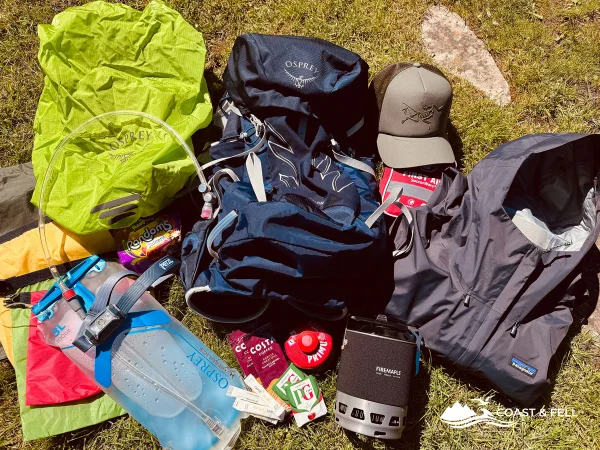


What to carry on a UK day walk: the essentials
The ten essentials are a systems-based checklist first assembled to keep walkers prepared when a straightforward day turns into something harder. The list matters more in the UK than the mild summer forecast suggests, because weather on exposed coast paths and open hills changes fast and daylight disappears quickly once cloud comes in.
Some of this kit is non-negotiable on any serious walk. Some is useful but optional depending on the route, the season and how remote you are. Knowing which is which is the point of a good kit list.
The ten essentials adapted for UK conditions
Navigation: a 1:25,000 OS map for the area and a compass, plus a GPS device or offline phone maps as backup. Illumination: a headtorch, always, whatever your planned finish time. Sun protection: sunglasses, sunscreen and lip balm, which still matter on bright or high days. First aid: a compact personal kit with blister treatment. Knife or multitool: for repairs and general use.
Fire or emergency shelter: a survival bag or bothy bag is the UK priority over fire-lighting. Extra food: more than you plan to eat, including something sugary for quick energy. Extra water: 1–2 litres for a typical day walk. Extra clothing: a waterproof shell and an insulating layer, because British weather demands both. A charged phone and a whistle complete the list as your primary means of raising help.
Navigation: map and compass, GPS and phone apps
Navigation is the single most important skill and kit decision for UK hiking. Phone signal is unreliable on coastal paths and largely absent on high ground, so your navigation cannot depend on a data connection. The reliable baseline is a paper map and a compass, backed up by an electronic aid rather than replaced by one.
OS map and compass: the baseline
A 1:25,000 Ordnance Survey map (the Explorer series) shows the field boundaries, crags and access land detail that UK walkers rely on. Paired with a baseplate compass it needs no battery, no signal and no charging, and it keeps working in driving rain when a touchscreen will not.
Learning to take a bearing, follow a contour and relocate yourself in poor visibility is worth more than any gadget. Treat the map and compass as the tool you trust when everything else fails, and carry the map in a waterproof case.
GPS watch vs phone vs handheld
A phone with offline OS Maps, Komoot or AllTrails downloaded is the most accessible GPS option and fine as a backup, but the screen is fragile, the battery drains in the cold and the touchscreen is useless in gloves or rain. Download your route and maps before you leave, and never rely on live signal.
A GPS watch gives you position, elevation and track at a glance without breaking stride, with better cold-weather battery life and weatherproofing than a phone. Higher-end Garmin watches carry full colour topographic mapping on the wrist. A handheld unit like the Garmin eTrex remains a rugged, long-battery option, and some handhelds accept 1:25,000 OS mapping on a microSD card. Whichever you choose, it complements the map and compass rather than replacing them.
Headtorches: lumens, runtime and beam
A headtorch belongs in every pack regardless of your planned finish time, because any UK walk can overrun and navigating in the dark without light is dangerous. The three variables are brightness, runtime and weight.
For paths and general camp use, 200–300 lumens is plenty. For navigating off-path, in mist or on winter walks that finish after dark, 400 lumens or more gives useful reach and a wider spill. Check the runtime at the brightness you will actually use, not the headline maximum, and favour models that take AAA batteries or offer a charge readout so a flat cell never leaves you in the dark. Carry a spare set of batteries or a small backup light.
Emergency kit: first aid, whistle and shelter
A compact first aid kit for a UK day walk should cover the likely scenarios rather than every eventuality: blister plasters and tape, wound-closure strips, a couple of dressings, antiseptic wipes, painkillers, and any personal medication. Add a small roll of zinc oxide tape, which handles both blisters and gear repairs.
A whistle is one of the lightest and most important items you can carry. The internationally recognised distress signal is six blasts in quick succession, then a minute's pause, repeated. A survival bag or group shelter (bothy bag) is the UK equivalent of the fire-starting essential: it keeps a casualty warm and out of the wind while you wait for help, and weighs almost nothing.
Staying contactable: phones, satellite comms and PLBs
In the UK you call for help by dialling 999 and asking for the Police, then Mountain Rescue. If you have signal for a text but not a call, the emergency SMS service to 999 often gets through where a voice call will not, but you must register your phone in advance by texting the word register to 999. Once connected, teams can locate you using SARLOC (a link sent to your phone that reads its GPS), what3words or the OS Locate app, so know your grid reference or three-word location.
For remote or committing routes where you may be out of signal for long periods, a satellite communicator adds a real safety margin. The Garmin inReach range and Zoleo both use the Iridium network for two-way messaging and SOS but require a subscription. A dedicated Personal Locator Beacon such as the rescueME PLB1 sends a one-way 406 MHz distress signal to search and rescue with no subscription and a long battery life, but no messaging. On lowland and coastal routes where help is rarely far away these are optional; on the high, remote ground they earn their place.
Water, power and the small stuff
For most UK day walks you carry the water you need (1–2 litres is typical) and treatment is not necessary. A lightweight water filter such as the Sawyer Squeeze or Katadyn BeFree becomes worthwhile on multi-day routes and wild camps where you refill from streams, filtering out the bacteria and protozoa found in UK hill water.
A power bank keeps your phone and GPS alive across a long day or a weekend. A 10,000mAh unit recharges most phones around twice and is the sweet spot between capacity and weight for hiking. Beyond that, the small kit that repeatedly proves its worth includes trekking poles, gaiters for boggy ground, a dry bag or two for electronics, and a repair kit of tape and cord.
Headtorch output for hiking
| Output | Best for |
|---|---|
| 100 to 200 lumens | Camp tasks, backup and short after-dark walking |
| 200 to 350 lumens | The day-hiking sweet spot |
| 350 lumens and up | Night navigation, trail running and winter |
Frequently asked questions
What are the ten essentials for hiking in the UK?+
The ten essentials are navigation (OS map and compass), a headtorch, sun protection, a first aid kit, a knife or multitool, an emergency shelter such as a survival bag, extra food, extra water (1–2 litres), extra clothing including a waterproof and an insulating layer, plus a charged phone and a whistle. Carry all of them on any serious day walk.
How many lumens do I need in a headtorch for hiking?+
For most hiking, 200–300 lumens is enough for paths and camp use. Step up to 400 lumens or more for navigating off-path, walking in mist, or finishing after dark on winter routes, where you need extra reach and a wider beam. Always check the runtime at that brightness and carry a spare set of batteries.
Do I need a GPS device for hiking, or is my phone enough?+
A phone with offline maps downloaded is fine as a backup, but it should not be your only navigation tool. Screens fail in cold and rain and batteries drain fast, so carry a paper OS map and a compass as the reliable baseline. A dedicated GPS device or watch adds glanceable, weatherproof, long-battery navigation on top.
Is a satellite communicator worth it for UK hiking?+
For remote, committing routes where phone signal is absent for long stretches, a satellite communicator or PLB adds a genuine safety margin. The Garmin inReach and Zoleo offer two-way messaging and SOS on subscription, while a rescueME PLB1 sends an SOS with no subscription. On coastal and lowland walks where help is close, they are optional.
How do I call mountain rescue in the UK?+
Dial 999 and ask for the Police, then Mountain Rescue. If you can text but not call, use the emergency SMS service to 999, but register your phone beforehand by texting register to 999. Rescue teams can pinpoint you using SARLOC, what3words or the OS Locate app, so know your grid reference or three-word location.
Do I need a water filter for hiking in the UK?+
For a typical UK day walk, no. Carry the water you need, usually 1–2 litres, and you will not need to treat it. A lightweight filter such as the Sawyer Squeeze or Katadyn BeFree becomes worthwhile on multi-day routes and wild camps where you refill from streams and need to remove bacteria and protozoa.
What is the six-blast whistle signal?+
Six blasts on a whistle in quick succession, followed by a minute's pause and then repeated, is the internationally recognised mountain distress signal. Six torch flashes work the same way after dark. Keep repeating the sequence so rescuers can home in on you. A whistle is one of the lightest and most important items in any UK hiking kit.