Quick answer
The best DJI power station for most UK buyers is the Power 1000 V2 at £579 at our September 2026 check: 1,024Wh of LiFePO4, 2,600W of output, a 56-minute full mains recharge (the second fastest we cover) and expansion to 11,264Wh. Its real distinction is the SDC ports that fast-charge DJI Mavic, Air and Inspire flight batteries directly, which no other brand offers. If you want the same trick lighter and cheaper, the Power 1000 Mini is £399; for the biggest expansion ceiling we cover, the Power 2000 grows to 22,528Wh.
Our pick: DJI Power 1000 V2
- Best overall: DJI Power 1000 V2 (~£579)
- Budget / lightest: DJI Power 1000 Mini (~£399)
- Cheapest 1kWh: DJI Power 1000 (original) (~£369)
- Expansion headroom: DJI Power 2000 (~£959)
Which DJI power station should you buy?
The best DJI power station for most UK buyers is the Power 1000 V2 at £579 at our September 2026 check: 1,024Wh of LiFePO4, 2,600W of output, a 56-minute full mains recharge (the second fastest we cover) and expansion to 11,264Wh. Its real distinction is the SDC ports that fast-charge DJI Mavic, Air and Inspire flight batteries directly, which no other brand offers. If you want the same trick lighter and cheaper, the Power 1000 Mini is £399; for the biggest expansion ceiling we cover, the Power 2000 grows to 22,528Wh.
DJI came to this category from drones, and it shows in both the best and the oddest parts of the range. The SDC ports are the best part: solar input, expansion batteries and drone fast charging all run through them. The oddest part is what is missing, and it is covered in full below, because it rules the whole brand out for one group of buyers entirely.
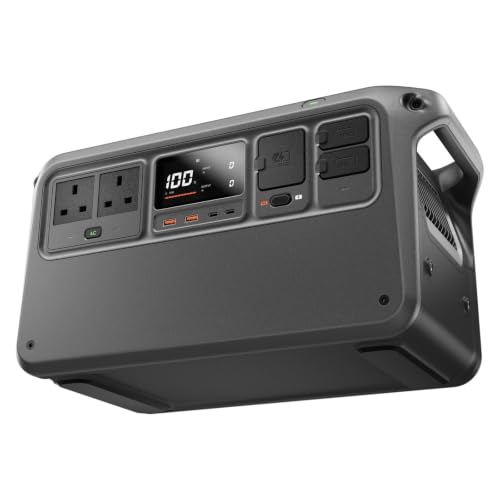
Here is the whole current range at a glance (tap a model name to jump to its full breakdown):
| Image | Product | Price | Buy |
|---|---|---|---|
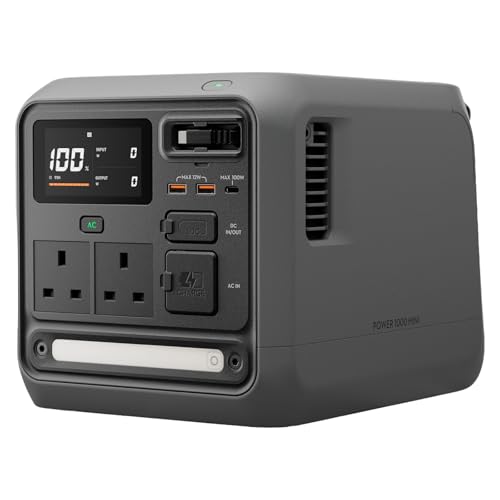 | DJI Power 1000 Mini | ~£399 | Buy now |
| 1,008Wh · 1,000W output · 11.5kg · up to 400W solar · mains 0–100% in 75 minBest for Drone days out, lightest DJI | |||
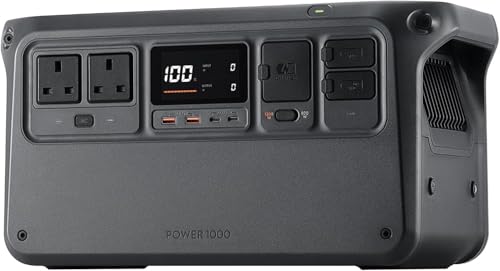 | DJI Power 1000 (original) | ~£369 | Buy now |
| 1,024Wh (expands to 11,264Wh) · 2,200W output · 13kg · up to 800W solar · mains 0–100% in 70 minBest for Big output on the smallest spend | |||
| DJI Power 1000 V2 | £579.00 | Buy now |
| 1,024Wh (expands to 11,264Wh) · 2,600W output · 14.2kg · up to 1,800W solar · mains 0–100% in 56 minBest for Most buyers, drone flyers especially | |||
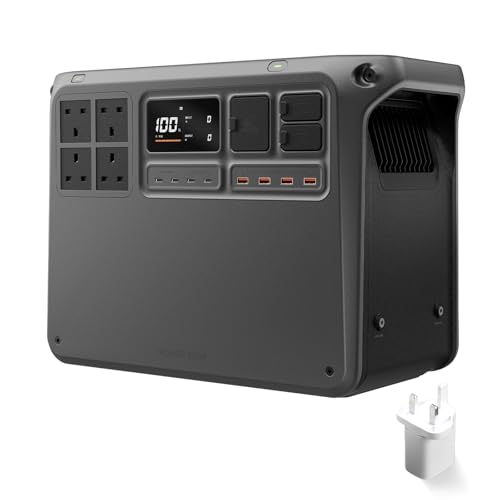 | DJI Power 2000 | ~£959 | Buy now |
| 2,048Wh (expands to 22,528Wh) · 3,000W output · 22kg · up to 1,800W solar · mains 0–100% in 75 minBest for Expansion headroom and home backup | |||
Weighing DJI against the other brands? The complete buying guide ranks all 24 current models side by side, or let the finder choose for you.
How the DJI range works
One family, four models, and the generation matters more than the size. The Power 1000 Mini (1,008Wh), Power 1000 V2 (1,024Wh) and Power 2000 (2,048Wh) are current-generation units with app control and batteries rated to hold over 80% capacity after 4,000 cycles. The original Power 1000, still on sale at £369, is the previous generation: more output than the Mini at a lower price, but no app control and a weaker battery promise, rated to 70% capacity after the same 4,000 cycles. Expansion runs through the SDC ports: up to five 2,048Wh Expansion Battery 2000 packs on the 1000 models for 11,264Wh, up to ten on the Power 2000 for 22,528Wh, the biggest growth ceiling we cover.
Now the missing piece: no DJI power station has a 12V car socket, on any model. DJI routes DC through its own SDC ports instead, which is fine if your DC needs are USB-C and flight batteries, and a dealbreaker if you run a 12V compressor fridge in a van. If cigarette-plug kit is part of your setup, the whole brand is the wrong answer, however good the rest of the spec.
One more UK-specific correction to reviews written elsewhere: the Power 1000 V2 has two AC sockets in its UK and EU version, not the four quoted in US coverage; DJI's own spec table splits the count by region. The two UK sockets still carry the full 2,600W.
The buying options are solar bundles (foldable and flexible panels from 100W to 400W) and expansion combos built on one part: the Power Expansion Battery 2000, a 2,048Wh pack at £799 at our September 2026 check that chains over the SDC ports. The bundle maths works: the Power 1000 V2 with expansion battery cost £1,298 at our check against £1,378 bought separately, an £80 saving. And note how solar gets in: only the Mini takes panels directly through its built-in 400W MPPT; the original 1000 needs DJI's Solar Panel Adapter Module, and the V2 and 2000 use either that module or the 1.8kW Super Fast Charger, which lets them swallow up to 1,800W of solar.
Not sure DJI is even the right brand? Answer a few questions in our Power Station Finder and it will narrow every current model we cover down to a shortlist.
The Portable Power Station Finder
Which portable power station should you buy? Seven questions
1. What's it mainly for?
Recommendations are computed from our verified spec inventory of every current UK model from EcoFlow, Anker, Bluetti, Jackery and DJI, with prices checked 24 September 2026.
Every current DJI model
Four models, from the 1,008Wh Power 1000 Mini to the 2,048Wh Power 2000, every one verified against DJI's UK spec pages with Amazon prices checked 24 September 2026.
Power 1000 Mini, from £399
1,008Wh at 11.5kg with a built-in retractable 100W USB-C cable, a built-in 400W MPPT solar controller that takes panels with no adapter, and DJI's SDC port for drone fast charging. AC output is a maximum 1,000W (800W rated), so it's a devices-and-small-appliances unit rather than a kettle machine. It recharges fully from the mains in 75 minutes and is explicitly not expandable; DJI's FAQ rules out the Expansion Battery 2000. £399 at our September 2026 check, with a five-year warranty per DJI's FAQ.
Power 1000 (original), from £369
The previous-generation unit, kept on sale at £369 at our September 2026 check, and the cheapest way we cover into 1kWh with a 2,200W inverter. Both USB-C ports run at 140W and it expands to 11,264Wh with up to five Expansion Battery 2000 packs via its SDC port. Two compromises date it: there's no app control (DJI lists Wi-Fi and Bluetooth on every other current model, not this one), and its battery is rated to 70% capacity after 4,000 cycles against 80% on the newer units. A lot of machine for the money if you can live with both.
- Power 1000 (1024Wh, base)£369Buy now
Power 1000 V2, from £579
The one to buy for most people, drone flyers especially: 1,024Wh with 2,600W of output, a 56-minute full mains recharge, two 140W USB-C ports, app control and expansion to 11,264Wh. With DJI's 1.8kW Super Fast Charger accessory it swallows up to 1,800W of solar, the highest solar input of any 1kWh unit we cover. UK buyers get two AC sockets (the four-socket count belongs to the US, China and Japan models) and, like every DJI, no 12V car socket. £579 at our September 2026 check.
- Power 1000 V2 (1024Wh, base)£579Buy now
- Power 1000 V2 + expansion battery combo£1,298Buy now
- Power 1000 V2 + 100W foldable solar panel£757Buy now
- Power 1000 V2 + 200W flexible solar panel£897Buy now
- Power 1000 V2 + 400W foldable solar panel£1,046Buy now
- Power 1000 V2 + 400W flexible solar panel£1,166Buy now
Power 2000, from £959
2,048Wh, 3,000W and the biggest growth ceiling in the market we cover: up to ten Expansion Battery 2000 packs for 22,528Wh. The port list is generous where DJI wants it to be, with four AC sockets, four USB-C (two at 140W) and four USB-A, plus two SDC ports for solar, expansion and drone charging, and, as ever, no 12V socket. Mains recharge is 75 minutes to full, or 80% in 45 minutes, at a quoted 29dB. £959 at our September 2026 check, and 22kg.
DJI expansion batteries & accessories
The add-ons the buying options above refer to, sold separately.
Power Expansion Battery 2000
Expansion for DJI Power 1000 / 1000 V2 (max 5 = 11,264Wh) and Power 2000 (max 10 = 22,528Wh); 2048Wh LFP; 16.5kg; 2x SDC chaining ports, no direct device outputs — must be used with a station; on the original Power 1000 it must connect to the SDC port, not SDC Lite
Should you buy DJI if you don't fly drones?
Sometimes, and the case is stronger than you might expect. Strip the drone trick away and the Power 1000 V2 still stands on general merit: a 56-minute full mains recharge is the second fastest of the 24 models we cover, 2,600W of output from a 1kWh unit beats every same-size rival in our pool, and the 11,264Wh expansion ceiling embarrasses most of the market. The original Power 1000 at £369 is the cheapest route we cover into 1kWh with a 2,200W inverter, if you can live without app control and with the weaker 70% cycle rating.
The counterargument is the port list and the price. With no 12V socket anywhere in the range, DJI is out for campervans and 12V fridges before the comparison starts. UK buyers get two AC sockets on the V2 where an Anker SOLIX C1000 Gen 2 gives four, and at £579 the V2 costs £80 more than that Anker and £180 more than an EcoFlow Delta 3 Classic, both 1kWh units that cover most people's needs.
So the fork is clean. If you fly DJI drones, buy DJI and stop reading: nothing else fast-charges your flight batteries in the field. If you do not, the V2 only earns its premium when its specific strengths, the 2,600W output or the expansion ceiling, are the thing you are buying; otherwise the £499 Anker or the £399 EcoFlow is the smarter cheque.
FAQs
Do DJI power stations have a 12V car socket?
What is the difference between the DJI Power 1000 and the Power 1000 V2?
How many AC sockets does the DJI Power 1000 V2 have in the UK?
Can the DJI Power 1000 V2 charge my drone batteries?
Is the DJI Power 1000 Mini expandable?
How do DJI power stations charge from solar?
How many expansion batteries does the DJI Power 2000 take?
Go deeper
If you are still weighing DJI against the rest of the market, our complete portable power station buying guide compares all 24 current models across the five brands we cover, the Power Station Finder will shortcut the choice to a personal shortlist, and the power stations overview covers battery care and buying safely.
The other brands each have a page like this one: