


Quick answer
For most UK buyers the Jackery Explorer 3000 v2 is the better buy at £1,599: it holds the same 3,072Wh LiFePO4 core and the same 3,600W AC output as the Anker SOLIX F3000, adds a third mains socket and a published 108-minute mains recharge, and weighs 14.5kg less at 27kg, all for £300 less at our September 2026 check. Buy the Anker SOLIX F3000 at £1,899 if you will ever need more than 3kWh: it expands to 12,288Wh with up to three BP3000 batteries, swallows 2,400W of solar for a claimed 90-minute refill against the Jackery's 1,000W ceiling, and rolls on built-in wheels to carry its 41.5kg. Prices from our September 2026 check.
Our pick: Jackery Explorer 3000 v2
F3000 or Explorer 3000 v2: which should you buy?
For most UK buyers the Jackery Explorer 3000 v2 is the better buy at £1,599: it holds the same 3,072Wh LiFePO4 core and the same 3,600W AC output as the Anker SOLIX F3000, adds a third mains socket and a published 108-minute mains recharge, and weighs 14.5kg less at 27kg, all for £300 less at our September 2026 check. Buy the Anker SOLIX F3000 at £1,899 if you will ever need more than 3kWh: it expands to 12,288Wh with up to three BP3000 batteries, swallows 2,400W of solar for a claimed 90-minute refill against the Jackery's 1,000W ceiling, and rolls on built-in wheels to carry its 41.5kg. Prices from our September 2026 check.
These two are closer on paper than almost any cross-brand pair at this size. Same 3,072Wh of LiFePO4. Same 3,600W of continuous AC output, with a 7,200W surge figure on both spec sheets. Same 20ms UPS switchover, same LiFePO4 chemistry rated for up to 4,000 cycles. If you only ever plan to buy one box and run it as a fixed 3kWh unit, they do the same job, and the Jackery does it for £300 less and 14.5kg lighter.
The gap that matters is what happens when 3kWh runs out. The Jackery has no expansion input and no v2 battery packs: 3,072Wh is the ceiling for the life of the unit. The Anker takes up to three BP3000 batteries and climbs to 12,288Wh, and it is built to be moved when it gets that heavy, with wheels and a towing handle. So the real question is not which is better. It is whether your future needs stop at 3kWh or not.
What the F3000 and Explorer 3000 v2 share
The core is effectively the same on both. 3,072Wh of LiFePO4, the long-life battery chemistry, feeding a 3,600W pure-load inverter that covers a kettle, a microwave, a fridge or a power tool one at a time. Both spec sheets quote a 7,200W surge for brief spikes, both list a 20ms UPS switchover for bridging a power cut, and both rate their cells for up to 4,000 cycles, which is the better part of a decade of regular use.
Both are app-controlled, both take solar, and both sit firmly in the home-backup and off-grid-base class rather than the rucksack class. Neither is a unit you carry any distance: the lighter of the two still weighs 27kg. And both land in the same price bracket, £1,599 for the Jackery and £1,899 for the Anker at our September 2026 check, which is why the decision comes down to the handful of things they do differently rather than a headline price war.
What £300 more actually buys you
The Anker SOLIX F3000, at £1,899 against the Jackery's £1,599, adds two things the Jackery cannot do at any price, and asks you to accept a lot more weight for them.
- Expansion to 12,288Wh. The F3000 takes up to three BP3000 batteries (3,072Wh each) through a dedicated expansion port. Anker's UK site sells it bundled with one BP3000 at 6,144Wh and describes the range as "3-12kWh". The Jackery Explorer 3000 v2 has no expansion input and no v2 battery packs, so its 3,072Wh is fixed for the unit's life.
- Far faster solar. The F3000 accepts up to 2,400W of solar across dual PV inputs (a 1,600W high-voltage input and an 800W low-voltage input) for a claimed 90-minute full refill. The Jackery caps solar at 1,000W across two 8mm inputs, and Jackery's own figure is 5.5 hours to full with four SolarSaga 200W panels.
- Wheels for the weight. The F3000 uses Anker's EasyTow suitcase design, with built-in wheels and a towing handle, because at 41.5kg it is not a unit you lift. The Jackery weighs 27kg and ships on a pallet.
- High-current DC. The F3000 carries an Anderson 13.4V/30A DC output alongside its car socket, useful for high-draw 12V kit. The Jackery's 12V is the car socket only.
Read the weight line again before defaulting to the Anker, because the Jackery's lightness is a feature, not a shortfall. At 27kg it is 14.5kg lighter, it carries three UK mains sockets to the Anker's two, and it publishes a full 0-100% mains recharge of 108 minutes where Anker publishes input wattages (1,800W standard, up to 3,600W with the EV-charging adapter) but no 0-100% time. Jackery also quotes 95% charge retention after a year of standby and a discharge rating down to -15C, wider than its smaller models and a real advantage for cold-weather backup. For a fixed 3kWh unit that mostly sits at home or travels by car, the Jackery is not the compromise. It is the cheaper, lighter, slightly better-connected box.
Buy the Anker SOLIX F3000 on AmazonAnker SOLIX F3000 and Jackery Explorer 3000 v2 specs and buying options
Both units verified against the manufacturers' UK pages and listings, with every Amazon buying configuration priced at our September 2026 check. The Anker SOLIX F3000 first, including its expansion and solar bundles:
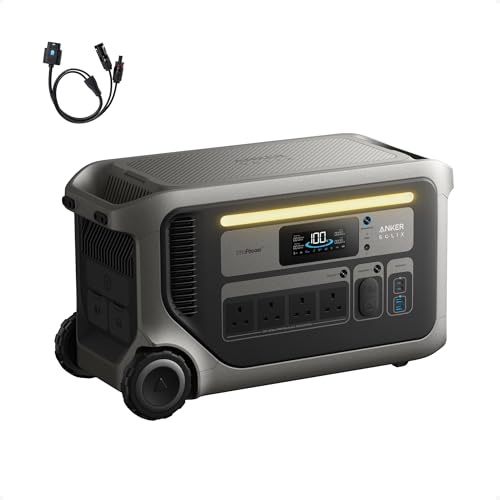
SOLIX F3000, from £1,899
A home-backup unit that's portable in the suitcase sense: 3,072Wh, 3,600W of output, 41.5kg on built-in wheels with a towing handle, and expansion to 12,288Wh with up to three BP3000 batteries. It swallows 2,400W of solar across dual inputs for a claimed 90-minute refill, and with the right adapter it recharges at up to 3,600W from an EV charger. £1,899 at our September 2026 check. Buy it for power cuts and off-grid bases, not for anything you plan to lift.
And the Jackery Explorer 3000 v2, which comes as the base unit or with a single SolarSaga 200W panel:
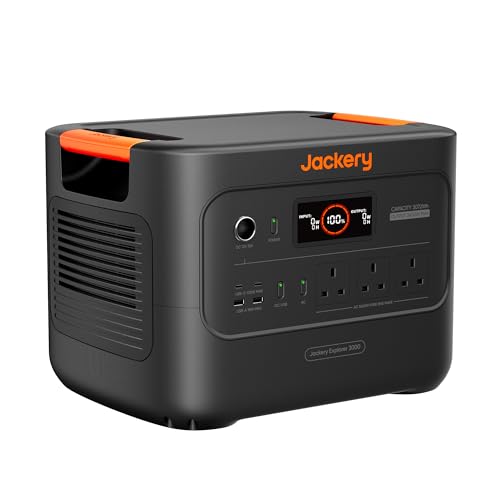
Explorer 3000 v2, from £1,599
The big one: 3,072Wh, 3,600W across three AC sockets, 1,000W of solar input and a discharge rating down to -15C, wider than the smaller models' ratings and the reason it suits cold-weather use. Jackery quotes 95% charge retention after a year of standby, and standard mains charging takes 1.8 hours. It weighs 27kg and ships on a pallet. £1,599 at our September 2026 check. As with the whole v2 line there's no expansion, so this is the ceiling: if you'll ever need more than 3kWh, you need a different brand.
What can 3,072Wh actually run?
The sums are identical for both units, because the usable capacity is the same. The numbers below are calculated estimates, not lab tests: rated capacity multiplied by an 85% usable conversion efficiency, divided by each device's battery capacity, rounded down. On 3,072Wh that gives roughly 2,611Wh of usable energy:
- Phone (iPhone 17, 14.4Wh): around 181 full recharges
- LED lantern (4,800mAh, 17.8Wh): around 146 recharges
- Drone battery (DJI Mini 4 Pro, 19Wh): around 137 recharges
- Tablet (iPad 11-inch, 28.9Wh): around 90 recharges
- Laptop (MacBook Air 13-inch, 53.8Wh): around 48 recharges
Those figures are academic at this size. Nobody buys a 3kWh station to charge phones; they buy it to run a household through a power cut or a base off-grid. On mains loads, the 2,611Wh of usable energy runs a steady 60W draw for around 43 hours, and the 3,600W inverter covers the big single appliances a smaller station cannot: a kettle, a microwave, a fridge-freezer or a power tool, one at a time and within the 3,600W budget. Anything above 3,600W continuous (7,200W briefly, per both spec sheets) is out on either unit.
The difference is what happens when the 2,611Wh is gone. On the Jackery you refill it, from the wall in a published 108 minutes or from up to 1,000W of solar. On the Anker you can do the same, faster from solar at up to 2,400W, or you can simply add another 3,072Wh battery and keep going, up to a total of 12,288Wh. That is the whole case for the F3000 in one sentence.
Who buys which?
The Jackery Explorer 3000 v2 buyer wants a fixed 3kWh unit and wants to spend as little as possible getting it. Power-cut insurance for the house, a caravan or campervan base, a cold-weather trip where the -15C discharge rating and 95% year-long standby retention earn their place. They value the three mains sockets, the published 108-minute mains recharge and the 5-year warranty, and they would rather pocket the £300 and carry 14.5kg less than pay for an expansion port they will never plug into. If your power needs stop at 3kWh, this is the buy.
The Anker SOLIX F3000 buyer is thinking bigger, or thinking ahead. Whole-home backup, a serious off-grid setup, or simply a refusal to be capped: the F3000 climbs to 12,288Wh with up to three BP3000 batteries, so today's 3kWh unit becomes tomorrow's 6kWh or 12kWh without a second base unit. They also get the fastest solar in this pair by a wide margin (2,400W for a claimed 90-minute refill) and the wheels and handle that make 41.5kg, and eventually a lot more, something you can actually move. Anyone who cannot say for certain that 3kWh is their ceiling should look hard at the F3000.
If you are torn and the budget stretches, the expansion port is the tie-breaker. A Jackery that turns out to be too small sends you back to buy a whole second station; an Anker that turns out to be big enough just never needed the extra battery. The regret risk sits on the fixed unit.
Buy the Jackery Explorer 3000 v2 on AmazonAnker SOLIX F3000 vs Jackery Explorer 3000 v2 FAQs
What is the difference between the Anker SOLIX F3000 and the Jackery Explorer 3000 v2?
Is the Anker SOLIX F3000 or the Jackery Explorer 3000 v2 better value?
Can the Jackery Explorer 3000 v2 be expanded with extra batteries?
How fast does each one recharge?
Are these portable enough to carry?
Which is better for cold-weather or winter use?
Both units sit at the top of a wide range. The Anker SOLIX brand guide places the F3000 against the smaller C-series units below it, and the Jackery brand guide does the same for the Explorer 3000 v2 and its 1000 and 2000 siblings. Across brands, the complete portable power station buying guide ranks all current models, or let the finder shortlist for you.