


Quick answer
Buy the Anker SOLIX C1000 Gen 2 at £499 if you want the more capable box: it delivers 2,000W across four UK three-pin sockets to the Jackery's 1,500W across two, recharges from empty in 49 minutes against the Explorer's 1.7 hours, and takes up to 600W of solar to the Jackery's 400W, all for the same money. Buy the Jackery Explorer 1000 v2, also £499, if portability decides it: at 10.8kg and a smaller footprint it is the lighter box, holds marginally more energy (1,070Wh to 1,024Wh) and was Amazon UK's best-selling outdoor generator at our September 2026 check. Both use LiFePO4 batteries rated to 4,000 cycles and neither is expandable.
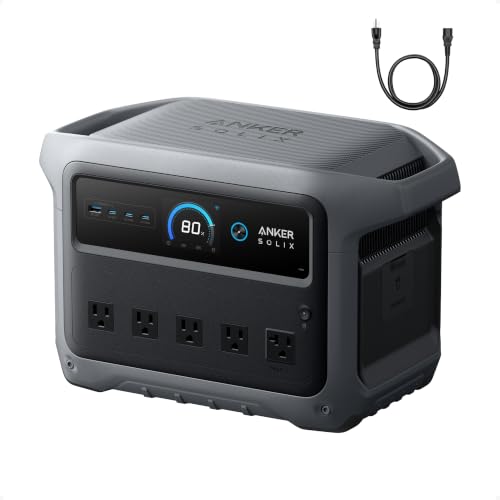
Our pick: Anker SOLIX C1000 Gen 2
C1000 Gen 2 or Explorer 1000 v2: which should you buy?
Buy the Anker SOLIX C1000 Gen 2 at £499 if you want the more capable box: it delivers 2,000W across four UK three-pin sockets to the Jackery's 1,500W across two, recharges from empty in 49 minutes against the Explorer's 1.7 hours, and takes up to 600W of solar to the Jackery's 400W, all for the same money. Buy the Jackery Explorer 1000 v2, also £499, if portability decides it: at 10.8kg and a smaller footprint it is the lighter box, holds marginally more energy (1,070Wh to 1,024Wh) and was Amazon UK's best-selling outdoor generator at our September 2026 check. Both use LiFePO4 batteries rated to 4,000 cycles and neither is expandable.
This is one of the closest calls in the 1kWh class, and price does not break the tie: both units land at £499 at our September 2026 check. What separates them is philosophy. The Anker is the higher-capability unit, more output, more sockets, a faster refill and a bigger solar ceiling. The Jackery is the easier-to-live-with one, lighter, smaller and the model more UK buyers have already chosen than any other in its category. Neither is a compromise. They are two answers to the same £499 question, and which is right depends entirely on whether you value headroom or portability.
What the C1000 Gen 2 and Explorer 1000 v2 share
More unites these two than divides them. Both are 1kWh-class stations built on LiFePO4 chemistry, the long-life battery type, and both carry the same 4,000-cycle rating and a 3,000W surge ceiling for the brief spikes that appliances draw at switch-on. Both give you UK three-pin sockets, USB-C, a USB-A port and a 12V car socket, both run through a phone app, and both include a UPS mode that bridges a mains power cut fast enough for a router or a desktop (10ms on the Anker, 20ms on the Jackery).
Both also draw the same hard line: neither is expandable. Unlike the original Anker C1000, the Gen 2 dropped its expansion port, and there is no add-on battery for the v2-generation Jackery. Whatever capacity you buy is the capacity you keep for the life of the unit, on either one. If you might need more than roughly 1kWh in a year or two, both are the wrong starting point.
And they cost the same. At £499 for the base configuration at our check, price is not the deciding factor here. The decision is what that £499 should buy you.
Where the C1000 Gen 2 pulls ahead
The Anker is the more powerful machine on almost every number that scales with capability.
- Output: 2,000W against 1,500W. The C1000 Gen 2's inverter runs a continuous 2,000W to the Explorer's 1,500W. That 500W gap is the practical divider between them: higher-draw kit that a 1,500W unit refuses, an 1,800W hairdryer or a single induction hob, runs on the Anker. Both share the same 3,000W surge headroom.
- Sockets: four against two. The C1000 Gen 2 carries four UK three-pin sockets to the Explorer's two, so it powers a fuller table of kit without a trailing block, and it does it over nine ports total (including two 140W USB-C ports) against the Jackery's six (a single 100W USB-C its fastest).
- Recharge: 49 minutes against 1.7 hours. The Anker's headline 49-minute full recharge comes from HyperFlash, a 1,600W mode you enable in the app (standard charging runs at 1,200W). The Jackery's standard mains recharge takes 1.7 hours, dropping to a claimed 1 hour in its app-based emergency mode. Even mode-for-mode, the Anker refills faster.
- Solar: 600W against 400W. The C1000 Gen 2 accepts up to 600W of solar for a claimed full recharge in 1.8 hours of strong sun; the Explorer caps at 400W. If you plan to run off-grid on panels, that is a meaningful difference in how fast the sun tops you back up.
None of that makes the Jackery a weak unit. It makes the Anker the one to buy when you want a 1kWh box that never leaves you waiting and never runs short of sockets or output.
Where the Explorer 1000 v2 wins
The Jackery's case is narrower but it is real, and for a lot of buyers it is the case that matters.
- Weight and size. At 10.8kg the Explorer is lighter than the Anker's 11.29kg, and it is the smaller box: 32.7 x 22.4 x 24.7cm against 38 x 20.8 x 24.4cm, with a notably shorter footprint. Jackery claims it as the smallest and lightest station in the 1kWh LiFePO4 class. If it lives in a car boot or gets carried to a pitch, half a kilo and a shorter body are felt every time.
- Slightly more capacity. The Explorer holds 1,070Wh to the Anker's 1,024Wh. It is a small margin, around 4.5%, but it lands on the larger side of the two.
- The crowd has chosen it. The Explorer 1000 v2 was Amazon UK's best seller in outdoor generators at our September 2026 check. That is not a spec, but a category best seller at this price is a strong signal that it does the everyday job well and reliably.
- Warranty and protection. Jackery covers the v2 with a 3+2 year warranty (five years registered) and a UPS mode certified to IEC 62040. It is the more explicitly reassured package of the two on paper.
If you do not need 2,000W of output, and your kit sits comfortably under 1,500W, the Jackery gives up nothing you will miss and hands back weight, size and the confidence of the best-selling choice.
C1000 Gen 2 and Explorer 1000 v2 specs and buying options
Both units verified against the manufacturers' UK pages and our fact base, with every Amazon buying configuration priced at our September 2026 check. The Anker SOLIX C1000 Gen 2 first, with six configurations from bare unit to a 400W solar bundle:
SOLIX C1000 Gen 2, from £499
Our best overall power station across all five brands, not just Anker's range. 1,024Wh, 2,000W across four UK sockets, a 49-minute full mains recharge via app-enabled HyperFlash, a 4,000-cycle battery rating and under 20dB of noise below 200W of load, at £499 at our September 2026 check. The one thing it doesn't do is grow: unlike the original C1000, the Gen 2 takes no expansion battery, so buy it as the size it is.
- SOLIX C1000 Gen 2 (1024Wh) with AC charging cable£499Buy now
- SOLIX C1000 Gen 2 with car charging cable£519Buy now
- SOLIX C1000 Gen 2 with IP54 carry bag£539Buy now
- SOLIX C1000 Gen 2 + 100W solar panel£623Buy now
- SOLIX C1000 Gen 2 + 200W solar panel£729Buy now
- SOLIX C1000 Gen 2 + 400W solar panel£898Buy now
And the Jackery Explorer 1000 v2, sold bare or with a SolarSaga panel:
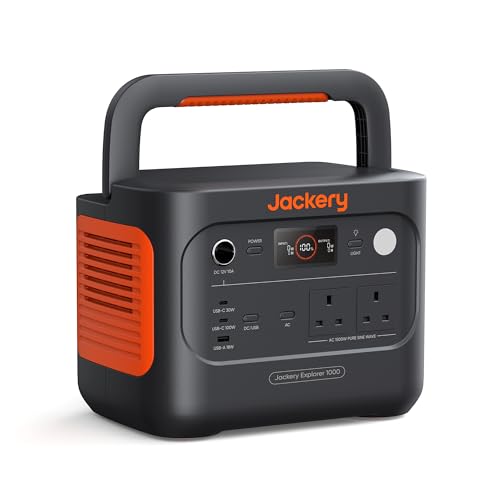
Explorer 1000 v2, from £499
The pick of the range and Amazon UK's best seller in its category at our September 2026 check. 1,070Wh and 1,500W in a 10.8kg box that Jackery claims as the smallest and lightest 1kWh LiFePO4 station, 18% smaller than the original Explorer 1000. Standard mains charging takes 1.7 hours (1 hour in app emergency mode), solar tops out at 400W, and the battery carries a 4,000-cycle rating. Not expandable, so if 1,070Wh isn't enough in two years, it never will be. £499 at our check.
On solar, match the panel to the unit: the Anker can use up to 600W of input and the Jackery up to 400W, so a larger array than that is wasted on either. For most weekend use a single 200W panel keeps either topped up in good sun.
What can 1kWh actually run?
Both units sit at roughly 1kWh, so the device sums are close. The numbers below are calculated estimates, not lab tests: rated capacity multiplied by an 85% usable conversion efficiency, divided by each device's battery capacity, rounded down. That gives roughly 870Wh usable on the Anker and 910Wh on the Jackery, close enough that the recharge counts below hold for both:
- Phone (iPhone 17, 14.4Wh): around 60 full recharges
- LED lantern (4,800mAh, 17.8Wh): around 48 recharges
- Drone battery (DJI Mini 4 Pro, 19Wh): around 45 recharges
- Tablet (iPad 11-inch, 28.9Wh): around 30 recharges
- Laptop (MacBook Air 13-inch, 53.8Wh): around 16 recharges
That is a long weekend for a family or a week of solo work off USB, on either unit. The difference is not how much they hold, it is what they will drive at once. The Anker's 2,000W ceiling covers higher-draw appliances the Jackery's 1,500W turns away, while both handle a laptop, a camping fridge, a TV, phones and lights without breaking sweat. And whatever the appliance, roughly 1kWh is the runtime limit: a steady 100W load runs for around eight to nine hours on either before it needs charging.
Buy the Jackery Explorer 1000 v2 on AmazonWho buys which?
The C1000 Gen 2 buyer wants headroom. They have kit that pushes past 1,500W, or they simply want the security of never hitting the ceiling, and they value the 49-minute recharge that means a forgotten charge the night before a trip is a non-event. They want four sockets so nothing waits its turn, and if they are heading off-grid they want the 600W solar ceiling to refill fast in daylight. Home-backup users, off-grid campers, anyone running power tools or higher-draw appliances: the Anker.
The Explorer 1000 v2 buyer wants the easiest 1kWh box to live with. Their loads sit under 1,500W, they carry the unit more than they wire it in, and half a kilo and a smaller footprint matter more to them than a faster refill or a fourth socket. They take comfort in buying the category best seller and the five-year registered warranty. Car campers, caravanners, festival-goers and first-time buyers: the Jackery.
If you are genuinely torn and both fit your loads, the Anker gives you more capability for the same £499, and the only thing you pay for it is half a kilo. If you already know your kit is light-draw and portability is the whole point, the Jackery is the box you will actually enjoy carrying.
Anker C1000 Gen 2 vs Jackery Explorer 1000 v2 FAQs
What is the difference between the Anker SOLIX C1000 Gen 2 and the Jackery Explorer 1000 v2?
Which is more powerful, the Anker C1000 Gen 2 or the Jackery Explorer 1000 v2?
Which charges faster, the C1000 Gen 2 or the Explorer 1000 v2?
Which is lighter, the Anker C1000 Gen 2 or the Jackery Explorer 1000 v2?
Are the Anker C1000 Gen 2 and Jackery Explorer 1000 v2 expandable?
Which is better value, the C1000 Gen 2 or the Explorer 1000 v2?
For the full story on each, read our Anker SOLIX C1000 Gen 2 guide and our Jackery Explorer 1000 v2 guide. To see how each fits its wider range, the Anker SOLIX brand guide and the Jackery brand guide compare them against the rest. Across all five brands, the complete portable power station buying guide ranks all 25 current models, or let the finder shortlist for you.