


Quick answer
Yes, Anker is a good brand, and for charging kit it is the default we recommend: the world's biggest name in power banks and chargers, with certified cells, honest capacity labels, 18-to-24-month warranties and, crucially, a recall system that makes customers whole when a batch goes wrong, which is the accountability the cheap no-name tier cannot offer. Its range runs from £15 pocket power banks through MagSafe chargers to SOLIX power stations, and its quality floor is remarkably consistent. It is rarely the absolute cheapest option; the £3 to £15 premium over unknown brands is exactly what we think you should pay. Buy Anker for charging and power; shop around only where a specialist genuinely beats them.
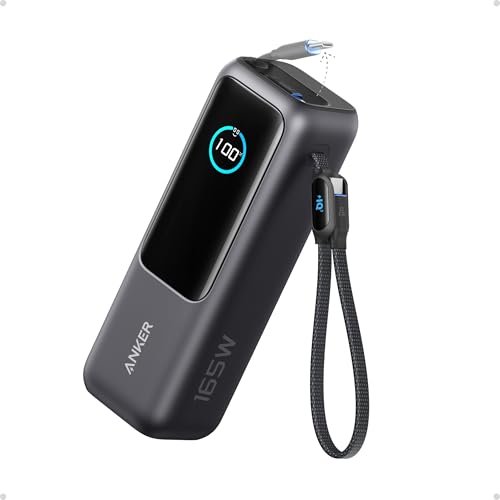
Our pick: Anker Power Bank (25K, 165W)
The verdict up front
Anker is the rare brand where the boring answer is the right one: buy it, it will work, and it will keep working. They are the biggest name in charging accessories for a reason, and across the power banks, plugs and adapters this household has accumulated, the quality floor has been absolutely consistent. Nothing they make is flashy. Everything they make turns up, does its job and refuses to die, and in a product category where the alternative is a £12 marketplace listing with an invented capacity figure and no one to answer for it, that reliability is the whole point.
Why I trust them: the adapter story
My Anker habit started the way I suspect most people's does: with a dead laptop adapter and a decision to make. The cheap unknown-brand replacement was a third of the price, and I did not want a mystery power supply attached to an expensive laptop, so I paid the extra for the Anker. That adapter did its job without a moment's drama, and that was the whole pitch: it earned the next purchase, and the one after that. Years later we have quite a few of their pieces in this house, and the pattern has never broken. Trust in a charging brand is built exactly that way, one unremarkable product at a time, and it is why I will pay Anker's modest premium without thinking twice.
What we actually own
The power banks are the daily drivers, and all three are reviewed in full on this site. The 25K travel bank is the family workhorse: flights, campsites, laptop charging, the lot. The 10K Slim is the most-used battery in the house, the one that gets handed to whichever child forgot to charge their phone. And the MagGo rides in my pack lid on every long walk since a dead phone 32km into the New Forest taught me the lesson. Around them sits the supporting cast of Anker plugs and adapters that just quietly work.
The safety record, honestly
Anker has recalled over 1.68 million power banks across four actions since 2023, and we would rather tell you that than have you find it as a gotcha, because understood properly it is a point in their favour. Lithium cells are a manufactured product with a real-world failure rate; the question that separates brands is what happens when a batch goes wrong. Anker finds out, publishes serial numbers, refunds customers and answers to regulators. The no-name tier, the one that fails safety tests at alarming rates, simply vanishes and relists under a new name. A recall system is most of what the premium buys, alongside the certified cells and the ActiveShield temperature monitoring that make a recall unlikely in the first place. Check your serials at Anker's recall page as you would any brand; then carry on buying them.
The range, mapped
Anker's range is enormous; here is where your money goes furthest, with our full coverage linked.
Power banks are the heart of it, and our power banks guide carries five of them: the £14.98 10K Slim for pockets, the £28.99 Zolo 20K with its built-in cable and CB-certified cells, the £69.98 25K for families and laptops, the MagGo line for MagSafe iPhones (now topped by the Qi2-25W MagGo 2 Pro), and the Prime 26K, built a quarter of a watt-hour under the airline limit.
SOLIX power stations are the bigger siblings, and genuinely excellent: the C1000 Gen 2 is our best-overall power station with the fastest recharge of the 28 models we cover, the C2000 Gen 2 leads the 2kWh class on charging, the C200 DC and C300 pair own the small end, and the S2000 is the home-backup bargain. The whole family lives in the Anker SOLIX brand guide.
Solar rounds it out: the PS30 panel is Amazon's best seller in its category at £49, the natural top-up partner for the power banks above.
Where Anker is not the pick
Honesty section, as ever. Anker is rarely the outright cheapest: INIU and UGREEN undercut them at the value end with perfectly credible certified kit, and our roundup carries both. In power stations, EcoFlow beats them on ecosystem expandability (the Delta 3 Plus grows to 5kWh; most SOLIX units are fixed) and Bluetti on sheer review scores in the 2kWh class. And one specific trap from our own coverage: the C200 DC does not accept Anker's own PS30 solar panel, a pairing gotcha that catches people precisely because both halves are Anker. None of this changes the default: for charging kit, start at Anker and make something else earn the switch.
The £15 Anker habit-starter, on Amazon