


Quick answer
The Jackery Explorer 1000 v2 is the right buy if weight decides it: 1,070Wh of LiFePO4 and 1,500W of output at 10.8kg, which Jackery claims as the smallest and lightest power station in the 1kWh class, for £499 at our September 2026 check, when it was also Amazon UK's category best seller. If you want more output and faster charging for the same money, the Anker SOLIX C1000 Gen 2 gives you 2,000W and a 49-minute refill; if you need capacity that can grow, nothing in the v2 line expands.
Our pick: Jackery Explorer 1000 v2
Should you buy the Jackery Explorer 1000 v2?
The Jackery Explorer 1000 v2 is the right buy if weight decides it: 1,070Wh of LiFePO4 and 1,500W of output at 10.8kg, which Jackery claims as the smallest and lightest power station in the 1kWh class, for £499 at our September 2026 check, when it was also Amazon UK's category best seller. If you want more output and faster charging for the same money, the Anker SOLIX C1000 Gen 2 gives you 2,000W and a 49-minute refill; if you need capacity that can grow, nothing in the v2 line expands.
The best-seller status is worth taking seriously, because the crowd has this one right. Jackery pared the original Explorer 1000 down by a claimed 18% and moved it to LiFePO4 chemistry rated for 4,000 cycles, kept the price at £499, and wrapped it in the most beginner-friendly package in the class: two UK sockets, a carry handle, a 20ms UPS mode certified to IEC 62040, and a noise claim of under 22dB. Nothing else at 1kWh is this easy to live with in a car boot or under the stairs. What it gives up against rivals is output, charging pace and any route to more capacity, and this guide covers all three plainly.
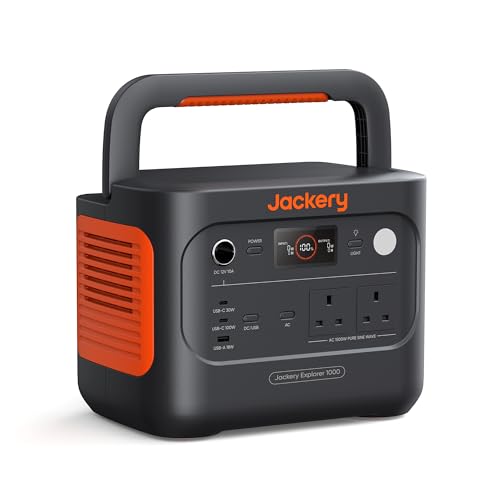
Jackery Explorer 1000 v2 specs and buying options
Every spec below is verified against Jackery's own UK data, with Amazon prices checked 24 September 2026.
Explorer 1000 v2, from £499
The pick of the range and Amazon UK's best seller in its category at our September 2026 check. 1,070Wh and 1,500W in a 10.8kg box that Jackery claims as the smallest and lightest 1kWh LiFePO4 station, 18% smaller than the original Explorer 1000. Standard mains charging takes 1.7 hours (1 hour in app emergency mode), solar tops out at 400W, and the battery carries a 4,000-cycle rating. Not expandable, so if 1,070Wh isn't enough in two years, it never will be. £499 at our check.
Three ways to buy it: the base unit at £499, or bundled with a SolarSaga 100W panel at £599 or a SolarSaga 200W panel at £759 at our check. The station takes up to 400W of solar across its two DC inputs, so the 200W bundle uses half its ceiling and leaves room to add a second panel later. If solar is central to your plan rather than a nice extra, note that 400W is a modest cap for this capacity; the maths is in the FAQ below.
Does the Jackery Explorer 1000 v2 really charge in 1 hour?
Only in one specific mode, and you should plan around the standard figure instead. The 1-hour claim belongs to Emergency Super Charging, a mode you switch on in the Jackery app for exactly what the name suggests: a storm warning tonight, an empty battery now. Standard mains charging takes 1.7 hours from empty to full.
That decoding matters when you compare it against rivals, because other brands put their fast mode in the headline too. Like for like, the Explorer 1000 v2's 1.7-hour standard recharge sits well behind the Anker SOLIX C1000 Gen 2's 49-minute HyperFlash and the EcoFlow Delta 3 Classic's 60 minutes, both of which are their fastest modes. On solar it needs 3.8 hours from two SolarSaga 200W panels at its 400W ceiling, or 7.5 hours from a single 200W panel, and a 12V car socket refills it in around 12 hours. None of that is a problem for a unit that charges at home before a weekend away. It only becomes one if rapid turnarounds are your buying reason, in which case the Anker is the better machine.
What can the Jackery Explorer 1000 v2 actually run?
The numbers below are calculated estimates, not lab tests: rated capacity multiplied by an 85% usable conversion efficiency, divided by each device's battery capacity, rounded down. On 1,070Wh that gives roughly 909Wh of usable energy, the most of any 1kWh-class unit we cover because Jackery's 1,070Wh rating starts slightly higher than the usual 1,024Wh.
- Phone (iPhone 17, 14.4Wh): around 63 full recharges
- LED lantern (4,800mAh, 17.8Wh): around 51 recharges
- Drone battery (DJI Mini 4 Pro, 19Wh): around 47 recharges
- Tablet (iPad 11-inch, 28.9Wh): around 31 recharges
- Laptop (MacBook Air 13-inch, 53.8Wh): around 16 recharges
For continuous loads, the same 909Wh estimate divides simply: a steady 60W draw runs for around 15 hours, a 300W draw for about three hours, and the full 1,500W for roughly 36 minutes. That 1,500W output rating, with a 3,000W surge, is the hard limit to understand before buying: it covers laptops, lights, camera kit, a projector, a travel kettle and most small appliances, but appliances rated above 1,500W will not run, a lower ceiling than its 1,800W and 2,000W mainstream rivals. If a microwave in a holiday let or power tools at the allotment are on your list, the 1,800W EcoFlow Delta 3 Classic or 2,000W Anker C1000 Gen 2 are the safer picks.
Check the Explorer 1000 v2 price on AmazonThe capacity you buy is the capacity you keep
No power station in Jackery's v2 line accepts an expansion battery, this one included. The Battery Pack 2000 Plus you may see on Jackery's site belongs to the separate Explorer 2000 Plus model, not the v2 range. So the sizing decision is one-time: if 1,070Wh is not enough in two years, it never will be.
Size it honestly, then. Around 1kWh comfortably covers a family camping weekend of phones, lights, laptops and camera batteries, with capacity to spare for a fan or a travel kettle. It runs thin if you add a fridge for days at a time or want backup through a long power cut. If you can already see those needs coming, buy either bigger (the Explorer 2000 v2 at £899) or expandable (the EcoFlow Delta 2 at £449 grows to 3kWh, and the DJI Power 1000 V2 at £579 grows to 11,264Wh). The flip side of the fixed capacity is what it buys you: no expansion port, no expansion electronics, and the lightest 1kWh unit in the pool we cover.
Jackery Explorer 1000 v2 alternatives
The Anker SOLIX C1000 Gen 2 is the same £499 spent on performance instead of portability: 2,000W of output against 1,500W, four UK sockets against two, a 49-minute full recharge against 1.7 hours standard, and 600W of solar input against 400W, at a slightly heavier 11.29kg. It is our overall top pick across all five brands we cover, and unless the Jackery's lower weight or simpler manner is the deciding factor, it is the stronger buy.
The EcoFlow Delta 3 Classic undercuts both at £399 at our check, with 1,024Wh, 1,800W of output and a 60-minute recharge. The catches: it has no 12V car socket at all, where the Jackery keeps one, and it weighs 12.1kg. If your kit includes anything with a cigarette plug, the Jackery holds its ground here.
The DJI Power 1000 V2 at £579 is the pick if a drone bag comes on every trip: 2,600W of output, a 56-minute recharge, expansion to 11,264Wh and direct fast charging of DJI flight batteries through its SDC ports. It gives up the 12V socket and, at 14.2kg, the weight advantage that defines the Jackery.
Jackery Explorer 1000 v2 FAQs
How long does the Jackery Explorer 1000 v2 take to charge?
Is the Jackery Explorer 1000 v2 expandable?
What solar panels work with the Jackery Explorer 1000 v2?
How heavy is the Jackery Explorer 1000 v2?
Can the Jackery Explorer 1000 v2 work as a UPS?
How long will the Jackery Explorer 1000 v2 battery last?
Sold on the brand but not sure of the size? The Jackery brand guide compares all four Explorer v2 models from £189 to £1,599. To weigh Jackery against the other four brands we cover, the complete portable power station buying guide ranks all 24 current models, or let the finder shortlist for you.