


Quick answer
The Anker SOLIX C1000 Gen 2 is the best portable power station for most UK buyers at £499 at our September 2026 check: 1,024Wh of LiFePO4, 2,000W of output across four UK three-pin sockets and a full mains recharge in 49 minutes, the fastest of the 24 current models we cover from any brand. Buy it if you want a 1kWh unit you will never wait for. If you need capacity that can grow later, it is not expandable: buy the Anker C2000 Gen 2 or EcoFlow Delta 2 instead.
Our pick: Anker SOLIX C1000 Gen 2
Should you buy the Anker SOLIX C1000 Gen 2?
The Anker SOLIX C1000 Gen 2 is the best portable power station for most UK buyers at £499 at our September 2026 check: 1,024Wh of LiFePO4, 2,000W of output across four UK three-pin sockets and a full mains recharge in 49 minutes, the fastest of the 24 current models we cover from any brand. Buy it if you want a 1kWh unit you will never wait for. If you need capacity that can grow later, it is not expandable: buy the Anker C2000 Gen 2 or EcoFlow Delta 2 instead.
That 49-minute figure is not a footnote, it is the reason this unit is our overall top pick across all five brands we cover. It comes from HyperFlash, a 1,600W charging mode you enable in the Anker app (standard charging runs at 1,200W), and it changes how you use the thing: forget to charge it the night before a trip and it is full again before you have finished packing the car. Around it sits a spec sheet with no soft spots for the price: a 3,000W surge rating, a 10ms UPS switchover, a 4,000-cycle battery rated to keep at least 80% of its capacity, and a noise claim of under 20dB below 200W of load.
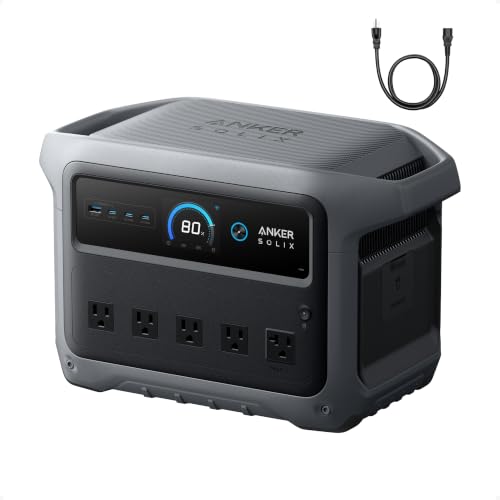
Anker SOLIX C1000 Gen 2 specs and buying options
Every spec below is verified against Anker's UK pages, with all six Amazon buying configurations and prices checked 24 September 2026.
SOLIX C1000 Gen 2, from £499
Our best overall power station across all five brands, not just Anker's range. 1,024Wh, 2,000W across four UK sockets, a 49-minute full mains recharge via app-enabled HyperFlash, a 4,000-cycle battery rating and under 20dB of noise below 200W of load, at £499 at our September 2026 check. The one thing it doesn't do is grow: unlike the original C1000, the Gen 2 takes no expansion battery, so buy it as the size it is.
- SOLIX C1000 Gen 2 (1024Wh) with AC charging cable£499Buy now
- SOLIX C1000 Gen 2 with car charging cable£519Buy now
- SOLIX C1000 Gen 2 with IP54 carry bag£539Buy now
- SOLIX C1000 Gen 2 + 100W solar panel£623Buy now
- SOLIX C1000 Gen 2 + 200W solar panel£729Buy now
- SOLIX C1000 Gen 2 + 400W solar panel£898Buy now
Six configurations, one simple rule: the first three are the same unit with a different accessory in the box, so pick by what you will actually use. The £499 version comes with the AC charging cable, £519 swaps in a car charging cable, and £539 adds an IP54 carry bag. The other three bundle a solar panel at 100W (£623), 200W (£729) or 400W (£898). The station accepts up to 600W of solar through its XT60i input and Anker claims a full solar recharge in 1.8 hours at that wattage, so even the 400W bundle leaves headroom.
What can the Anker SOLIX C1000 Gen 2 actually run?
The numbers below are calculated estimates, not lab tests: rated capacity multiplied by an 85% usable conversion efficiency, divided by each device's battery capacity, rounded down. On 1,024Wh that gives roughly 870Wh of usable energy.
- Phone (iPhone 17, 14.4Wh): around 60 full recharges
- LED lantern (4,800mAh, 17.8Wh): around 48 recharges
- Drone battery (DJI Mini 4 Pro, 19Wh): around 45 recharges
- Tablet (iPad 11-inch, 28.9Wh): around 30 recharges
- Laptop (MacBook Air 13-inch, 53.8Wh): around 16 recharges
For continuous loads, the same 870Wh estimate works as simple division: a steady 60W draw runs for around 14.5 hours, a 300W draw for just under three hours, and a full 2,000W load for roughly 26 minutes. The output side is the more useful test of what this unit is for. 2,000W of real output with a 3,000W surge covers travel kettles, most microwaves, power tools and anything else rated at 2,000W or below across its four UK sockets. Anything rated above 2,000W is out, and that includes plenty of full-size kettles, so check the rating plate before you plan your brews around it. USB kit is well served too: two 140W USB-C ports charge laptops at full speed, alongside a 15W USB-C, a 12W USB-A and a 120W car socket.
Check the C1000 Gen 2 price on AmazonIs not being expandable a dealbreaker?
Here is the one line on the spec sheet that needs a decision from you before you buy. The original C1000 accepted an expansion battery; the Gen 2 does not, and Anker's own UK comparison table says so explicitly. The capacity you buy is the capacity you keep.
For most buyers at this size, that matters less than it sounds. A 1kWh station is a devices-and-weekends machine: phones, laptops, lights, camera batteries, a projector, the odd mains appliance. Those needs do not usually grow, and the recharge speed partly substitutes for capacity anyway, because a unit that refills in 49 minutes from any socket, or 1.8 hours from 600W of panels, spends far less of its life empty than a slower rival.
It becomes a dealbreaker in one specific case: you are buying 1kWh now but you can already see home backup or off-grid use in your future. Then buy the growth path instead. Within Anker's range that means the C2000 Gen 2 at £999, which doubles to 4,096Wh with a BP2000 battery. Outside it, the EcoFlow Delta 2 at £449 is the cheapest expandable 1kWh unit we cover, growing to 3kWh. If neither of those futures is yours, the missing port costs you nothing.
Anker SOLIX C1000 Gen 2 alternatives
The EcoFlow Delta 3 Classic is the value play at the same capacity: 1,024Wh and 1,800W for £399 at our check, £100 less than the Anker, with a 60-minute full recharge and the same 10ms UPS. The Anker answers with more output, more sockets (four against two), faster charging and a higher published cycle rating, and the Classic has no 12V output at all where the Anker keeps a 120W car socket. Tight budget, the Classic; everything else, the Anker.
The Jackery Explorer 1000 v2 matches the Anker's £499 price and was Amazon UK's best seller in its category at our check. Its case is weight: 10.8kg against the Anker's 11.29kg, and Jackery claims it as the lightest unit in the 1kWh class. The Anker beats it nearly everywhere else: 2,000W against 1,500W, 49 minutes against 1.7 hours standard charging, 600W of solar input against 400W.
The DJI Power 1000 V2 is the pick for one audience: drone flyers. £579 at our check buys 1,024Wh with 2,600W of output, a 56-minute recharge, expansion to 11,264Wh and SDC ports that fast-charge DJI flight batteries directly, something no other brand offers. It has no 12V car socket, and UK units carry two AC sockets to the Anker's four.
Anker SOLIX C1000 Gen 2 FAQs
How fast does the Anker SOLIX C1000 Gen 2 charge?
Is the Anker SOLIX C1000 Gen 2 expandable?
What solar panel works with the Anker SOLIX C1000 Gen 2?
How many plug sockets does the Anker SOLIX C1000 Gen 2 have in the UK?
How long does the Anker SOLIX C1000 Gen 2 battery last?
Can the Anker SOLIX C1000 Gen 2 run a kettle?
Set on Anker? The Anker SOLIX brand guide compares the C1000 Gen 2 against the whole current range, from the £189 C300 DC to the wheeled F3000. Still weighing brands against each other, the complete portable power station buying guide ranks all 24 current models side by side, or answer a few questions in the finder and let it shortlist for you.