


Quick answer
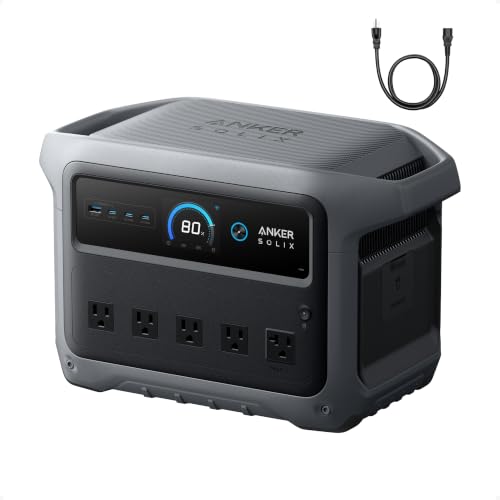
Our pick: Anker SOLIX C1000 Gen 2
C1000 Gen 2 or Elite 100 V2: which should you buy?
For most UK buyers the Anker SOLIX C1000 Gen 2 is the one to buy at £499 at our September 2026 check: both stations carry the same 1,024Wh LiFePO4 battery, but the Anker pushes 2,000W across four UK three-pin sockets to the Bluetti's 1,800W across two, and it publishes a full mains recharge in 49 minutes. Buy the Bluetti Elite 100 V2 at £469 instead if you plan to run the thing from panels: it accepts 1,000W of solar input to the Anker's 600W and claims a full recharge in around 70 minutes of good light, the fastest solar charging near this price. Same capacity, same 10ms UPS, same 4,000-cycle battery rating; the fork is sockets and output against solar and price.
This is one of the cleaner decisions in the 1kWh class. Two units at the same 1,024Wh, within £30 and 0.21kg of each other, that split on the one axis a buyer can actually answer for themselves: how are you going to fill it back up, and how much do you need to run at once? Answer those two and the winner falls out.
What the C1000 Gen 2 and Elite 100 V2 share
More than they differ. Both are 1,024Wh of LiFePO4, the long-life chemistry, rated for 4,000-plus charge cycles and a claimed decade of service. Both offer a UPS mode with a 10ms switchover, so either will bridge a power cut for a router or a desktop. Both are app-controlled, and neither is expandable: 1,024Wh is what you buy and what you keep on both units, with no bolt-on battery to grow into later.
They are near-twins on the scales too. The Anker weighs 11.29kg, the Bluetti 11.5kg, so the 0.21kg gap between them is noise. The Bluetti is the more compact box at 32 x 21.5 x 25cm against the Anker's 38 x 20.8 x 24.4cm, which mostly shows in the shorter footprint; the Anker is the longer, slightly flatter unit. For carrying either up a slope or wedging one into a car boot, treat them as the same size and weight class.
Both also carry nine ports, and both give you at least one 140W USB-C port that will charge a serious laptop at full speed. The differences start at what those ports are.
Where they split: solar against sockets
Everything that separates these two comes down to two questions.
How will you recharge it? This is the Bluetti's win, and it is not close. The Elite 100 V2 accepts up to 1,000W of solar through a built-in MPPT controller, and Bluetti claims a full recharge in around 70 minutes of strong light. The Anker caps solar at 600W and claims 1.8 hours for a full fill at that input. If panels are central to how you run the thing, on a van roof, at a festival, off-grid for days, the Bluetti fills faster and takes bigger arrays. From the mains the gap narrows: the Anker publishes a full 0 to 100% recharge in 49 minutes via its app-enabled 1,600W HyperFlash mode (standard charging runs at 1,200W), while Bluetti quotes 80% in 45 minutes from its 1,200W TurboBoost but does not publish a full-charge time. Both are quick from the wall. Only the Bluetti is quick from the sun. The Bluetti also supports Bluetti's Charger 1 alternator accessory for DC-DC charging from a vehicle while driving, which suits van and overland use.
How much do you need to run at once? This is the Anker's win. It delivers 2,000W of continuous output with a 3,000W surge across four UK three-pin sockets. The Bluetti delivers 1,800W with a 2,700W surge across two sockets. The extra 200W of headroom and the two extra sockets matter if you want to run several mains devices together, or a single higher-draw appliance up to 2,000W, without playing musical plugs. The Bluetti answers with a richer DC side: two DC5521 12V outputs alongside the car socket (they share a 10A budget with it), and a dual USB-C layout of one 100W and one 140W port. The Anker pairs two 140W USB-C ports with a 15W USB-C and a 12W USB-A.
On price, the Bluetti undercuts the Anker: £469 base against £499, a £30 saving at our September 2026 check.
Anker SOLIX C1000 Gen 2 and Elite 100 V2 specs and buying options
Both units verified against the manufacturers' UK pages and official manuals, with every Amazon buying configuration priced at our September 2026 check. The Anker SOLIX C1000 Gen 2 first:
SOLIX C1000 Gen 2, from £499
Our best overall power station across all five brands, not just Anker's range. 1,024Wh, 2,000W across four UK sockets, a 49-minute full mains recharge via app-enabled HyperFlash, a 4,000-cycle battery rating and under 20dB of noise below 200W of load, at £499 at our September 2026 check. The one thing it doesn't do is grow: unlike the original C1000, the Gen 2 takes no expansion battery, so buy it as the size it is.
- SOLIX C1000 Gen 2 (1024Wh) with AC charging cable£499Buy now
- SOLIX C1000 Gen 2 with car charging cable£519Buy now
- SOLIX C1000 Gen 2 with IP54 carry bag£539Buy now
- SOLIX C1000 Gen 2 + 100W solar panel£623Buy now
- SOLIX C1000 Gen 2 + 200W solar panel£729Buy now
- SOLIX C1000 Gen 2 + 400W solar panel£898Buy now
The first three Anker options are the same unit with a different accessory in the box, an AC cable, a car cable or an IP54 carry bag; the rest bundle a solar panel. And the Bluetti Elite 100 V2:
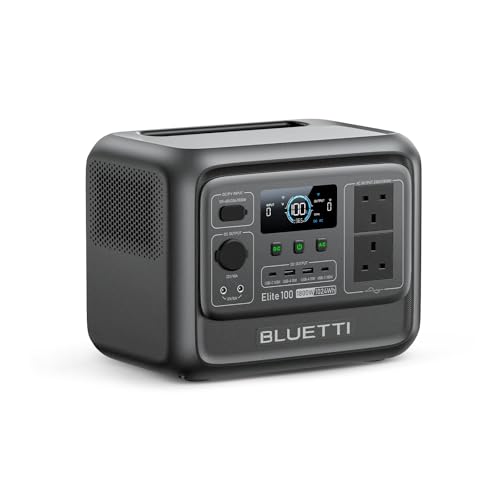
Elite 100 V2, from £469
The solar bargain of the entire market we cover: a 1,000W solar input and built-in MPPT controller on a £469 unit, filling its 1,024Wh battery in a claimed 70 minutes of good light. Output is 1,800W, the battery is rated 4,000-plus cycles, and it takes Bluetti's Charger 1 alternator accessory for van charging. From the mains, Bluetti quotes 80% in 45 minutes with TurboBoost. If panels are how you plan to run the thing, nothing near this price gets close.
Note the Bluetti's higher-priced bundles carry its Charger 1 and Charger 2 alternator chargers and its 200W or 350W panels, so buy by how you plan to feed it. Given the Bluetti's 1,000W solar ceiling, its bigger panel bundles have real headroom to use; the Anker tops out at 600W of solar, so there is no point over-panelling it.
What can 1,024Wh actually run?
The sums are identical for both units, because the battery is the same size. The numbers below are calculated estimates, not lab tests: rated capacity multiplied by an 85% usable conversion efficiency, divided by each device's battery capacity, rounded down. On 1,024Wh that gives roughly 870Wh of usable energy:
- Phone (iPhone 17, 14.4Wh): around 60 full recharges
- LED lantern (4,800mAh, 17.8Wh): around 48 recharges
- Drone battery (DJI Mini 4 Pro, 19Wh): around 45 recharges
- Tablet (iPad 11-inch, 28.9Wh): around 30 recharges
- Laptop (MacBook Air 13-inch, 53.8Wh): around 16 recharges
For continuous loads the same 870Wh estimate works as simple division. A steady 60W draw runs for around 14.5 hours on either unit. The difference shows only at the top of each one's range: run the Anker flat out at 2,000W and it holds roughly 26 minutes by our calculation; the Bluetti at its 1,800W ceiling holds roughly 29 minutes. Neither is a machine for sustained high loads, and neither pretends to be. Both cover a long weekend of devices, lights and the odd mains appliance for one or two people.
Buy the Bluetti Elite 100 V2 on AmazonWho buys which?
Choose the Anker SOLIX C1000 Gen 2 if you will mostly refill from the mains or the car, you want to run more than one mains device at once, or a single appliance up to 2,000W, and you value having four sockets rather than two. You want the published 49-minute full recharge that means the unit is rarely caught empty, and the £30 premium over the Bluetti is nothing you will notice. This is the pick for family camping, home backup, worksites and anyone whose recharging happens at a plug.
Choose the Bluetti Elite 100 V2 if solar is central to your plan. The 1,000W input and built-in MPPT, the claimed 70-minute solar fill and the option of alternator charging via Charger 1 make it the off-grid and van-life pick of the pair, and it saves you £30 doing it. You are happy with two sockets and 1,800W of output because your loads are devices and lighting rather than a bank of mains appliances. Festivals, overlanding, off-grid weekends and anyone running the thing from panels: this is the one.
If you genuinely cannot separate the two, default to the Anker. It is the more broadly capable unit for the way most people actually use a 1kWh station, at a plug, and the site's overall top pick across every brand we cover. The Bluetti is the specialist that wins decisively for one job: charging from the sun.
Anker C1000 Gen 2 vs Bluetti Elite 100 V2 FAQs
What is the difference between the Anker SOLIX C1000 Gen 2 and the Bluetti Elite 100 V2?
Which charges faster from solar, the Anker C1000 Gen 2 or the Bluetti Elite 100 V2?
Which has more plug sockets and more output?
Are the Anker C1000 Gen 2 and Bluetti Elite 100 V2 expandable?
Which is cheaper, the Anker C1000 Gen 2 or the Bluetti Elite 100 V2?
Can the Bluetti Elite 100 V2 charge from a vehicle while driving?
Want the fuller picture on the winner? The Anker SOLIX C1000 Gen 2 guide covers all six buying configurations and the expandability question in depth, and the Bluetti brand guide places the Elite 100 V2 against the rest of Bluetti's range. Still weighing brands against each other, the complete portable power station buying guide ranks all 25 current models side by side, or answer a few questions in the finder and let it shortlist for you.