


Quick answer
Buy the Anker SOLIX C1000 Gen 2 at £499 if you want the stronger unit: the same 1,024Wh LiFePO4 core as the Delta 2, but 2,000W of AC output against 1,800W, a full mains recharge in 49 minutes against 80, 600W of solar against 500W, 4,000 charge cycles against 3,000, and a lighter 11.29kg. Buy the EcoFlow Delta 2 at £449 for the two things the Anker cannot match at any price: it takes an extra battery to roughly 3kWh where the C1000 Gen 2 is fixed at 1,024Wh, and it costs £50 less. Prices from our September 2026 check.
Our pick: Anker SOLIX C1000 Gen 2
C1000 Gen 2 or Delta 2: which should you buy?
Buy the Anker SOLIX C1000 Gen 2 at £499 if you want the stronger unit: the same 1,024Wh LiFePO4 core as the Delta 2, but 2,000W of AC output against 1,800W, a full mains recharge in 49 minutes against 80, 600W of solar against 500W, 4,000 charge cycles against 3,000, and a lighter 11.29kg. Buy the EcoFlow Delta 2 at £449 for the two things the Anker cannot match at any price: it takes an extra battery to roughly 3kWh where the C1000 Gen 2 is fixed at 1,024Wh, and it costs £50 less. Prices from our September 2026 check.
These two are the most direct rivals in the 1kWh class, and on paper the decision is unusually clean. They carry an identical 1,024Wh of LiFePO4, the long-life battery chemistry, and both put four UK three-pin sockets on the front. Almost everywhere they differ, the Anker is the newer, faster, harder-working unit. The one place the EcoFlow answers back is the place a spec sheet never shows you until you need it: the Delta 2 grows, and the C1000 Gen 2 does not.
That is the whole comparison in a sentence. If the amount of power you need today is the amount you will ever need, the Anker is the better machine for £50 more. If there is any chance you will want double the capacity next year, the Delta 2 buys you that option and the C1000 Gen 2 slams the door on it.
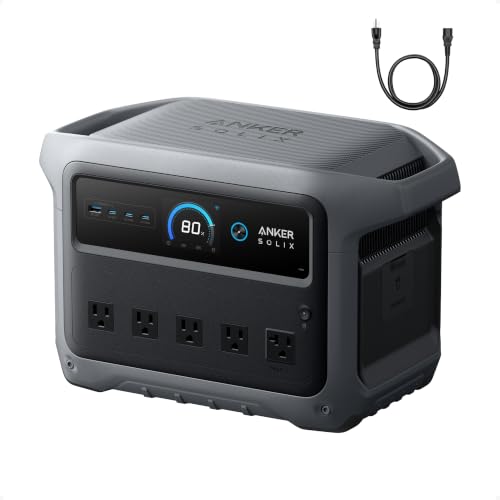
What the C1000 Gen 2 and Delta 2 share
Start with the common ground, because it is substantial. Both hold 1,024Wh of LiFePO4, so the raw energy in the box is the same on either unit: the same number of laptop charges, the same hours of a mains fridge, the same weekend of devices. Both use LiFePO4 rather than the older NMC chemistry, which is why both quote lifespans measured in thousands of cycles rather than hundreds.
Both put four UK three-pin sockets on the front, both run a pure inverter capable of household appliances, both take up to solar and mains charging, and both are controlled from a phone app over Wi-Fi and Bluetooth. In weight they are close: the C1000 Gen 2 is 11.29kg to the Delta 2's 12kg. Neither is a rucksack unit; both are a two-hands-and-a-car-boot proposition for camping, van life or a power cut at home.
So this is not a capacity decision or a chemistry decision. It is a decision about how fast the power goes in and out, how long the unit lasts, and whether it can ever get bigger.
Where the C1000 Gen 2 pulls ahead
On the numbers that describe how hard a station works, the newer Anker leads across the board:
- AC output: 2,000W against 1,800W, with a 3,000W surge on the Anker to the Delta 2's 2,700W. The C1000 Gen 2 runs more demanding appliances continuously. The Delta 2 counters with X-Boost, EcoFlow's mode that runs some resistive loads up to 2,400W by trimming voltage, so the gap narrows for kettles and heaters, though neither is rated to run a full 3,000W UK kettle at full power.
- Mains recharge: 49 minutes against 80. The C1000 Gen 2 refills 0 to 100% in a claimed 49 minutes on its 1,600W HyperFlash mode (app-enabled; 1,200W on standard AC). The Delta 2 claims 0 to 100% in 80 minutes at 1,200W input, or 0 to 80% in 50 minutes. If you charge in short windows, that difference is real.
- Solar: 600W against 500W. The Anker accepts up to 600W of panels for a claimed full recharge in 1.8 hours; the Delta 2 caps at 500W for a stated 3 to 6 hours depending on the panel. More solar headroom and a faster claimed fill both go to the Anker.
- USB-C: 140W against 100W. The C1000 Gen 2 carries two 140W USB-C ports (plus a 15W); the Delta 2's two USB-C ports top out at 100W. If you charge a power-hungry laptop over USB-C, the Anker feeds it faster.
- Cycle life: 4,000 against 3,000. Anker rates the C1000 Gen 2 to 4,000 cycles to 80% or more of capacity; EcoFlow rates the Delta 2 to 3,000. Both are long lives; the Anker's is a third longer.
- Noise: rated under 20dB under 200W on the C1000 Gen 2. EcoFlow does not publish a decibel figure for the Delta 2 anywhere we could find, so this is one for the Anker on the record and an unknown for the EcoFlow.
The C1000 Gen 2 is also, marginally, the smaller and lighter box: 11.29kg and 38 x 20.8 x 24.4cm against 12kg and 40 x 21.1 x 28.1cm.
The one thing the Delta 2 does that the Anker cannot
Read the last line of that list again before you default to the Anker, because the Delta 2 has one answer that outweighs several of them for the right buyer: it is expandable.
The EcoFlow Delta 2 accepts an extra battery. EcoFlow states a 1 to 3kWh range, supporting one Delta 2 Smart Extra Battery or one Delta Max Extra Battery, taking a single 1,024Wh unit up towards roughly 3kWh of total capacity. That turns a weekend station into a serious multi-day or light home-backup system without buying a second unit.
The Anker SOLIX C1000 Gen 2 cannot do this. The original C1000 was expandable; the Gen 2 dropped the feature, and Anker's own UK comparison confirms it. 1,024Wh is what you buy and what you keep, for the life of the unit.
The Delta 2 also carries more ports for small kit: four USB-A ports (two 12W and two 18W fast) to the C1000 Gen 2's single 12W USB-A. If you charge a lot of phones, cameras and battery banks over USB-A rather than USB-C, that matters at a busy campsite.
And it is £50 cheaper: £449 for the Delta 2 against £499 for the C1000 Gen 2 with its AC charging cable, at our September 2026 check.
Anker SOLIX C1000 Gen 2 and EcoFlow Delta 2 specs and buying options
Both units verified against the manufacturers' UK pages and listings, with Amazon buying configurations priced at our September 2026 check. The C1000 Gen 2 first, with its charging-cable, carry-bag and solar bundles:
SOLIX C1000 Gen 2, from £499
Our best overall power station across all five brands, not just Anker's range. 1,024Wh, 2,000W across four UK sockets, a 49-minute full mains recharge via app-enabled HyperFlash, a 4,000-cycle battery rating and under 20dB of noise below 200W of load, at £499 at our September 2026 check. The one thing it doesn't do is grow: unlike the original C1000, the Gen 2 takes no expansion battery, so buy it as the size it is.
- SOLIX C1000 Gen 2 (1024Wh) with AC charging cable£499Buy now
- SOLIX C1000 Gen 2 with car charging cable£519Buy now
- SOLIX C1000 Gen 2 with IP54 carry bag£539Buy now
- SOLIX C1000 Gen 2 + 100W solar panel£623Buy now
- SOLIX C1000 Gen 2 + 200W solar panel£729Buy now
- SOLIX C1000 Gen 2 + 400W solar panel£898Buy now
And the EcoFlow Delta 2:
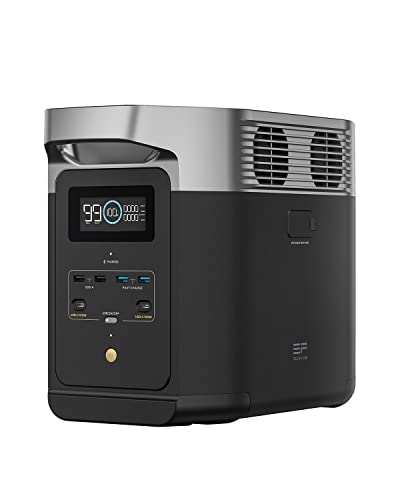
Delta 2, from £449
The older 1kWh Delta survives in the range for one reason: it's the only 1,024Wh EcoFlow you can expand, taking a Delta 2 or Delta Max extra battery to reach up to 3kWh. It also keeps the 12V car socket and DC ports the Delta 3 Classic dropped, with four AC sockets and 1,800W of output. The trade is an 80-minute recharge against the Classic's 60 and a £449 price against the Classic's £399 at our check. Buy it for the expansion or the 12V ports; otherwise the Classic is newer and cheaper.
- Delta 2 (1024Wh, expandable)£449Buy now
What can 1,024Wh actually run?
The sums are identical on both units, because the battery is the same size. The numbers below are calculated estimates, not lab tests: rated capacity multiplied by an 85% usable conversion efficiency, divided by each device's battery capacity, rounded down. On 1,024Wh that gives roughly 870Wh of usable energy:
- Phone (iPhone 17, 14.4Wh): around 60 full recharges
- LED lantern (4,800mAh, 17.8Wh): around 48 recharges
- Drone battery (DJI Mini 4 Pro, 19Wh): around 45 recharges
- Tablet (iPad 11-inch, 28.9Wh): around 30 recharges
- Laptop (MacBook Air 13-inch, 53.8Wh): around 16 recharges
That is a long camping trip's worth of devices, or a useful buffer through a home power cut, on either unit. On mains appliances the difference is output, not capacity: the C1000 Gen 2's 2,000W inverter runs a slightly wider range of kit continuously than the Delta 2's 1,800W (with X-Boost stretching the EcoFlow towards 2,400W on resistive loads). Around 870Wh of usable energy runs a 700W mains fridge-freezer's compressor cycles across a long outage, or a 100W load for the best part of a working day, on both.
Who buys which?
The C1000 Gen 2 buyer wants the best 1kWh unit and knows 1kWh is enough. They value the fast 49-minute mains recharge for topping up in short windows, the 600W solar ceiling for off-grid days, the 4,000-cycle life for years of use, and the quiet running for a tent or a home office. Campers, van-lifers and home-backup buyers who have sized their needs and will not outgrow them: C1000 Gen 2.
The Delta 2 buyer wants a foot in the door of a bigger system, or simply wants to spend £50 less today. They accept the slower 80-minute recharge and the lower 1,800W output in exchange for the ability to bolt on an extra battery towards 3kWh later, and for the extra USB-A ports. Anyone unsure how much power they will eventually need, or building towards multi-day and light home backup on a budget: Delta 2.
If you are torn and the budget stretches, the C1000 Gen 2 is the better machine on almost every performance line. If the budget is tight, or expandability is on your mind at all, the Delta 2 is the smarter long-game buy. There is no wrong answer here, only two clear priorities.
Buy the EcoFlow Delta 2 on AmazonAnker SOLIX C1000 Gen 2 vs EcoFlow Delta 2 FAQs
What is the difference between the Anker SOLIX C1000 Gen 2 and the EcoFlow Delta 2?
Is the Anker SOLIX C1000 Gen 2 expandable?
Can the EcoFlow Delta 2 be expanded?
Which charges faster, the C1000 Gen 2 or the Delta 2?
Which is better value, the Anker C1000 Gen 2 or the EcoFlow Delta 2?
Can either the C1000 Gen 2 or the Delta 2 run a kettle?
Both units sit at the popular 1kWh sweet spot of a much larger range. For the Anker's full write-up see the Anker SOLIX C1000 Gen 2 guide, or compare each brand's whole line-up in the Anker SOLIX brand guide and the EcoFlow brand guide. Across all brands, the complete portable power station buying guide ranks every current model, or let the finder shortlist for you.