


Quick answer
The EcoFlow Delta 3 Classic is the best-value 1kWh power station we cover: 1,024Wh of LiFePO4, 1,800W of output (2,400W with X-Boost for simple heating elements), a 60-minute full mains recharge and a 10ms UPS switchover for £399 at our September 2026 check, £100 under its usual price. Buy it for mains and USB kit. Do not buy it for a campervan: it has no 12V output at all, and it is not expandable, two catches that send some buyers to the £449 Delta 2 instead.
Our pick: EcoFlow Delta 3 Classic
Should you buy the EcoFlow Delta 3 Classic?
The EcoFlow Delta 3 Classic is the best-value 1kWh power station we cover: 1,024Wh of LiFePO4, 1,800W of output (2,400W with X-Boost for simple heating elements), a 60-minute full mains recharge and a 10ms UPS switchover for £399 at our September 2026 check, £100 under its usual price. Buy it for mains and USB kit. Do not buy it for a campervan: it has no 12V output at all, and it is not expandable, two catches that send some buyers to the £449 Delta 2 instead.
At £399 nothing else in the 1kWh class touches the core numbers. The 60-minute recharge from a 1,400W mains input, or 0 to 80% in 45 minutes in fast mode, is beaten in the 1kWh class only by the Anker C1000 Gen 2's 49 minutes and the DJI Power 1000 V2's 56, both £100 or more dearer. The cells are EcoFlow's automotive-grade full-tab LiFePO4 with a ten-year lifespan claim, the 3,600W surge rating is double the class norm, and it holds a quoted noise ceiling of 30dB at 600W of load. EcoFlow built this price by cutting exactly two things, and whether you should care about either is what the rest of this guide is for.
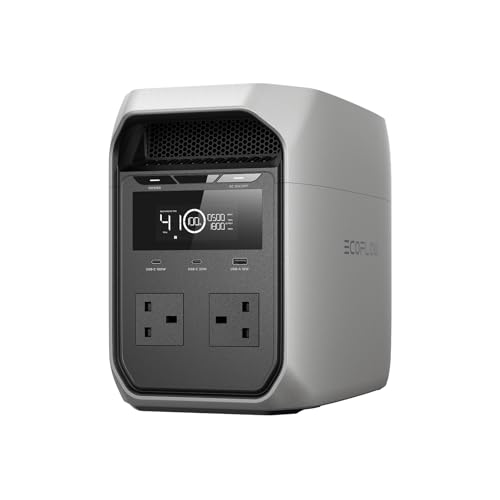
EcoFlow Delta 3 Classic specs and buying options
Every spec below is verified against EcoFlow's UK pages, with all three Amazon buying configurations priced at our 24 September 2026 check.
Delta 3 Classic, from £399
The value pick of the whole range: 1,024Wh, 1,800W of output with a 3,600W surge, a 60-minute full recharge, a 10ms UPS switchover and a quoted noise ceiling of 30dB at 600W, for £399 at our September 2026 check. One omission you must check before buying: it has no 12V output at all. No car socket, no DC barrel ports, nothing, so campervan fridges and cigarette-plug kit are out, and it isn't expandable either. For mains-powered and USB kit it's the strongest sub-£400 unit EcoFlow sells.
Three ways to buy it: the base unit at £399, bundled with a 160W solar panel at £558, or with two 100W panels at £617. The station accepts up to 500W of solar for a full recharge in a claimed 2.5 hours, so both bundles leave input headroom. Van owners can also add EcoFlow's 500W Alternator Charger, which takes it to 80% in 1.8 hours while driving, a genuine workaround for one of the two catches below.
The two catches: no 12V output, no expansion
Catch one: the Delta 3 Classic has no 12V output of any kind. No car socket, no DC barrel ports. Five output ports in total, all AC and USB: two UK sockets, a 100W and a 30W USB-C, and one 18W USB-A. For most buyers running mains and USB kit this costs nothing. For anyone with a compressor cool box, a 12V fridge or any cigarette-plug equipment, it rules the unit out entirely, and no adapter fixes it cleanly. Campervan buyers should look at the Bluetti Elite 300 instead, whose dedicated 12V/30A output is built for exactly that job, or at the Delta 2 below.
Catch two: it is not expandable. EcoFlow's own comparison table says so in as many words. The 1,024Wh you buy is the ceiling for the unit's whole life; expansion in EcoFlow's current Amazon UK range belongs to the Delta 2 at this size and the Delta 3 Max Plus above it. If you can already see home backup or off-grid growth in your future, buy the growth path now rather than replacing a £399 unit in two years.
If neither catch touches your kit list, stop deliberating. Mains appliances, laptops, lights, a home-office UPS, garden power: this is the strongest sub-£400 unit in the class, and the cuts that made the price are cuts you will never notice.
Delta 2 or Delta 3 Classic?
The older Delta 2 is still on sale at £449, £50 above the Classic at our check, and it exists in the range precisely because it keeps what the Classic cut. Same 1,024Wh capacity, same 1,800W output, and then the differences stack up on both sides.
The Delta 2 wins on connectivity and growth. It has the 12V car socket and two DC5521 barrel ports the Classic lacks, four AC sockets against two, four USB-A ports against one, and it accepts a Delta 2 or Delta Max extra battery to reach up to 3kWh, the one expandable 1kWh EcoFlow. If either catch above stung, this is the £50 answer.
The Classic wins on everything newer. It charges fully in 60 minutes against the Delta 2's 80, surges to 3,600W against 2,700W, publishes a 10ms UPS switchover where the Delta 2's EPS mode has no published figure, quotes a 30dB noise ceiling where the Delta 2 quotes none, and its automotive-grade full-tab cells carry the newer CTC construction. It is also £50 cheaper.
The rule: 12V kit or future expansion, Delta 2; everything else, Delta 3 Classic. The Delta 2 remains a strong unit, but for a buyer starting fresh with mains-and-USB needs, the newer one is the better £399.
What can the EcoFlow Delta 3 Classic actually run?
The numbers below are calculated estimates, not lab tests: rated capacity multiplied by an 85% usable conversion efficiency, divided by each device's battery capacity, rounded down. On 1,024Wh that gives roughly 870Wh of usable energy.
- Phone (iPhone 17, 14.4Wh): around 60 full recharges
- LED lantern (4,800mAh, 17.8Wh): around 48 recharges
- Drone battery (DJI Mini 4 Pro, 19Wh): around 45 recharges
- Tablet (iPad 11-inch, 28.9Wh): around 30 recharges
- Laptop (MacBook Air 13-inch, 53.8Wh): around 16 recharges
For continuous loads the same 870Wh divides simply: a steady 60W draw runs for around 14.5 hours, a 300W draw for just under three hours, a full 1,800W for roughly 29 minutes. On the output side, 1,800W covers microwaves, most power tools and any appliance rated to 1,800W, and X-Boost stretches the ceiling to 2,400W for simple resistive loads such as kettles and heaters. Appliances rated above 2,400W, which includes 3kW full-size kettles, stay out of reach. Remember the port shape too: everything here runs through two AC sockets and three USB ports, so a four-way extension lead earns its place in the kit.
Check the Delta 3 Classic price on AmazonEcoFlow Delta 3 Classic alternatives
The Anker SOLIX C1000 Gen 2 is our overall top pick across all five brands and the upgrade answer at £499: 2,000W of output against 1,800W, four UK sockets against two, a 49-minute recharge against 60, 600W of solar input against 500W, and a 120W car socket where the Classic has none. The Classic's reply is £100 and X-Boost. If the budget reaches £499, the Anker is the better machine; if it does not, the Classic gives up less than the price gap suggests.
The Jackery Explorer 1000 v2 sells portability: 1,070Wh at 10.8kg against the Classic's 12.1kg, with a 12V car socket, for £499. Its 1,500W output trails the Classic's 1,800W and its standard recharge takes 1.7 hours, so the Classic beats it on every performance number while undercutting it by £100. Buy the Jackery for the weight and the socket, not the spec sheet.
The Bluetti Elite 100 V2 at £469 is the solar specialist: 1,024Wh and 1,800W with a 1,000W solar input that refills it in a claimed 70 minutes of good light, double the Classic's solar ceiling, plus a 12V socket and DC ports. If panels are your primary charger rather than the wall, it is the stronger buy; from the mains, the Classic charges faster for £70 less.
EcoFlow Delta 3 Classic FAQs
Does the EcoFlow Delta 3 Classic have a 12V car socket?
Is the EcoFlow Delta 3 Classic expandable?
How fast does the EcoFlow Delta 3 Classic charge?
Should I buy the EcoFlow Delta 2 or the Delta 3 Classic?
How loud is the EcoFlow Delta 3 Classic?
How long will the EcoFlow Delta 3 Classic battery last?
Weighing it against the rest of EcoFlow's range, including the River 3 Plus ladder below it and the expansion question above it, the EcoFlow brand guide compares every current model. Across brands, the complete portable power station buying guide ranks all 24 current models side by side, or answer a few questions in the finder for a personal shortlist.