


Quick answer
The Jackery Explorer 240 v2 is the best-selling small power station on Amazon UK and the easiest answer for power-cut and campsite basics: 256Wh of LiFePO4 (3,000 cycles, a claimed 10-year lifespan), a real 300W UK mains socket, 100W USB-C, a 20ms UPS switchover, a built-in camping light and a 1-hour fast charge, all at 3.5kg for £259 at our 30 October 2026 check. It runs phones, laptops, a router and lights, not kettles or heaters. If everything you own charges by USB-C, the DC-only Jackery Explorer 300D gives you more capacity for £169; if you want more AC headroom, the EcoFlow River 3 Plus and Anker SOLIX C300X are the step up.
Our pick: Jackery Explorer 240 v2
Should you buy the Jackery Explorer 240 v2?
Buy the 240 v2 if you want the simplest possible insurance against dark evenings and dead devices: a small, genuinely portable battery with a real three-pin socket on the front. It is the best-selling unit of its size on Amazon UK, and the formula explains why: 256Wh of long-life LiFePO4, 300W of AC output, a 100W USB-C port, a 20ms UPS switchover and even a built-in camping light, in a 3.5kg box at £259 at our 30 October 2026 check.
This is the smallest station we cover with a UK mains socket, and that socket is the whole decision. If anything you need in a power cut or a tent ends in a three-pin plug, a lamp, a radio charger, a CPAP, this is the entry ticket. If it does not, read the cons section before you spend the extra £90 over its DC-only sibling.
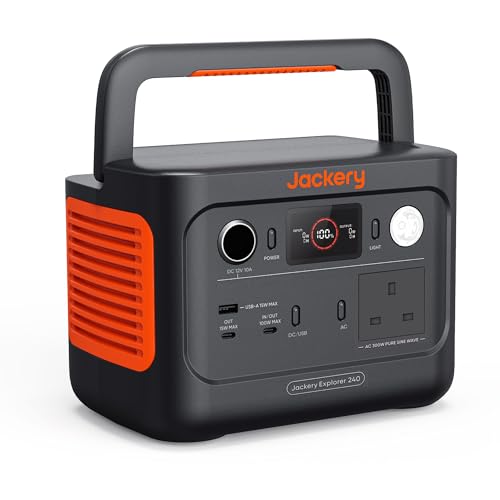
What you get
The battery is LiFePO4, rated by Jackery at 3,000 cycles and a 10-year lifespan, which matters double at this end of the market where cheap units still ship short-life chemistry. Output is five ports: a 300W pure sine mains socket (600W surge), a 100W two-way USB-C, a second 15W USB-C, a 15W USB-A and a 12V car socket, so a car fridge or 12V kit is catered for too.
Charging is quick and flexible: a 1-hour fast charge from the mains (app-controlled), a gentler 2-hour mode that favours battery lifespan, or around 3 hours from a 100W solar panel, which feeds in through the USB-C port (Jackery's solar adapter is sold separately, worth knowing before you buy a panel). The app connects over Wi-Fi or Bluetooth for charge status, auto-off and battery-saving settings.
Two details push it beyond the basics. The 20ms UPS means you can leave the router plugged through it and ride out a power cut without the broadband dropping. And the built-in camping light sounds like a gimmick until the lights actually go out, at which point the battery that is also a lamp becomes the most sensible object in the house. Safety certification is to IEC 62368 and UL94V-0 fire-resistance standards, with 5-year customer support behind it.
Check today's price on AmazonWhat can 256Wh actually run?
Think phones, laptops, router, lights. The honest maths, with 10 to 15% inverter overhead allowed: a home router at 8 to 10W runs for roughly a full day, a phone charge costs 15 to 20Wh so a dozen or more charges, a laptop charge around 60Wh so three to four. For the government's 3-day Be Ready yardstick it will keep a household's phones and a nightly router session going; it will not run heating, kettles or a fridge, and its 300W socket rules those out anyway. That is not a flaw, it is the tier: this is the keep-connected unit, not the keep-the-freezer unit.
The honest cons
300W of AC is the ceiling, and plenty of mains kit exceeds it: anything with a heating element is out, as are most hair dryers and power tools. If your power-cut plan includes a fridge, this is the wrong tier; start at 1kWh with something like the EcoFlow Delta 3 Classic.
And if nothing you carry needs a mains socket at all, the £259 includes an inverter you would never use. Jackery's own Explorer 300D drops the AC socket, adds capacity (288Wh), loses a kilo (2.5kg) and costs £169. That £90 question is exactly the one we walk through in the C300 DC vs C300X comparison: empty your kit bag and count the three-pin plugs.
How it compares
Against the EcoFlow River 3 Plus (£219 to £239, 286Wh, 600W AC): the EcoFlow gives more AC headroom and capacity for similar money, while the Jackery counters with lighter weight, the built-in light and its simpler one-box appeal. Against the Anker SOLIX C300X (£249, 288Wh, 300W): very close on paper, with Anker taking the port count and Jackery the weight. Among the DC-only options, its own 300D at £169 and the Anker C300 DC at £189 undercut it for USB-C-only households. The finder tool will settle it against your actual kit list in seven questions.
Specs at a glance
Jackery's claimed figures from the UK listing, price from our 30 October 2026 check:
| Spec | Jackery Explorer 240 v2 |
|---|---|
| Capacity | 256Wh LiFePO4 (3,000 cycles, 10-year design life) |
| AC output | 300W pure sine, 1 UK socket |
| Ports | 1× AC, USB-C 100W two-way, USB-C 15W, USB-A 15W, 12V car socket (10A) |
| UPS switchover | 20ms |
| Recharge | 1 hour fast (app), 2 hours standard AC, ~3 hours via 100W solar |
| Extras | Built-in camping light, Wi-Fi/Bluetooth app |
| Safety | IEC 62368, UL94V-0 fire resistance |
| Weight | 3.5kg |
| Support | 5-year customer support |
| Price | £259 |
Verdict
The Jackery Explorer 240 v2 is the best small power station for most UK households, and the right way to judge it is as the first rung of real backup power: the unit that keeps phones, laptops, the router and a light alive through a power cut or a camping weekend, with a proper mains socket, a UPS mode and a battery built to last a decade. It earns its bestseller status honestly. Buy the 300D instead if you have no three-pin needs, step up a tier if your plan includes a fridge, but if you want one simple box that makes a blackout boring, this is it.