


Quick answer
The Jackery Explorer 300D is the cheapest serious battery we cover at £169 (30 October 2026 check): 288Wh of LiFePO4, equivalent to roughly a 78,000mAh power bank, with two 140W USB-C ports, a 65W third, a USB-A and a 12V car socket powering five devices at once, at just 2.5kg. There is no mains socket: it is a pure DC unit for phones, laptops, tablets, routers with USB power, drones and camera batteries, claiming 95% DC-to-DC efficiency and 4,000 charge cycles. If anything in your bag needs a three-pin plug, buy the Jackery Explorer 240 v2 (£259) or Anker SOLIX C300X instead; if USB-C is your whole world, nothing matches the 300D's capacity per pound.
Our pick: Jackery Explorer 300D
Should you buy the Jackery Explorer 300D?
Buy the 300D if your kit list is USB-C from top to bottom and you want the most watt-hours per pound of any unit we cover. £169 at our 30 October 2026 check buys 288Wh, which in power bank language is roughly a 78,000mAh battery, nearly three times the legal flight limit, with laptop-grade output and barely any weight penalty at 2.5kg.
The catch is the whole personality of the product: there is no mains socket. No inverter, no three-pin anything. Jackery has stripped the AC hardware out and passed the savings on, which is either the smartest buy in the small-station market or a dealbreaker, depending entirely on what is in your bag.
What you get
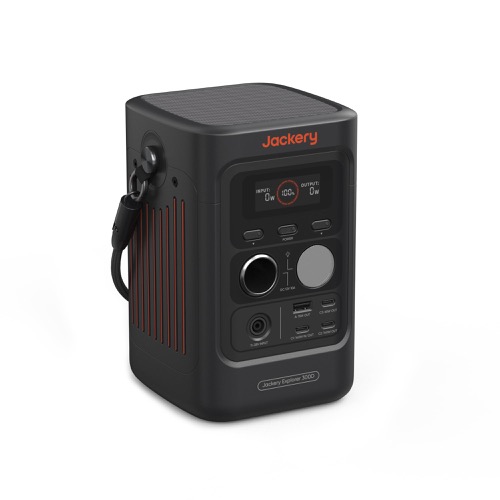
The battery is 288Wh of LiFePO4 rated at 4,000 cycles while keeping at least 70% capacity, with an operating range from -20°C, so it will not sulk in a cold car boot. Output is 300W of pure DC across five ports: two 140W USB-C, a third USB-C at 65W, a 15W USB-A and a 12V car socket (Jackery's own spec sheet; the Amazon listing's "4 ports" miscounts by ignoring the car port). That is enough to fast-charge a serious laptop and two phones simultaneously, with no inverter in the chain; Jackery claims up to 95% DC-to-DC efficiency, which is the quiet advantage of skipping AC conversion, since an inverter typically burns 10 to 15% of your stored energy before your device sees any of it.
Charging back up is flexible: USB-C input, up to 100W of solar, the car socket, or a dual AC-DC input that takes it from empty to 80% in about an hour. Like its 25K power bank cousin, it ships with a 2-in-1 strap cable, a carrying strap that is also a 140W USB-C lead.
One spec that will matter to a specific crowd: Jackery quotes up to 10 hours of runtime for a Starlink Mini over USB-C, which makes this a tidy off-grid internet battery for remote working, filming days and genuinely serious power-cut setups.
Check today's price on AmazonThe giant power bank framing
The honest way to understand the 300D is as the top rung of the power bank ladder rather than the bottom rung of the power station one. Reputable brands stop making conventional power banks at 27,000mAh because that is the 100Wh flight ceiling; above it, this form factor is what they build instead. Against the Anker 25K power bank (90Wh, £69.98), the 300D gives you more than three times the energy for about 2.4 times the price, plus higher per-port wattage. The trade is that it stays home when you fly, and it rides in a boot or a base camp rather than a jacket pocket.
The honest cons
No AC socket means no lamp with a plug, no CPAP with a mains adapter, no battery chargers that only ship with wall warts. Count your three-pin dependencies honestly before buying; it is the same empty-your-kit-bag test we set in the C300 DC vs C300X comparison, and one mains-only device in the bag flips the answer.
It cannot fly, at nearly three times the 100Wh cabin limit; the Anker Prime 26K exists precisely for that job. And although the USB-A port is welcome, this is a USB-C-first device; households still running on old USB-A cables will not get the best from it.
How it compares
Its direct rival is the Anker SOLIX C300 DC: identical 288Wh capacity, similar DC-only philosophy, £189 at our last check against the Jackery's £169, with Anker countering on port count and its larger review base. The 300D wins on weight (2.5kg vs 2.8kg) and price. Within Jackery's own range, the Explorer 240 v2 at £259 trades 32Wh of capacity and a kilo of weight for a real 300W mains socket, a UPS mode and a camping light: that is the upgrade path for anyone whose power cut plan includes anything with a plug. Still unsure where you land? The finder sorts it in seven questions.
Specs at a glance
Jackery's claimed figures from the UK listing, price from our 30 October 2026 check:
| Spec | Jackery Explorer 300D |
|---|---|
| Capacity | 288Wh LiFePO4 (~78,000mAh equivalent; 4,000 cycles to ≥70%) |
| Output | 300W DC total: 2× USB-C 140W, 1× USB-C 65W, 1× USB-A 15W, 12V car socket (10A) |
| AC socket | None, DC only |
| Efficiency | Up to 95% DC-to-DC (claimed) |
| Recharge | USB-C, solar up to 100W, car, or AC-DC dual input (0-80% in ~1 hour) |
| Starlink Mini runtime | Up to 10 hours (claimed) |
| Operating range | -20°C to 45°C |
| Weight | 2.5kg |
| In the box | Strap cable (carry strap + 140W USB-C lead) |
| Price | £169 |
Verdict
The Jackery Explorer 300D is the best pound-per-watt-hour buy in the small battery market, and the right way to judge it is as the giant power bank it really is: 288Wh of long-life LiFePO4 with laptop-grade USB-C output, for £169 and 2.5kg. For a USB-C household's power-cut kit, a remote-working boot battery or a base-camp charger, nothing we cover touches its value. The 240 v2 exists for everyone whose plan involves a plug; for everyone else, this is the quiet bargain of the tier.