


Quick answer
Buy the EcoFlow Delta 2 at £449 if you want the stronger all-rounder: 1,024Wh, an 1,800W inverter (2,400W X-Boost, 2,700W surge), a full mains recharge in 80 minutes, up to 500W of solar and expansion to 3,000Wh with an add-on battery, all for £50 less. Buy the Jackery Explorer 1000 v2 at £499 if you want the lightest 1kWh unit at 10.8kg, a fractionally bigger 1,070Wh battery, the highest surge headroom at 3,000W and a claimed 22dB running noise. Both run on long-life LiFePO4 cells and carry two UK mains sockets. Prices from our September 2026 check.
Our pick: EcoFlow Delta 2
Delta 2 or Explorer 1000 v2: which should you buy?
Buy the EcoFlow Delta 2 at £449 if you want the stronger all-rounder: 1,024Wh, an 1,800W inverter (2,400W X-Boost, 2,700W surge), a full mains recharge in 80 minutes, up to 500W of solar and expansion to 3,000Wh with an add-on battery, all for £50 less. Buy the Jackery Explorer 1000 v2 at £499 if you want the lightest 1kWh unit at 10.8kg, a fractionally bigger 1,070Wh battery, the highest surge headroom at 3,000W and a claimed 22dB running noise. Both run on long-life LiFePO4 cells and carry two UK mains sockets. Prices from our September 2026 check.
These two are the obvious head-to-head at the 1kWh mark, and they split on temperament rather than capacity. The batteries are almost the same size, 1,024Wh against 1,070Wh, so on watt-hours alone there is nothing in it. The gap is in what EcoFlow and Jackery chose to prioritise around that battery. EcoFlow built the busier, harder-working box: more sockets, more output, faster charging, an expansion port. Jackery built the tidier, lighter, quieter one and made it the UK's best-selling outdoor generator. Decide which of those two personalities suits your kit, because that is the real choice here.
What the Delta 2 and Explorer 1000 v2 share
Start with the common ground, because it is wide. Both are portable power stations built on LiFePO4 (LFP) chemistry, the long-life cell type that shrugs off years of daily cycling, and both land at roughly 1kWh: 1,024Wh on the Delta 2, 1,070Wh on the Explorer. Both carry two UK three-pin mains sockets, a 12V car socket, USB-A and two USB-C ports rated to 100W, so either one charges a serious laptop at full speed. Both have app control over Wi-Fi and Bluetooth, both accept solar, and both are covered by the kind of long warranty this class has settled on.
In other words, for a weekend of phones, laptops, lights and a small fridge, either unit does the job. The differences below decide how fast, how heavy, how loud and how far you can push it.
Where the Delta 2 and Explorer 1000 v2 split
Same-sized batteries, five differences that actually matter:
- Inverter output. The Delta 2 runs 1,800W continuous, with a 2,400W X-Boost mode for stubborn resistive loads and a 2,700W surge. The Explorer 1000 v2 runs 1,500W continuous with a higher 3,000W surge. So the Delta 2 sustains heavier appliances (a 1,700W load is inside its rating and outside the Jackery's), while the Explorer has more headroom for the brief spike of a motor starting up.
- Charging speed. The Delta 2 refills from a flat battery to 100% in 80 minutes on mains (1,200W AC input). The Explorer takes 102 minutes in standard mode, though its app-only Emergency Super Charging can reach a full charge in as fast as an hour. In everyday use the Delta 2 is the quicker standard charger.
- Expansion. This is the big one. The Delta 2 has an expansion port: add one EcoFlow extra battery and EcoFlow quotes a 1 to 3kWh range, so a single Delta 2 can grow to around 3,000Wh. The Explorer 1000 v2 has no expansion input and no v2 battery pack exists, so 1,070Wh is what you buy and what you keep.
- Weight and size. The Explorer is the lighter, tidier box: 10.8kg and 32.7 x 22.4 x 24.7cm, against the Delta 2's 12kg and longer 40 x 21.1 x 28.1cm. Jackery markets it as the smallest and lightest 1kWh LFP station, and on these numbers it is the more portable of the two.
- Ports and solar. The Delta 2 carries more of almost everything: four AC sockets to the Jackery's two, four USB-A ports to its one, plus two DC5521 outputs, and it takes up to 500W of solar against the Explorer's 400W. If you are charging a tentful of kit at once, the Delta 2 has the outlets for it.
Read the split before defaulting to the cheaper unit, because the Jackery earns its £50 in the two areas EcoFlow did not chase. At 10.8kg it is the one you would rather carry from car to pitch, and Jackery's quoted 22dB running noise (a marketing claim, mode unspecified) points at the quieter box for an awning or a bedroom. The Explorer also holds the trust card: it was Amazon UK's number one best seller in Outdoor Generators at our September 2026 check.
EcoFlow Delta 2 and Jackery Explorer 1000 v2 specs and buying options
Both units verified against the manufacturers' UK pages and Amazon UK listings, with prices from our 24 September 2026 check. The EcoFlow Delta 2 first:
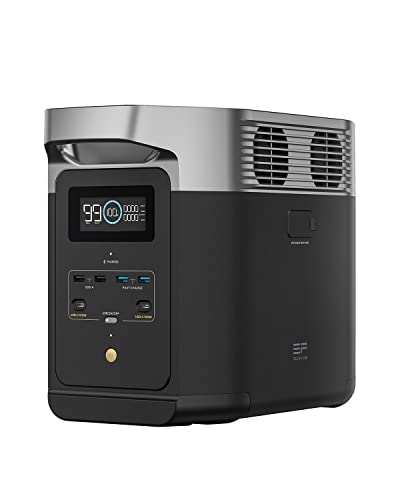
Delta 2, from £449
The older 1kWh Delta survives in the range for one reason: it's the only 1,024Wh EcoFlow you can expand, taking a Delta 2 or Delta Max extra battery to reach up to 3kWh. It also keeps the 12V car socket and DC ports the Delta 3 Classic dropped, with four AC sockets and 1,800W of output. The trade is an 80-minute recharge against the Classic's 60 and a £449 price against the Classic's £399 at our check. Buy it for the expansion or the 12V ports; otherwise the Classic is newer and cheaper.
- Delta 2 (1024Wh, expandable)£449Buy now
And the Jackery Explorer 1000 v2:
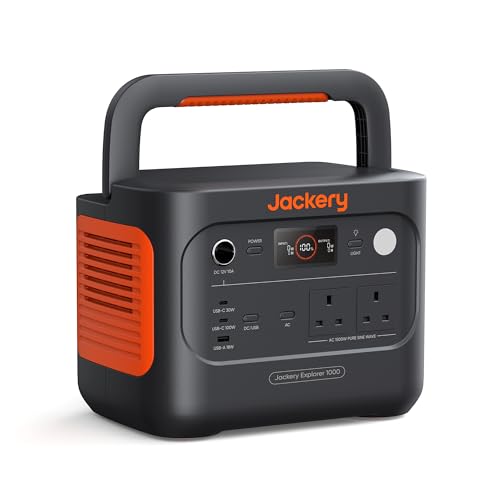
Explorer 1000 v2, from £499
The pick of the range and Amazon UK's best seller in its category at our September 2026 check. 1,070Wh and 1,500W in a 10.8kg box that Jackery claims as the smallest and lightest 1kWh LiFePO4 station, 18% smaller than the original Explorer 1000. Standard mains charging takes 1.7 hours (1 hour in app emergency mode), solar tops out at 400W, and the battery carries a 4,000-cycle rating. Not expandable, so if 1,070Wh isn't enough in two years, it never will be. £499 at our check.
A note on the charge figures above and how the two brands quote them. EcoFlow's 80-minute time is a straight 0 to 100% on mains. Jackery publishes 102 minutes as its standard 0 to 100% time and reserves the faster one-hour figure for the app's Emergency Super Charging mode, which drives the unit harder. On solar, the Delta 2 accepts up to 500W and EcoFlow quotes as fast as three hours (a 3 to 6 hour range); the Explorer accepts up to 400W and Jackery quotes 3.8 hours with two SolarSaga 200W panels, or 7.5 hours with one.
What can 1kWh actually run?
The two batteries are close enough that the day-to-day answer is the same. The numbers below are calculated estimates, not lab tests: rated capacity multiplied by an 85% usable conversion efficiency, divided by each device's battery capacity, rounded down. That gives roughly 870Wh usable on the Delta 2 and 910Wh on the Explorer:
- Phone (iPhone 17, 14.4Wh): around 60 recharges on the Delta 2, 63 on the Explorer
- Tablet (iPad 11-inch, 28.9Wh): around 30 recharges on the Delta 2, 31 on the Explorer
- Laptop (MacBook Air 13-inch, 53.8Wh): around 16 recharges on either unit
That is a long weekend of devices for a group, or the best part of a week for one person, on either box. The 46Wh capacity edge to the Jackery is real but marginal, a single extra phone charge or so, and not a reason to choose it.
The difference that matters is at the mains socket. The Delta 2's 1,800W inverter (2,400W in X-Boost) covers a wider band of household appliances than the Explorer's 1,500W, so a higher-draw kettle, heater or power tool that sits above 1,500W runs on the EcoFlow and stalls on the Jackery. Neither is a whole-house machine, and a full-size UK kettle at 2,500 to 3,000W is beyond both, but the Delta 2 gives you more of the mains world within its rating. Run a steady 60W load and either unit lasts around 14 to 15 hours before it needs charging.
Buy the Jackery Explorer 1000 v2 on AmazonWho buys which?
The Delta 2 buyer wants the most capable 1kWh box for the money and is willing to carry an extra 1.2kg for it. They value the 1,800W output for heavier appliances, the four AC sockets and four USB-A ports for charging a lot at once, the 80-minute mains top-up, and above all the expansion port: the option to bolt on a second battery later and reach 3,000Wh without buying a whole new station. Van-dwellers, family campers running a fridge and lights, anyone who might want more capacity down the line, and anyone counting the pennies, since it is the cheaper unit at £449: Delta 2.
The Explorer 1000 v2 buyer prioritises the physical experience of living with it. They want the lightest 1kWh unit to lift in and out of the boot, the quietest one to run near where they sleep, and the reassurance of the best-selling name in the category. They accept 1,500W of output, two mains sockets and no expansion path in exchange for 10.8kg, a more compact footprint and Jackery's quoted 22dB. Solo campers, festival-goers, caravanners who want simple and quiet, and anyone who values portability over headroom: Explorer 1000 v2.
If you are genuinely torn and the £50 does not decide it, the Delta 2 is the safer long-term buy. Its output, charging speed and, most of all, its expansion port mean you are less likely to outgrow it, and an expansion port you never use costs you nothing.
EcoFlow Delta 2 vs Jackery Explorer 1000 v2 FAQs
What is the difference between the EcoFlow Delta 2 and the Jackery Explorer 1000 v2?
Which has the bigger battery, the Delta 2 or the Explorer 1000 v2?
Which is lighter, the EcoFlow Delta 2 or the Jackery Explorer 1000 v2?
Which charges faster, the Delta 2 or the Explorer 1000 v2?
Can the EcoFlow Delta 2 be expanded, and can the Jackery Explorer 1000 v2?
Which power station runs higher-powered appliances?
Both units sit in the middle of a much larger range. The EcoFlow brand guide and the Jackery brand guide compare each against its own stablemates, the full Jackery Explorer 1000 v2 guide goes deeper on that unit, and the complete portable power station buying guide ranks every current model across brands, or let the finder shortlist for you.