


Quick answer
The EcoFlow Delta 3 Plus is the 1kWh power station to buy if you want home-backup credentials that can grow: 1,024Wh of LiFePO4 rated for 4,000 cycles, 1,800W of output (3,600W surge, with X-Boost running simple heating elements up to 2,400W), a 10ms UPS switchover, 30dB quiet running and a 56-minute full mains recharge, expandable to 5kWh with extra batteries, for £699 at our 30 October 2026 check. If you will never expand, the Delta 3 Classic gives you the same capacity and output for £399 and is our value pick; if you want cheap expandability and a 12V socket, the Delta 2 is £449; if you need 2kWh from day one, step up to the Delta 3 Max.
Our pick: EcoFlow Delta 3 Plus
Should you buy the EcoFlow Delta 3 Plus?
Buy the Delta 3 Plus if you want a 1kWh station that takes the home-backup job seriously and leaves the door open to more. It shares its headline numbers with the much cheaper Delta 3 Classic, 1,024Wh and 1,800W, then justifies its £699 price (at our 30 October 2026 check) with the things the Classic cannot do: expansion to 5kWh with extra batteries, a faster 56-minute full recharge, quieter running, and an app that actually plans around power cuts. If none of those four things made your ears prick up, buy the Classic at £399 and keep the £300.
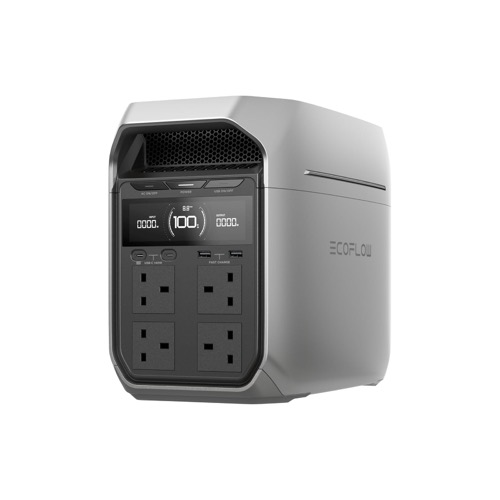
What you get
The core is 1,024Wh of LiFePO4, the long-life chemistry, rated by EcoFlow at 4,000 cycles to 80% health, which at a cycle a day is roughly a decade of use. The battery pack itself carries an IP65 rating inside the housing, a belt-and-braces detail most rivals skip.
Output is 1,800W continuous with a 3,600W surge across 11 ports, enough for kettles-and-toasters reality checks to matter: X-Boost, EcoFlow's trick for simple resistive loads, lets heating elements rated up to 2,400W run at reduced power. That is the same output story as the Classic and the Delta 2, and it covers the overwhelming majority of household kit.
Three things separate the Plus in daily use:
Recharge speed. A 1,500W AC input takes it from empty to 80% in 40 minutes and 100% in 56 minutes. Only the Anker SOLIX C1000 Gen 2 at 49 minutes beats it among the models we cover, and nothing else in EcoFlow's 1kWh range comes close. Solar matches the pace: it takes up to 1,000W of panel input through twin XT60 ports, and EcoFlow claims 80% in an hour with enough panel.
UPS behaviour and noise. The 10ms switchover means you can leave a router, NAS or desktop plugged through it and a power cut becomes a non-event: the load transfers to battery faster than the electronics notice. And X-Quiet keeps the fans at a claimed 30dB at 600W of load, which in practice means it can live in a bedroom or home office without announcing itself.
The app. Beyond the usual remote control and consumption stats, it pushes 12-hour storm and outage warnings so the unit is full when the weather arrives, and a Time-of-Use mode charges on cheap overnight rates automatically. For a unit that is partly a resilience purchase, software that watches the forecast is genuinely useful rather than gimmick.
Check today's price on AmazonThe expansion story, and the extra battery
This is the Plus's real argument over the Classic. The Delta 3 Plus accepts EcoFlow's extra batteries, including the 1,024Wh Delta 3 series battery, and scales to a maximum of 5kWh; it also plays with Delta Pro 3 and Delta 2 Max packs within the EcoFlow ecosystem.
That changes what the purchase is. £699 buys a 1kWh station today; adding the extra battery at £549 (at our check) makes it a 2kWh system for £1,248, and you can keep going. If a future with home backup, an EV-adjacent garage setup or longer off-grid trips is plausible, the Plus is the cheapest EcoFlow door into that future. If it is not, you are paying for a socket you will never use.
EcoFlow Delta 3 Extra Battery (1,024Wh), £549 on AmazonWhat can 1,024Wh actually run?
The practical yardsticks: a router (roughly 8 to 10W) for about three days, which covers the government's Be Ready 72-hour guidance with room to spare; a phone charge is 15 to 20Wh, so dozens of them; a laptop around 60Wh per charge; an evening of TV plus lights in the tens of watt-hours per hour. A fridge is the stretch case: typical UK fridges average 40 to 80W over a day of cycling, so 1kWh covers roughly a day, which is exactly the scenario where the extra battery earns its place. Allow 10 to 15% on top for inverter overhead when you do your own maths.
The honest cons
The price gap is real. £300 over the Delta 3 Classic buys expansion, 4 minutes faster charging than you will ever notice against the Classic's hour, quieter fans and the smarter app. Those are worth £300 to a home-backup buyer and worth nothing to someone who wants a campsite battery.
It is still a 1kWh unit until you spend again, and 2kWh buyers are better served from day one by the Delta 3 Max at £999. At 12.5kg it is also a two-hands unit; portable in the boot-and-back-door sense rather than the carry-it-up-a-hill one. One genuine advantage over the Classic worth knowing: EcoFlow's manual confirms a 12V cigarette-lighter output alongside two DC5521 ports, so unlike the 12V-free Classic, campervan and car-fridge owners are catered for here.
Delta 3 Plus vs Classic vs Delta 2 vs Max
Four EcoFlow units, one decision tree. The Delta 3 Classic at £399 is the value answer: same capacity and output, fixed forever, our pick for most 1kWh buyers. The Delta 2 at £449 is the budget expandable (to 3kWh) with a 12V socket, the campervan-friendly middle child. The Delta 3 Plus at £699 is the premium 1kWh: fastest recharge of the family, UPS-grade switchover, quietest running, and the biggest expansion ceiling at 5kWh. The Delta 3 Max at £999 starts at 2kWh for people who already know they need it. Undecided across brands? The finder tool will place you in about seven questions.
Specs at a glance
EcoFlow's claimed figures from the UK listing, prices from our 30 October 2026 check:
| Spec | EcoFlow Delta 3 Plus |
|---|---|
| Capacity | 1,024Wh LiFePO4 (4,000 cycles to 80%) |
| Output | 1,800W continuous, 3,600W surge, X-Boost to 2,400W resistive |
| Ports | 11 outputs: AC sockets, 2× USB-C (140W each), 2× USB-A (36W), 12V cigarette lighter, 2× DC5521 |
| Weight | 12.5kg (20.2 × 28.4 × 39.8cm) |
| Full mains recharge | 56 minutes (80% in 40 minutes, 1,500W input) |
| Solar recharge | 80% in 1 hour, 100% in 70 minutes (claimed, max input) |
| UPS switchover | 10ms |
| Noise | 30dB at 600W load, 40dB at 1,200W (claimed) |
| Expansion | Up to 5kWh with EcoFlow extra batteries |
| Battery protection | IP65-rated pack, BMS |
| Price | £699 (extra 1,024Wh battery £549) |
Verdict
The EcoFlow Delta 3 Plus is the best expandable 1kWh power station we cover, and that is precisely how to judge it: as the entry point to a system rather than a sealed box. Judged as a sealed box it loses to its own sibling, the £399 Classic, every time. Judged as the unit that recharges in under an hour, bridges a power cut without your router noticing, runs silently in the room you live in, and doubles its capacity the day you decide you need more, the £699 makes sense. Buy the Classic for a battery; buy the Plus for a plan.