


Quick verdict
The EcoFlow Delta 3 Max is the power station to buy when 1kWh is no longer enough and you want to stay under a grand: 2,048Wh of LiFePO4, 2,400W of output (4,800W surge) across four UK three-pin sockets, and nine output ports in total, for £999 at our September 2026 check. Buy it if you want a fixed 2kWh unit for van trips, worksites or budget home backup. If you can see your power needs growing, spend £100 more on the Delta 3 Max Plus, which pushes 3,000W and expands to 10kWh; if 1kWh actually covers you, the Anker SOLIX C1000 Gen 2 at £499 saves you £500.
EcoFlow Delta 3 Max: 4.7/5
2,048Wh of LiFePO4 and 2,400W across four UK sockets, nine output ports and a 4,800W surge, for £999 at our September 2026 check.
The full review is below.
Should you buy the EcoFlow Delta 3 Max?
The EcoFlow Delta 3 Max is the power station to buy when 1kWh is no longer enough and you want to stay under a grand: 2,048Wh of LiFePO4, 2,400W of output (4,800W surge) across four UK three-pin sockets, and nine output ports in total, for £999 at our September 2026 check. Buy it if you want a fixed 2kWh unit for van trips, worksites or budget home backup. If you can see your power needs growing, spend £100 more on the Delta 3 Max Plus, which pushes 3,000W and expands to 10kWh; if 1kWh actually covers you, the Anker SOLIX C1000 Gen 2 at £499 saves you £500.
The Max doubles the capacity of the 1kWh class without doubling the price, and that is its whole pitch. 2,048Wh is enough to keep a fridge, lights and devices going through a long power cut, run a worksite off-grid for a day, or power a weekend of van life without a hookup. It carries four UK sockets where most 2kWh rivals give you two, a 10ms UPS switchover for anything you cannot let drop, and a quiet 25dB rating at 600W of load.
There is one line on the spec sheet that decides everything below, and it is the word "expandable". The plain Max is not. If that matters to you, the answer is not a different brand, it is the Max Plus, and the section below spells out exactly when the £100 gap is worth crossing.
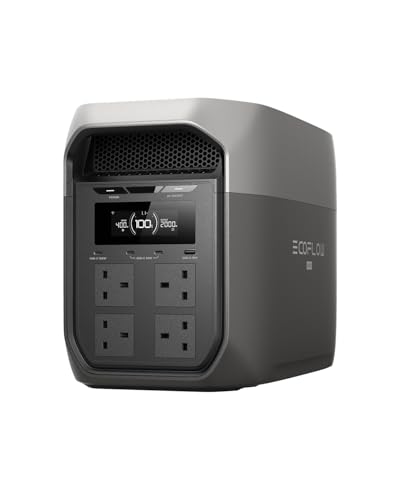
EcoFlow Delta 3 Max specs and buying options
Every spec below is verified against EcoFlow's UK pages, with prices checked in September 2026.
Delta 3 Max, from £999
2,048Wh and 2,400W of output in a 20.3kg box, with a quiet 25dB rating at 600W and nine ports including a 12V car socket. The problem is its own sibling: the Max Plus delivers 3,000W, expands to 10kWh, takes double the solar and charges USB-C at 140W, and on EcoFlow's own UK store it listed £100 cheaper than this at our check. On Amazon the Max was £999 against £1,099 for the Plus. Buy the Max only if you're certain you'll never expand, never pass 2,400W and never run more than 500W of solar.
The base unit is £999 at our check, down from a £1,199 list price. From there EcoFlow sells two solar bundles, and here the pricing does something odd worth flagging: the 220W panel bundle and the 400W panel bundle both land at £1,548. Same price, double the panel, so if you want a bundle, take the 400W one. The station accepts up to 500W of solar through its input, so a 400W panel sits comfortably under the ceiling and a 220W panel leaves a lot of that headroom unused.
One thing the Max is not is light. At 20.3kg it is heavier than the Anker SOLIX C2000 Gen 2 (18.9kg) and the Jackery Explorer 2000 v2 (17.5kg), though lighter than Bluetti's Elite 200 V2 (24.2kg). This is a two-handed lift and a boot-of-the-car unit, not something you carry far. That is true of the whole 2kWh class, but the Max is at the heavier end of it.
What can the EcoFlow Delta 3 Max actually run?
The numbers below are calculated estimates, not lab tests: rated capacity multiplied by an 85% usable conversion efficiency, divided by each device's battery capacity, rounded down. On 2,048Wh that gives roughly 1,740Wh of usable energy.
- Phone (iPhone 17, 14.4Wh): around 120 full recharges
- LED lantern (4,800mAh, 17.8Wh): around 97 recharges
- Drone battery (DJI Mini 4 Pro, 19Wh): around 91 recharges
- Tablet (iPad 11-inch, 28.9Wh): around 60 recharges
- Laptop (MacBook Air 13-inch, 53.8Wh): around 32 recharges
For continuous loads, the same 1,740Wh estimate works as simple division: a steady 60W draw runs for around 29 hours, a 300W draw for just under six hours, and a full 2,400W load for roughly 43 minutes.
The output side is the more useful test of what a 2kWh unit is for. 2,400W of rated output with a 4,800W surge covers microwaves, power tools, most travel appliances and anything else rated at 2,400W or below across its four UK sockets. EcoFlow also lists an X-Boost mode rated to 3,200W, which is designed to run some higher-wattage resistive appliances by lowering the output voltage, so a few full-size kettles and heaters that would otherwise trip the 2,400W limit can still run. Check the rating plate before you count on it.
USB kit is handled by a 100W USB-C, two 30W USB-C ports and an 18W USB-A, plus a 126W car socket on the 12V side. That 100W USB-C ceiling is the one place the cheaper Max is clearly capped against the Max Plus, which carries a faster 140W USB-C port.
Check the Delta 3 Max price on AmazonIs the Delta 3 Max expandable? And should you buy the Max Plus instead?
No. The EcoFlow Delta 3 Max is not expandable. Its spec table lists no extra-battery port, because expansion is the Max Plus's feature, not the Max's. The 2,048Wh you buy is the 2,048Wh you keep for the life of the unit.
This is the single decision to make before you buy, because the alternative is not another brand, it is the model one rung up. The Delta 3 Max Plus starts from the same 2,048Wh base but expands to 10kWh with extra batteries, pushes 3,000W of output rather than 2,400W, accepts 1,000W of solar rather than 500W, and carries a 140W USB-C port rather than 100W. It is £1,099 at our Amazon check, £100 more than the plain Max.
The pricing gets stranger on EcoFlow's own UK site, where the Max lists at £1,199 and the better-specced Max Plus at £1,099, so the Plus is actually the cheaper of the two direct from EcoFlow. On Amazon at our check the order flips back: the Max is £999 and the Max Plus £1,099. Either way, £100 is a small gap against expansion to 10kWh, more output and faster charging.
So buy the plain Max in one case: you are certain 2kWh fixed is your ceiling, you do not need more than 2,400W, and you want the lowest price on a 2kWh EcoFlow. If any part of that is uncertain, the Max Plus is the buy, and it is only £100 away.
EcoFlow Delta 3 Max alternatives
The Anker SOLIX C2000 Gen 2 is the closest head-to-head: 2,048Wh, 2,400W output and four UK sockets, the same £999 as the Max at our check. Anker's case is charging and growth. It publishes a clean 58-minute full mains recharge where EcoFlow does not give the Max a labelled 0 to 100% figure, and unlike the Max it expands, doubling to 4,096Wh with a BP2000 Gen 2 battery. The Max answers with a higher surge (4,800W against 4,000W) and EcoFlow's X-Boost mode. If you want a fixed 2kWh unit with the strongest surge, the Max; if you want a published recharge time or a growth path, the Anker.
The Jackery Explorer 2000 v2 is the value and portability pick at £899, £100 less than the Max. It is the lightest of this group at 17.5kg, and Jackery claims it as the lightest and smallest 2kWh LFP station. The trade-offs are real: 2,200W of output against the Max's 2,400W, two AC sockets against four, 400W of solar input against 500W, and a slower standard mains charge (Jackery quotes 102 minutes, with a faster app emergency mode). Tight budget and carrying it about, the Jackery; more sockets and more output, the Max.
The Bluetti Elite 200 V2 is the pick for two specific priorities: silence and longevity. At £999 it matches the Max on price and slightly beats it on capacity (2,073.6Wh), and it carries a class-leading 16dB quiet claim at low load plus a 6,000-cycle battery rating, the highest in this size bracket. It also takes 1,000W of solar to the Max's 500W. The Max wins on sockets (four against two) and weight (20.3kg against a hefty 24.2kg). If you will live near it or cycle it hard for years, the Bluetti; for socket count and a lighter lift, the Max.
EcoFlow Delta 3 Max FAQs
How much can the EcoFlow Delta 3 Max power?
Is the EcoFlow Delta 3 Max expandable?
What is the difference between the Delta 3 Max and the Delta 3 Max Plus?
How many plug sockets does the EcoFlow Delta 3 Max have in the UK?
How fast does the EcoFlow Delta 3 Max charge?
Can the EcoFlow Delta 3 Max run a kettle?
Set on EcoFlow? The EcoFlow brand guide compares the Delta 3 Max against the whole current range, from the River 3 Plus to the expandable Max Plus. Still weighing brands against each other, the complete portable power station buying guide ranks all current models side by side, or answer a few questions in the finder and let it shortlist for you.
Head to head with its rivals, we compare the Delta 3 Max against the Anker SOLIX C2000 Gen 2, the Anker SOLIX S2000 and the Jackery Explorer 2000 v2.