


Quick answer
The best small solar charger for most UK buyers is the Anker SOLIX PS30 at £49: 30W, IP65 weather resistance, USB-C and USB-A output and Amazon's best seller in the category, ideal for topping up power banks and phones on campsites or through a long power cut. The BigBlue 28W (£71.99) is the long-standing enthusiast favourite with a built-in ammeter, and the FlexSolar 100W (£99.99) is the step up that can also feed power stations through its XT60 and DC connectors. Two honest rules before buying: panels deliver well below their rated wattage in UK conditions, so size up and charge a power bank all day rather than expecting phone-from-flat miracles, and check compatibility, because small USB panels cannot charge some DC units, including Anker's own C200 DC.
Our pick: Anker SOLIX PS30 (30W)
A power bank solves the first day of a power cut; a solar panel solves every day after it. Fold-out USB solar chargers have quietly become good and cheap, £49 now buys the category's best seller, and they are the final rung of the preparedness ladder this cluster has been building: power banks for the phones, small stations for the router, and a panel to refill any of them for as long as the sun keeps cooperating. They also happen to be brilliant campsite kit, which is the buy-it-calmly test passed before we start.
Two pieces of honesty before the picks, because this category runs on optimistic numbers.
The honest UK-weather expectations
A panel's rated wattage is a laboratory figure: panel angled at full sun, perfect conditions. British reality, especially October to March, delivers a fraction of it, and one manufacturer in this list admits in its own small print that shade or partial cloud can cut output by up to 70%. So the honest framing is this: a 30W panel in decent UK daylight is a power-bank filler, not a phone fast-charger. Clip it to a south-facing window, garden chair or tent all day and it will put meaningful charge into a 20,000mAh bank; expect it to rescue a flat phone in an hour and you will be disappointed. Angle it at the sun (around 45 degrees, re-aimed occasionally) and output improves markedly, which is exactly why the panels with live power displays earn their place: you can see the difference aiming makes, and chase it.
The pairing trap
Small USB solar panels output 5V USB power, the same as a phone charger, which makes them perfect for power banks, phones, head torches and USB lanterns, and useless for some bigger batteries that need higher-voltage input. The sharpest example is in our own coverage: Anker's own SOLIX C200 DC explicitly does not accept the PS30 or any 5V USB-C panel. Rule of thumb: USB panels (everything under £80 here) feed USB devices and power banks; power stations want the bigger panels with DC/XT60 connectors, like the FlexSolar 100W below or the station-class panels we cover separately.
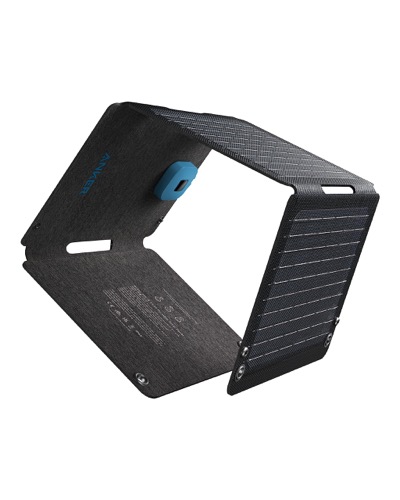
Best overall: Anker SOLIX PS30 (30W, £49)
Amazon UK's number one best seller in the category, and the one currently sitting in our own basket. 30W across USB-C and USB-A, IP65 weather resistance (the best rating here), a foldable design with carabiners included, and an 18-month warranty from the brand whose power banks it will spend its life feeding. At £49 on its current deal (usually £68.99) it is the simplest answer: if you own Anker banks, and our roundup suggests you might, this is their solar sibling. Just remember the trap above: its 5V USB output is for banks and phones, not for DC power stations, including Anker's own.
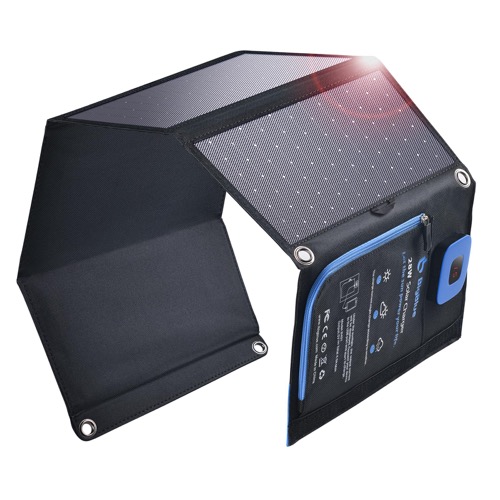
Best for enthusiasts: BigBlue 28W (£71.99)
The category's long-standing reference, with a review base (over 8,000 ratings) nothing else here approaches. Its party trick is the built-in digital ammeter showing live charging current, so you can aim the panel properly instead of guessing, plus N-type cells with a claimed 25.4% conversion efficiency, a zippered phone pocket, and USB-C and USB-A outputs with smart device detection. IP44 means it shrugs off drizzle rather than downpours. At £71.99 (19% off at our check) it costs more than the Anker; the display and the decade of goodwill are what you are paying for.
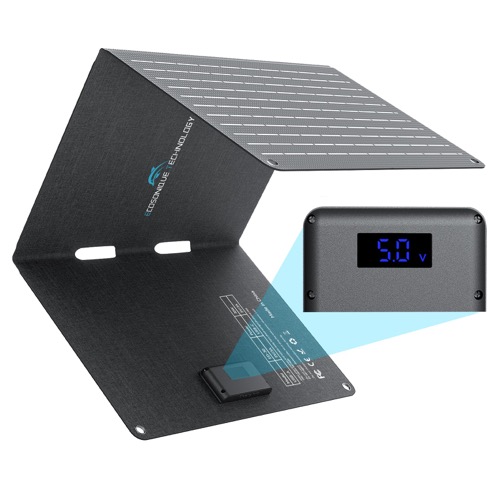
Best budget with a display: 30W panel with power meter (£59.98)
A newer entry whose whole pitch is the BigBlue trick at a keener price: a live V/A/W display refreshing every two seconds, dual USB-C and USB-A output, IP67-rated ETFE lamination and a 24-month warranty. It is not a brand with Anker's pedigree, which is exactly the trade: more features per pound, less track record. For a display panel on a budget it is a reasonable pick; for set-and-forget reliability, spend the £49 on the Anker.
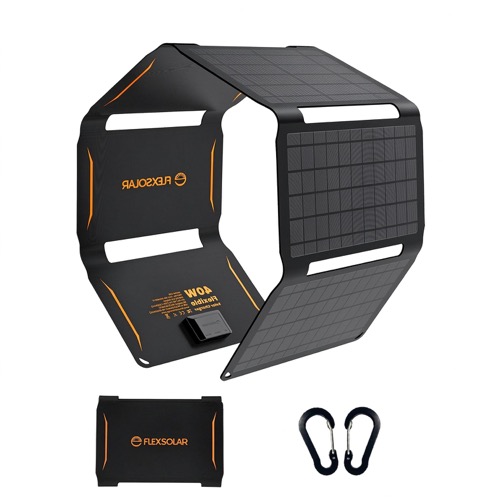
Best step-up: FlexSolar 40W (£62.99) and VTOMAN VS40 (£59.99)
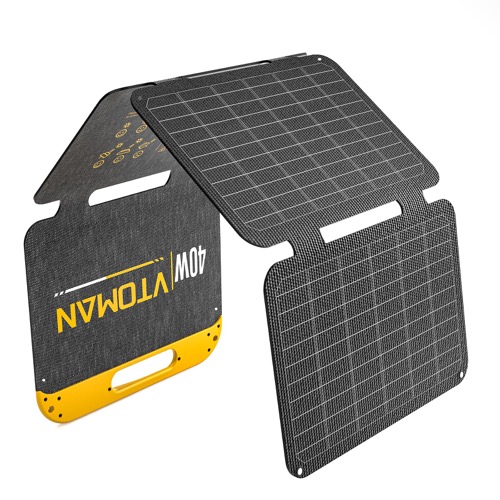
Two 40W options for more winter headroom. The FlexSolar 40W adds a genuinely useful third port: alongside QC3.0 USB-A and 40W USB-C PD there is a 19V DC output, letting it feed some laptops and small power stations directly, with IP67 ETFE build and 24% claimed efficiency at 1.07kg. The VTOMAN VS40 counters at 0.82kg with kickstands for proper sun-angling, 25% claimed efficiency and a 30W USB-C, at £59.99 on a heavy launch discount (normally £89.99). The FlexSolar's DC port makes it the more versatile buy; the VTOMAN is the lighter pack-friendly one.
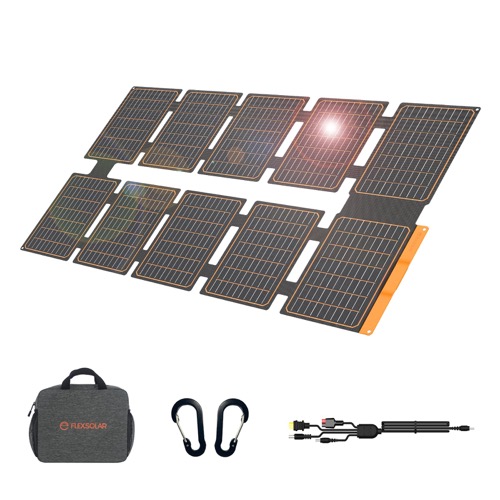
Best for power stations too: FlexSolar 100W (£99.99)
The crossover pick: still folding and portable at 1.85kg, but with the connector set that changes what it can feed: alongside USB-C PD and QC USB-A it ships a 4-in-1 DC cable with XT60, Anderson, DC7909 and DC5521 heads, covering most portable power stations on the market. If your preparedness setup includes a small station as well as power banks, £99.99 buys one panel that tops up everything. (Check your station's solar input spec first; our station solar guide covers the matching rules.)
The at-a-glance comparison
| Image | Product | Price | Buy |
|---|---|---|---|
| Best overallAnker SOLIX PS30 (30W) | £49.00 | |
| 30W · USB-C + USB-A · IP65 · ~1.1kgBest for Power banks and phones, set-and-forget | |||
| BigBlue 28W | ~£72 | |
| 28W · USB-C + USB-A · built-in ammeter · IP44Best for Enthusiasts who aim their panel | |||
| 30W panel with power display | £59.99 | |
| 30W · USB-C + USB-A · live V/A/W meter · IP67Best for A display panel on a budget | |||
| FlexSolar 40W | £62.99 | |
| 40W · USB-C PD 40W + USB-A QC + DC 19V · IP67 · 1.07kgBest for Winter headroom and DC versatility | |||
 | VTOMAN VS40 (40W) | £59.99 | |
| 40W · USB-C PD 30W + USB-A · kickstands · 0.82kgBest for The lightest 40W for a pack | |||
| Stations tooFlexSolar 100W | £99.99 | |
| 100W · USB-C PD + USB-A + DC with XT60/Anderson · 1.85kgBest for One panel that also feeds power stations | |||
Manufacturer-claimed outputs; prices live where shown, otherwise our 30 October 2026 check, and several are limited-time deals.
How this fits the power-cut plan
The government's Be Ready standard asks households to manage for three days, and a solar panel is what turns that from a countdown into a routine: panel out in the morning, power bank full by the evening, phones alive indefinitely. Pair any panel here with the power bank strategy, add the lighting setup (the Glocusent pocket lantern even brings its own small panel), and the whole plan is covered in the Be Ready guide. Rest of the year, the same panel lives on the tent. Not sure which battery the panel should be feeding in the first place? The finder tool sizes it for you, from pocket bank to whole-home station.