


Quick verdict
The Anker 10,000mAh PowerCore Slim is the best cheap power bank for most people: two full smartphone charges in a case 1.5cm thin and 244g light, with two-way USB-C, certified drop-test toughness and an 18-month warranty, for £14.98 at our 30 October 2026 check (usually £17.99). It is a phone-and-small-devices bank, not a laptop charger, and it has no built-in cable. If you need laptop power or one bank for a whole family, step up to the Anker 25K at £69.98; if you want wireless MagSafe charging for an iPhone, the Anker MagGo 10K is the pick.
Anker Power Bank (10,000mAh, PowerIQ): 4.5/5
Two full phone charges in a pocket-slim, drop-tested 244g bank with two-way USB-C. £14.98 at our 30 October 2026 check, usually £17.99.
The full review is below.
Should you buy the Anker 10,000mAh PowerCore Slim?
Yes, and probably before anything else on this site's power pages. This is the most frequently used power bank in our family, and it is the most-used precisely because it is the least impressive on paper: small, light and thin, it is the one that actually gets picked up and stuck in a pocket when someone (usually one of the kids) has forgotten to charge their phone. At £14.98 at our 30 October 2026 check, it is also the cheapest thing we recommend in the whole power category.
What it is
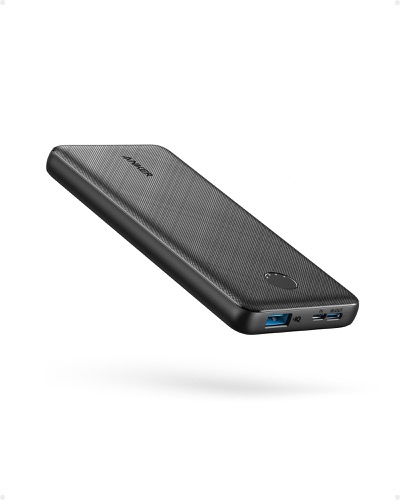
Anker's PowerCore Slim 10000 is the entry point of the range done properly: 10,000mAh in one of the slimmest cases in its class, at 15.2 x 7.1 x 1.5cm and 244g. By Anker's figures that capacity is two full charges for an iPhone 15, nearly two for a Galaxy S23, or 1.2 charges of an iPad mini.
The single USB-C port works both ways, charging the bank and your device, alongside a USB-A for older leads, and a USB-C cable comes in the box. There is no built-in cable, no display beyond the charge lights, and no fast-charge headline. That simplicity is most of why it costs £15.
Living with it
Ours is, honestly, the family's favourite without anyone ever having chosen it. It is the bank that goes in a coat pocket for a dog walk, the one that gets handed to a teenager heading out with 8% battery, the one in the glovebox. The slim shape is the feature: at a centimetre and a half thick it disappears into a pocket in a way chunkier banks never do, so it actually gets taken.
It has also proven properly robust. Ours is definitely showing signs of usage, but after a lot of use and a few drops it is still going strong, which squares with Anker's claimed one-metre drop-test certification and scratch-resistant finish.
And there is a household tactic worth sharing: this is the bank I hand out. The family get this one rather than my 25K travel bank or my MagGo magnetic one, because then when I need my kit, I know exactly where it is. At £15, buying a second bank purely to protect your good one is a completely rational move.
Check today's price on AmazonThe honest cons
It charges phones, and that is it. Anker does not headline an output wattage on this model, and that tells you the brief: steady phone and small-device charging rather than fast-charge heroics. A laptop is out of the question; for that you want 60W+ of USB-C, which is the 25K's territory.
There is no built-in cable, so you still need to remember a lead (the box includes one, but boxes stay at home). And with one USB-C and one USB-A, it is a one-or-two device bank; a family travel day will outrun it quickly.
None of those are faults at £15. They are the definition of the product.
Where it fits
This is the bottom rung of the ladder and the one most people should start on: a 10,000mAh pocket bank covers the everyday problem, a phone that will not last the day, for less than a round of drinks. Step up to the Anker 25K when one bank needs to serve several people or a laptop; go magnetic with the MagGo if you want cable-free iPhone charging; and when the question becomes routers, lights and days rather than hours, you are into power station territory, where our finder tool will size one for you.
Specs at a glance
Anker's claimed figures from the UK listing, price from our 30 October 2026 check:
| Spec | Anker PowerCore Slim 10000 |
|---|---|
| Capacity | 10,000mAh (approx. 37Wh) |
| Charges | iPhone 15 x2, Galaxy S23 x1.9, iPad mini 6 x1.2 (claimed) |
| Ports | 1× USB-C (two-way), 1× USB-A |
| Size and weight | 15.2 x 7.1 x 1.5cm, 244g |
| Durability | 1m drop-test certified, scratch-resistant finish |
| In the box | USB-C to USB-C cable, welcome guide |
| Flight status | Well under the 100Wh cabin limit; hand luggage only |
| Warranty | 18 months |
| Price | £14.98 (usually £17.99) |
Verdict
The Anker PowerCore Slim 10000 is the best £15 you can spend on not running out of battery, and that is exactly how to judge it: not on wattage figures it never claims, but on whether it gets carried, survives family life and delivers its two phone charges when someone needs them. Ours does, constantly. Every household should have one of these in the coat-pocket rotation, and on the government's own power-cut checklist logic, a charged one of these is the single cheapest piece of resilience kit you can own.