


Quick answer
The Anker SOLIX C200 DC is the cheapest way into proper battery capacity: 192Wh of LiFePO4, equivalent to about a 52,000mAh power bank, with 200W of DC output across five ports including a 140W two-way USB-C, for £129 at our 30 October 2026 check. There is no mains socket and no AC charger needed: it recharges to 80% in about 1.3 hours from any 100W USB-C source. One catch: despite being solar-capable up to 100W, it does not work with Anker's own small PS30 panel. If you need a three-pin socket, the Anker C300X or Jackery 240 v2 is your tier; if you want more capacity for £40 more, the Jackery 300D gives 288Wh at £169.
Our pick: Anker SOLIX C200 DC
Should you buy the Anker SOLIX C200 DC?
Buy the C200 DC when a power bank stops being enough and £129 is the budget. It holds 192Wh, which is roughly double the biggest power bank you can legally fly with, and serves it through five ports at once: a 140W two-way USB-C that charges serious laptops, a 100W USB-C, a third 15W USB-C and two USB-A. For a USB-C household's power-cut drawer, a boot battery for day trips, or a desk battery for load-shedding the home office through an outage, it is the cheapest serious capacity we cover, and its 4.5-star average across more than a thousand Amazon ratings says the formula works.
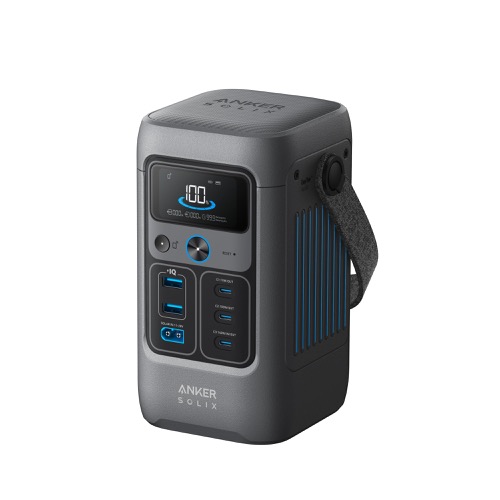
What you get
The cells are LiFePO4 rated at 3,000 cycles, the same long-life chemistry as the serious stations, with smart temperature control, impact resistance and a 3-year warranty behind them. At a verified 1.9kg and 10 x 11 x 18.5cm (Anker's UK spec sheet), it is the lightest unit we cover by some margin; the DC-only approach is why: with no inverter inside there is less to house, less to pay for and less stored energy wasted as conversion heat.
Output is 200W in total, and the port mix is the selling point at this price: the 140W port is two-way, so the same socket that fast-charges a MacBook also recharges the unit itself. Plug it into any 100W USB-C wall charger (18W is the minimum it accepts; the right charger is not in the box, so budget for one if you own nothing suitable) and it reaches 80% in about 1.3 hours by Anker's figures.
The solar gotcha
Worth pausing on, because it is counterintuitive: the C200 DC takes up to 100W of solar input, but not from Anker's own SOLIX PS30 panel, nor the PS200 or PS400, nor any basic 5V USB-C panel. Anker states this plainly in the listing and plenty of buyers will miss it. If your preparedness plan is "small panel tops up the battery", pair the PS30 with your power banks instead, and feed the C200 DC from a panel with proper high-voltage USB-C PD output. We cover the pairings in the solar section of this cluster.
Check today's price on AmazonWhat can 192Wh actually run?
In power bank language this is a 52,000mAh battery, and DC-only means barely anything is lost in conversion. Realistic yardsticks: eight to ten phone charges, two to three laptop charges, a USB-powered light for several nights, a dashcam or camera rig for a long weekend. It will not run anything with a mains plug, there is no socket, and at 192Wh it is a keep-devices-alive unit rather than a run-appliances one. For the Be Ready 3-day household yardstick, think of it as the family's shared phone-and-laptop reserve.
The honest cons
The missing mains socket is the obvious one, and the same empty-your-kit-bag test applies as ever: one three-pin dependency and you want the C300X (£249) or Jackery 240 v2 (£259) instead.
Capacity-per-pound, it faces a strong rival from Jackery: the Explorer 300D offers 288Wh and twin 140W ports for £169, though at 2.5kg it concedes the weight crown to the 1.9kg Anker. The C200 DC counters at a lower absolute price with Anker's bigger review base. And like all of this class it cannot fly; the biggest flight-legal battery remains a 27,000mAh bank like the Anker Prime 26K.
Where it fits
This is the bridge product. Below it sit the true power banks, the Anker 25K at £69.98 being our family pick; above it the C300 pair add capacity and (in the X) a mains socket; and beyond that the 1kWh class starts running appliances. The C200 DC is the first rung where "battery" stops meaning pocket kit and starts meaning household resilience, and £129 is the cheapest that rung has ever been from a brand with this safety record. The finder will tell you if it is your rung.
Specs at a glance
Anker's claimed figures from the UK listing, price from our 30 October 2026 check:
| Spec | Anker SOLIX C200 DC |
|---|---|
| Capacity | 192Wh LiFePO4 (~52,000mAh equivalent; 3,000 cycles) |
| Output | 200W DC total |
| Ports | USB-C 140W (two-way), USB-C 100W, USB-C 15W, 2× USB-A 12W |
| AC socket | None, DC only |
| Weight | 1.9kg (10 × 11 × 18.5cm) |
| Recharge | 80% in ~1.3 hours via USB-C PD (18W minimum input, charger not included) |
| Solar | Up to 100W, NOT compatible with Anker PS30/PS200/PS400 or 5V USB-C panels |
| Protection | Smart temperature control, impact resistance |
| Warranty | 3 years |
| Price | £129 |
Verdict
The Anker SOLIX C200 DC is the best £129 in the small-battery market for USB-C households, and judging it is simple: it is double the capacity of the biggest legal power bank, from a brand with a real safety record and warranty, at a price that makes "one for the power-cut drawer" a reasonable decision rather than an indulgence. Mind the solar pairing gotcha, accept that plugs are not its business, and it is exactly what the bottom of the power-station ladder should look like. If £40 more is available, weigh the Jackery 300D's extra 96Wh first; if the answer is still Anker, buy with confidence.