


Quick verdict
The Arc'teryx Thorium is a rugged down insulated jacket built for warmth when you stop moving, the tougher, more weather-tolerant sibling of the lighter Cerium. It uses 750 fill-power down with a durable 30D shell and synthetic Coreloft mapped into the damp-prone zones, so it keeps working where pure down fails. The men's Thorium Hoody (around £450, 598g) is the warm, hooded flagship; the hoodless men's Thorium Jacket (around £400, 526g) layers under a shell. Women get the Thorium Jacket (around £400) and a Thorium Vest (around £320). It is not waterproof: wear it over your layers at belays, cold summits and camp, and under a shell when the rain comes.
Arc'teryx Thorium Hoody: 4.6/5
A 750-fill down jacket that stays sensible in the damp: Arc'teryx maps synthetic insulation into the cuffs, hem and underarms so the jacket keeps performing where pure down would fail. The tough, warm layer for cold belays, cold summits and cold camp evenings.
- Hoodless, lighter: Arc'teryx Thorium Jacket (~£400)
- Active midlayer instead: Arc'teryx Atom Hoody (~£260)
The full review is below.
The Arc'teryx Thorium is a down insulated jacket built to keep you warm when you have stopped moving, and it is the rugged, damp-tolerant one in the Arc'teryx down range. It uses warm 750-fill-power goose down, but the detail that makes it work in Britain is a tough 30D shell and synthetic insulation mapped into the zones that get damp. This is not a waterproof, and it is not a jacket to sweat in on the climb. It is a warmth layer, and judged as one it is one of the most sensible down jackets you can buy for the UK hills.
This guide is a spoke off our full Arc'teryx jackets explained hub, where the Thorium sits alongside the Beta shells, the Atom midlayers and the lighter Cerium down. If you already know you want warmth at rest, read on.
Which Arc'teryx Thorium should you buy?
For most people the Thorium Hoody (~£450) is the one to buy. The insulated hood adds real warmth around the head and neck exactly when you are stationary and cold, which is the whole point of the jacket. It is the warm, hooded flagship: cold belays, cold summits, the hour after you pitch camp.
Buy the hoodless Thorium Jacket (~£400) instead if you already run a shell or a helmet hood and do not want a second one, or if you just prefer a cleaner layer under a shell. It is a little lighter and saves the hood you may not need. Women's buyers get the Thorium Jacket and a core-only Thorium Vest (~£320).
What the Arc'teryx Thorium actually is
The Thorium is Arc'teryx's rugged down jacket, and it does a very specific job: it keeps you warm once you have stopped. It uses 750-fill-power goose down through the body and sleeves, so the warmth-to-weight is still excellent, but it pairs that down with a tougher 30D face fabric and generous synthetic insulation in the damp-prone zones. That is the trade it makes against the lighter Cerium: a bit more weight, a lot more durability and damp-tolerance.
Down collapses and stops insulating when it gets wet, which is the classic failure mode of a down jacket in a damp climate. The Thorium hedges that, so it carries on performing where a pure-down design would quietly fail. It is not waterproof and no amount of DWR changes that; in sustained rain you wear it under a shell. Think of it as the warm layer you carry and deploy, not the layer you march in.
Arc'teryx Thorium Hoody
The Thorium Hoody (~£450) is the flagship and the right call for most buyers. It runs 750-fill down with the tough 30D Toray mini-ripstop shell, weighs around 598g, and adds an insulated, adjustable hood cut to work over a beanie and seal warmth around the neck.


This is the warm jacket that lives in the top of the pack for when you stop: the piece you pull on at the trig point while you eat, at the belay while your partner leads, or in camp once the walking heat has drained out of you. It is warmth you carry and deploy, not warmth you hike in. For cold-but-dry conditions, a frosty start, a still clear summit, a stationary crag session, it is also a superb outer layer, the down lofting up and holding a big cushion of warm air for very little weight.
Buy the Thorium Hoody direct at Arc'teryxArc'teryx Thorium Hoody, Jacket or Vest?
The Thorium line is smaller than the Cerium's, and the forms split by gender in the current range, worth knowing before you shop.
Men get the Hoody and the hoodless Jacket. The only real difference is the hood (and a little weight: around 598g for the Hoody against 526g for the Jacket). Choose the Thorium Jacket (~£400) if you layer under a shell or helmet that already has a hood, or simply do not want a second one.


Women get the Thorium Jacket (~£400) and a Thorium Vest (~£320), the vest dropping the sleeves for core-only down warmth as a layering piece. There is no men's vest and no women's hooded Thorium in the current line; if you want a hood, men choose the Hoody, and women cross-shop the hooded Cerium instead.
Women's Arc'teryx Thorium range
The women's Thorium comes on a women's-specific cut with the same 750-fill down and Down Composite Mapping, in two forms:
- The women's Thorium Jacket (~£400) is the warm, hoodless down jacket, around 430g, with heavier Coreloft mapped into the moisture zones.
- The women's Thorium Vest (~£320) gives core-only down warmth for layering, around 290g.
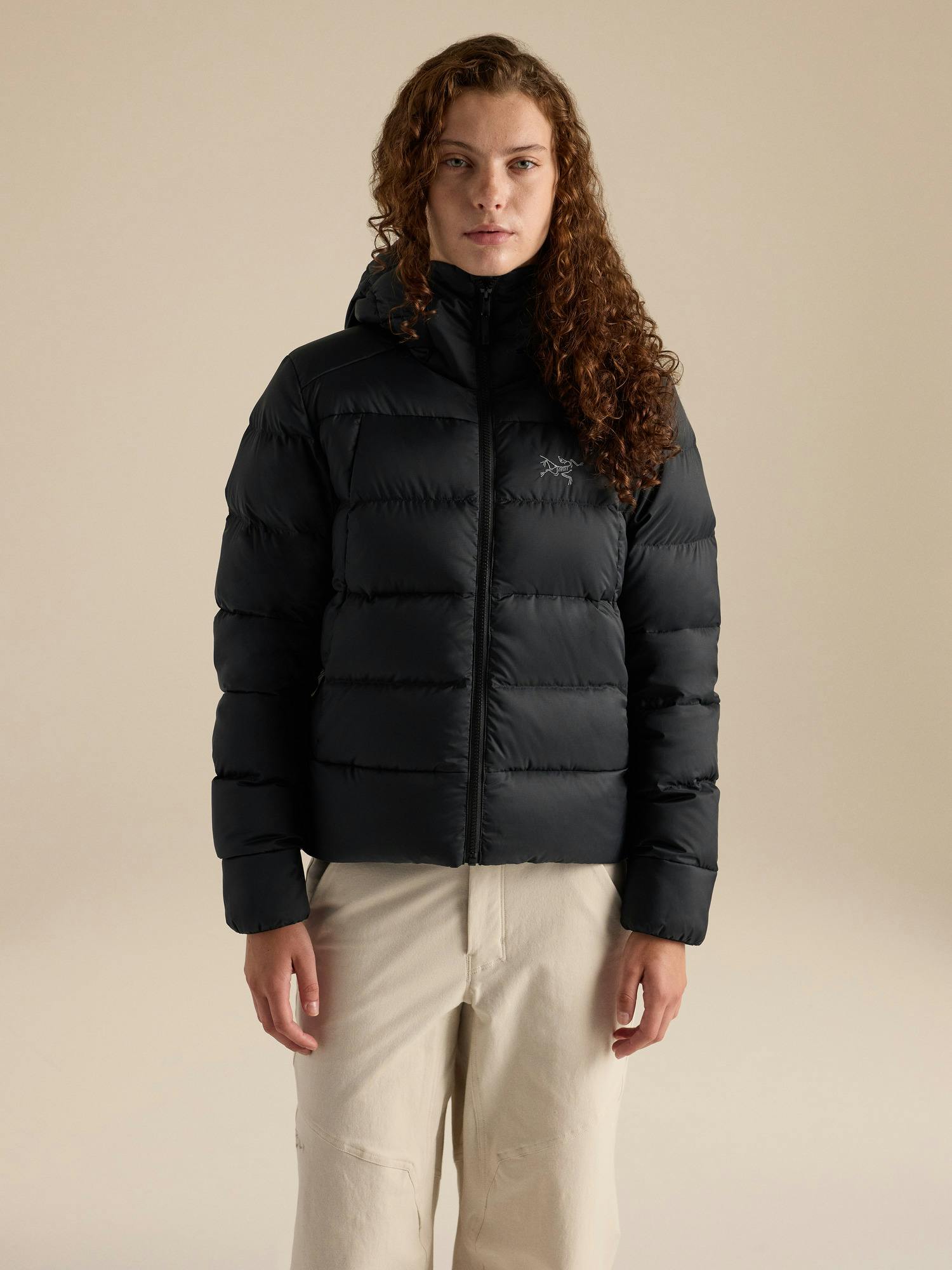
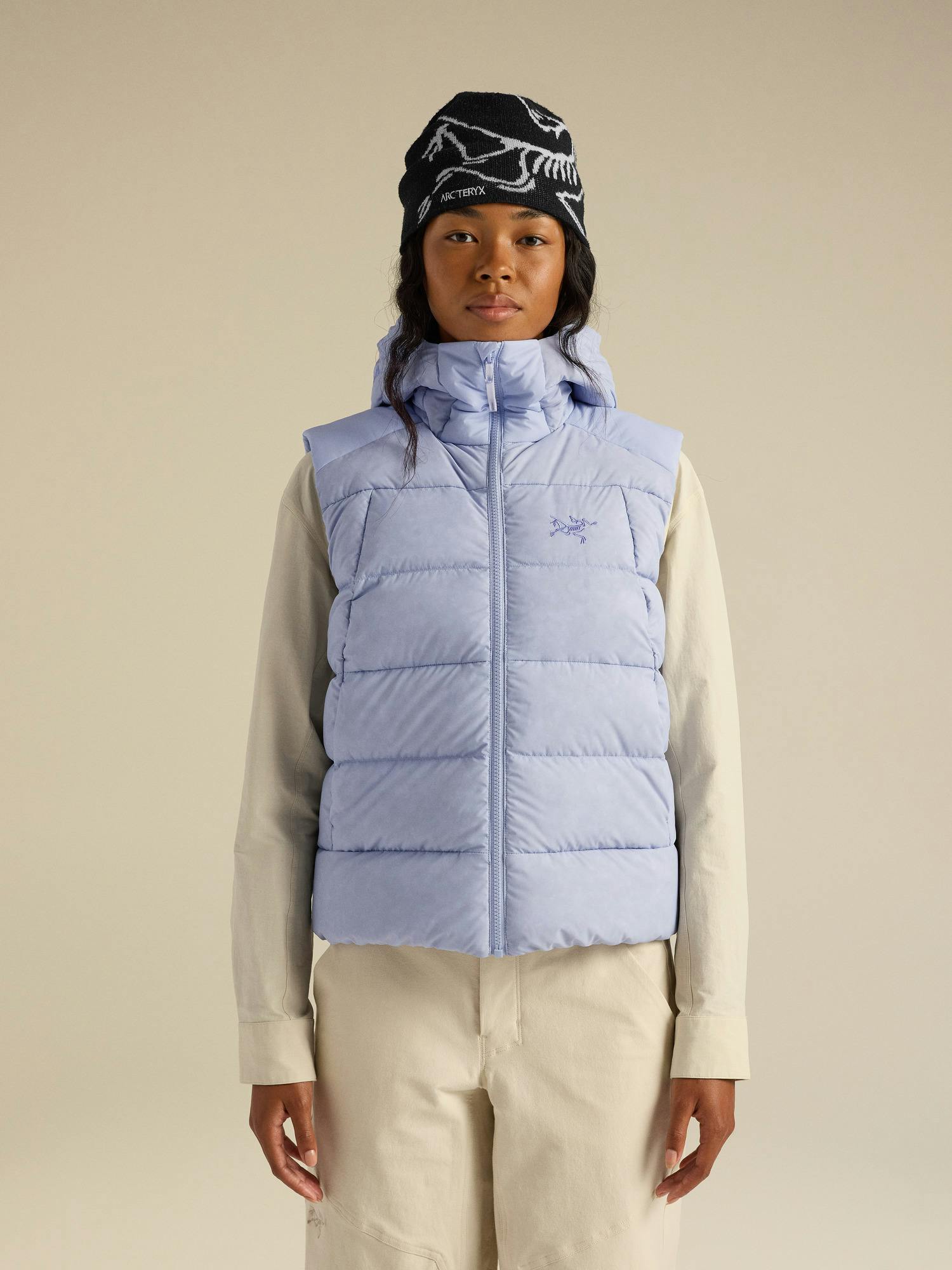
The Arc'teryx Thorium's down and Down Composite Mapping
The body and sleeves are filled with 750-fill-power goose down. Fill power measures how much a given weight of down lofts, so a higher number means more warmth for less weight. At 750 the Thorium is warm and light without straying into the ultra-premium, ultra-fragile territory of the highest fill powers. It is a sensible, hard-wearing grade of down for a jacket that is going to get real use.
The clever part is what Arc'teryx does in the damp-prone zones, the cuffs, hem, underarms and hood edge. Those are the spots that wet out first, and wet down collapses and stops insulating. So instead of running down all the way out to those areas, Arc'teryx maps synthetic Coreloft into them. Synthetic keeps lofting even when it is damp, so the jacket carries on performing exactly where a pure-down design would be quietly failing. Arc'teryx calls this Down Composite Mapping, and it is the single reason the Thorium makes more sense in Britain than a lot of pure-down rivals.
If you want to go deeper on down versus synthetic for UK conditions, and on the Rab down jackets that compete with the Thorium (the Microlight Alpine, Electron Pro and Nebitron Pro), our Rab insulated jackets guide is the piece to read next.
Arc'teryx Thorium vs Cerium
The Thorium and the Cerium are the two down jackets in the Arc'teryx range, and they are built for different priorities. The Thorium Hoody runs 750-fill down in a tough 30D shell at around 598g; the Cerium Hoody runs loftier 850-fill down in a lighter 15D shell at around 338g. In other words the Cerium is the lighter, more packable, warmer-for-weight one, and the Thorium is the tougher, more weather-tolerant, more durable one, with more synthetic in the exposed zones.
Choose the Cerium when warmth-to-weight and pack size matter most and you can keep it dry, a fast-and-light summit layer. Choose the Thorium when conditions are damper or rougher and you want a down jacket you are not babying, a belay jacket, a knockabout camp layer, a piece that takes pack straps and crag abrasion without complaint. Both want keeping dry under a shell in real rain; the Thorium just copes better when things get damp.
Arc'teryx Thorium pros and cons
- Excellent warmth-to-weight from 750-fill goose down
- Tough 30D shell and synthetic-mapped wear zones shrug off damp and abrasion
- Insulated, adjustable hood on the flagship Hoody
- Trim, well-cut Arc'teryx fit that layers cleanly under a shell
- The most damp-tolerant, hard-wearing down jacket in the Arc'teryx range for UK use
- Heavier and bulkier than the lighter Cerium for the same warmth
- Expensive next to warm down rivals from Rab and others
- Not waterproof, and down needs keeping dry under a shell in rain
- Wrong tool for high-output moving; that is the Atom's job


