


Quick answer
Our pick: YQXCC Cooling Towels (2-pack)
- Best cooling towel: YQXCC Neck Towel (2-pack) (~£10)
- Best sunglasses: Ray-Ban RB4468 (~£145)
- Sun hat: Adidas Adizero CLIMACOOL Cap (~£25)
The full reasoning, and everything we ruled out, is below.
Staying hydrated is one half of hiking safely in a heatwave. Not overheating in the first place is the other, and it is the half people plan for least. You can drink perfectly and still cook yourself by walking up a south-facing chalk slope at one in the afternoon in full sun.
This is how I stay cool on the trail when the UK turns properly hot. Most of it is tactics, timing, shade and water on your skin, and costs nothing. A little of it is kit, and I have kept that to the few things I actually use: a cheap cooling towel, the sunglasses that never leave my bag, and a hat that does its job. The hydration side of the same problem is covered in its own guide, staying hydrated on the trail in a heatwave, and the two go hand in hand. Keeping your drinks and picnic cold back at the car or camp is a separate job again, and that is what a cool box is for.
Start early, rest through the midday peak
The simplest way to stay cool is to not be walking through the hottest part of the day.
In a UK heatwave the peak runs roughly from midday to four in the afternoon. If I can, I start a hot walk early, first thing, when the air is still cool and the sun is low, and I get the hard climbing done before it bites. Then I treat the middle of the day as a rest window rather than a push window. A long lunch in the shade, feet up, is not lost time on a scorching day. It is the smart move.
If a walk has to run through the middle of the day, I slow the pace right down. Heat and effort stack up, and the same climb that is fine at nine in the morning will empty you at two in the afternoon. There is no medal for maintaining your usual pace in 30-degree heat.
Use shade as a strategy, not an accident
Shade is not something you stumble into, it is something you plan around.
On the hottest days I pick routes with tree cover rather than exposed ridgelines and open coast. The New Forest is my go-to for exactly this, forest canopy for most of the way and only short open sections. An exposed coast path with the sun hammering down and light bouncing off the sea is a completely different proposition, and I save those walks for cooler, brighter days rather than heatwave days.
When you do stop, stop in shade deliberately. Toughing out a rest break in full sun to save two minutes finding a tree is a false economy. Get out of the direct sun, let your core temperature drop, then carry on.
Wet a cap or buff and soak it in a stream
Water on your skin is one of the fastest ways to shed heat, because as it evaporates it pulls heat out with it.
If I pass a stream or a tap on a hot walk, I soak my cap or a buff and put it straight back on. A wet buff round the neck, over the big blood vessels there, cools you down noticeably as it dries. On a hot day I will re-wet it at every water source I pass. It is free, it works, and it buys you a good stretch of cooler walking each time.
The cap I actually reach for is the Adidas Adizero Climacool cap, and it is made for exactly this. It is a low-profile running cap in lightweight ventilated mesh, so you can genuinely feel the breeze coming through it, and it sits close to your head without ever feeling like it traps heat. Best of all it dries in minutes, so a quick rinse in a stream to flush the sweat out and it is straight back on. I flip it backwards when the sun swings round onto the back of my neck, which is an easy place to burn if you are not paying attention. It keeps the sun off my head and keeps me cool, though for proper UV cover on an exposed day a brimmed hat does more, which I get into in the sun protection guide.


The New Forest trails are ideal for this because of the rivers and streams. My Brockenhurst tall trees trail guide runs through exactly this kind of shaded, river-crossed woodland, the sort of route I pick on the hottest days. Dunking a buff, and dangling your feet in the cold water while you are at it, does more for your core temperature than almost anything else out there.
Cooling towels round the neck
When there is no stream to rely on, a dedicated cooling towel does the same job on demand.
The one I would point most people to is the YQXCC microfibre cooling towel, which comes as a two-pack with a little pouch and a carabiner clip so it hangs off the outside of the pack. You wet it, wring it out, give it a snap, and drape it round your neck. The microfibre holds the water and the evaporation keeps you cool for a good while before it needs re-wetting. It is a popular, well-reviewed choice, and having used one I understand why. It is cheap, it packs to nothing, and on a hot exposed stretch it makes a real difference.
No comparison table needed for this one. It is a tenner, it works, buy it and clip it to your bag.
Buy the YQXCC Cooling Towels on Amazon


Sunglasses: why they live in my bag
This one is personal, and it is not optional for me.
I wear contact lenses on the trail, and that changes the sunglasses question entirely. Without lenses I could squint through a bright day if I had to. With contacts in, bright sun and glare are properly uncomfortable, and my eyes dry out faster, so sunglasses are not a nice-to-have. They live permanently in my bag and they come out the moment the sun does. On the coast especially, where hard light bounces off the water all day, a polarised lens is the difference between an enjoyable walk and a headache by lunchtime.
My pick is the Ray-Ban RB4468, which I actually wear. Blacks stock them, which is where I would buy. They are not the cheapest option, but they are the ones on my face, and a good lens matters more here than almost anywhere.
Buy the Ray-Ban RB4468 at GO OutdoorsOne habit worth copying if you also wear contacts: I carry my normal glasses as a backup on long walks, or on any walk that might run into dusk. Walking in sunglasses once the light goes is no good, and contact lenses can dry out and turn scratchy after a very long day. Having my glasses in the bag means I can drop the lenses out and still see properly for the walk home. It is a small thing that has saved a couple of long evenings.
If you want to browse a few styles before you decide, Blacks carry a range worth a look.
A sun hat that actually shades you
A cap keeps the sun off your face, and a wide-brim hat keeps it off your ears and the back of your neck too, which is where a lot of hot-day sunburn actually happens.
For a hot-weather cap, the Adidas Adizero Lightweight CLIMACOOL Cap is a smart pick: a pre-curved brim to cut the glare, laser-cut perforations and moisture-wicking HEAT.RDY fabric to keep your head cool, and an adjustable back so one size fits most.
Buy the Adidas Adizero cap on Amazon Or buy at BlacksWhatever you go for, a light colour beats a dark one in the sun, and something you can wet at a stream doubles up nicely with the cap-soaking trick above. For more on caps, sunglasses and the rest of my warm-weather kit, my summer day walk packing list goes through the full bag.
When cooling is not enough: spotting heatstroke
Get the tactics above right and you should stay well clear of trouble. But it is worth knowing where overheating leads if it is ignored, because heatstroke is a medical emergency and it can be life-threatening.
Heat exhaustion is the warning stage: heavy sweating, headache, dizziness, cramp and feeling washed out. Stop, get into shade, cool down and drink water with electrolytes and you will usually recover quickly. Heatstroke is different and serious: if someone stops sweating, becomes confused or drowsy, or their skin is hot and they are clearly not right, treat it as an emergency. Call 999, move them into shade, get ice packs or frozen water bottles onto the neck, armpits and groin, wet their skin and fan them, and give small sips of cool water only if they are fully alert. Stay with them, and do not give paracetamol or ibuprofen. The British Red Cross has a simple guide to treating heatstroke worth a quick read. There is more on heat and hydration, including what I keep in my first aid kit, in the hydration guide.
Staying cool gets harder with age
Worth a short note, because it is real. Your body handles heat less efficiently as you get older. Sweat response drops and blood flow to the skin reduces, so you shed heat more slowly than you did in your twenties. The changes begin gradually from around your forties, and they mean the tactics on this page matter more, not less, the older you get.
If you want the detail, the physiology sits in the hydration guide, which is written for exactly this. See the over-40 section in staying hydrated on the trail in a heatwave, and if you are on regular medication read the note there about heat tolerance and speaking to your GP.
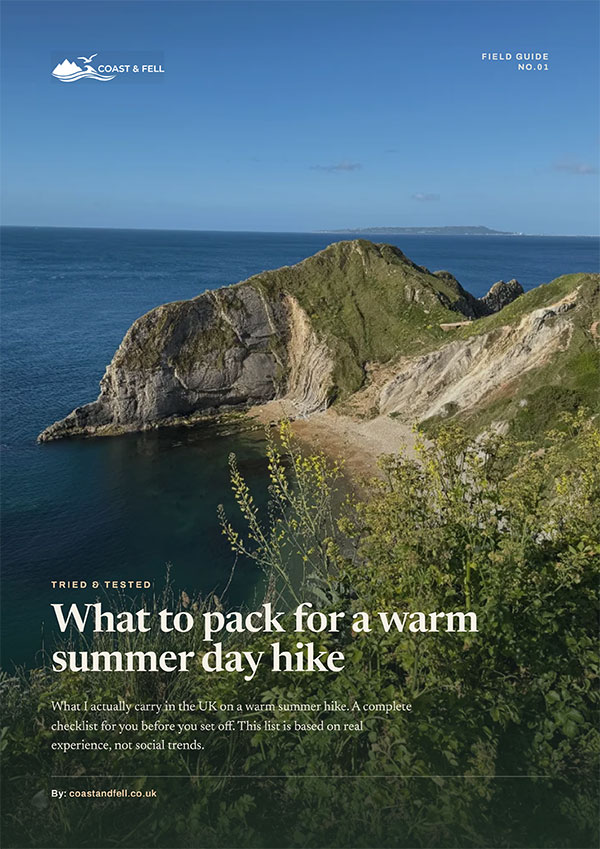
Free printable guide
What to pack for a warm summer day hike
My full warm-weather day-walk kit list as a printable PDF: what I carry, what I leave at home, and how to pack it. The honest article distilled onto a page you can take with you.
FAQ
What is the best way to stay cool while hiking in hot weather?
Do cooling towels actually work?
Should I wear sunglasses hiking?
Why does heat feel harder to cope with as you get older?
Staying cool is mostly about decisions you make before you overheat, not after. Start early, plan for shade, get water on your skin, and keep the sun out of your eyes. Do that and a hot day on the trail stays a good day. Then read the other half of the job, staying hydrated on the trail in a heatwave, because cool and hydrated are the same problem from two angles.