


Quick verdict
Garmin Fenix 8 Solar: 4.7/5
The benchmark GPS watch for serious UK hikers. Multi-day battery, preloaded topo maps, multi-band GPS. The watch that makes battery anxiety irrelevant.
The full review is below.
A disclosure worth reading first
I haven't yet worn the Fenix 8 Solar on trail. What follows is based on extensive research across independent reviews and manufacturer specifications, plus context from three years of daily use with the Apple Watch Ultra 3 — the watch I'm considering replacing.
The full hands-on review will update this piece once I've spent meaningful time on trail with it. At that point, real-world battery numbers, GPS track comparisons, and how the solar lens behaves on a grey Purbeck morning will replace the research-based sections below.
This framing is intentional. A review that presents research as first-hand experience would be doing you a disservice. If you want to know what I've personally verified: I've verified the specs, the independent reviewer consensus, and the manufacturer's published data. That's what this is built from.
Why I'm researching this watch
The reason is specific: battery life.
I've worn an Apple Watch Ultra since launch. The Ultra 3 is the current version on my wrist. It handles hiking GPS, health monitoring, daily payments and phone independence well enough that I've pushed my thinking about the Fenix 8 Solar off for three years.
What keeps bringing me back to it is the battery situation on long days. On a 35km walk — the kind of distance I cover on a big South Downs Way section or a long circuit around the Purbeck ridge — the Ultra 3 needs external power. I carry an Anker MagSafe power bank in my lid pocket, snap it to the watch, and it charges on the move. The system works. But it is a system, and the Fenix 8 Solar's 52 hours of GPS recording without any external power represents a fundamentally different approach.
The question I'm trying to answer is whether what I'd gain in battery independence justifies what I'd lose in daily life integration. This review is the research phase of that decision.
Quick verdict
- 52 hours GPS / up to 92 hours with solar — multi-day capable without power banks
- Preloaded TopoActive European topo maps with 32GB storage
- Multi-band GPS across all major satellite constellations
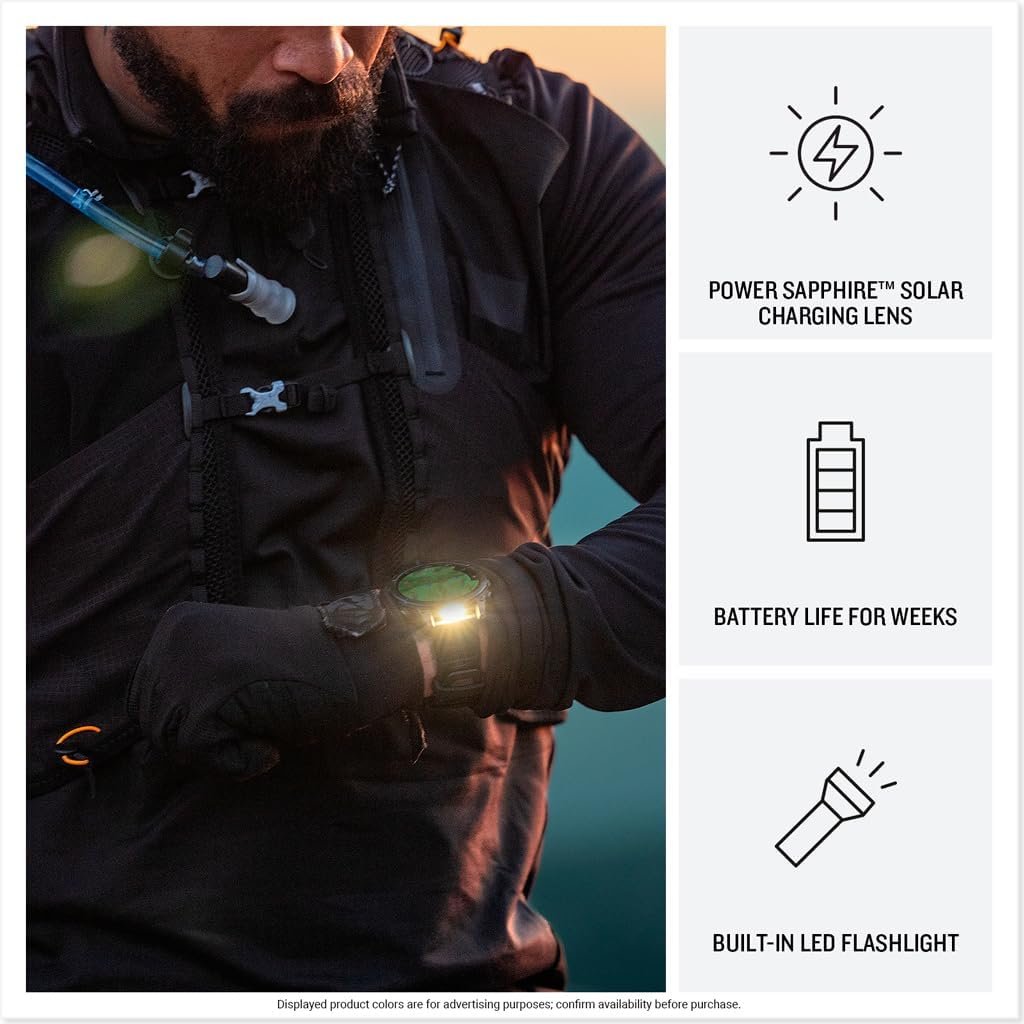
- Built-in LED torch with spotlight and strobe modes
- 100m water resistance (10ATM) with sapphire lens and titanium case
- Dive rated — unusually capable for multi-activity outdoor use
- Voice commands via built-in speaker and mic
- Garmin's mature Connect ecosystem with deep training and health analysis
- ~£870 — significant investment, though consistent with category pricing
- Solar gain in UK overcast conditions is substantially below manufacturer claims
- 65g and a 47mm case — larger and heavier than a running watch
- No Apple Pay or Google Pay — limited contactless payment options
- Garmin Pay has limited UK bank support compared to Apple Pay
- Switching from Apple Watch Ultra means losing the Apple ecosystem entirely
Who is this for?
The Fenix 8 Solar is the right watch if two or more of the following are true:
You regularly hike for more than 14 hours in a single day. You do multi-day routes where charging access is uncertain. You want to navigate directly from the watch using proper topo maps rather than a breadcrumb trail. You're not embedded in the Apple ecosystem, or you're willing to leave it. You want one watch that also works for diving, trail running and other activities without compromise.
It is not the right watch if you're primarily an iPhone user who wants ecosystem integration, if you're doing mainly shorter day walks of under 25km on well-signed routes, or if the £870 price point is a stretch — the Coros Apex 4 delivers comparable GPS and battery at half the cost.
Specifications
- Case
- 47mm titanium — ~65g with band (DLC coating on carbon grey variant)
- Display
- 1.3-inch MIP solar lens, sapphire crystal
- Battery GPS
- 52h standard · up to 92h with solar
- Battery watch
- Up to 28 days · up to 90 days with solar
- GPS
- Multi-band multi-GNSS — GPS, GLONASS, Galileo, QZSS, BeiDou
- Maps
- TopoActive European topo maps, 32GB storage
- Water resistance
- 100m (10ATM) — dive rated
- Torch
- Built-in LED, spotlight and strobe
- Payments
- Garmin Pay
- UK price
- ~£870
Note on AMOLED vs Solar: Garmin makes the Fenix 8 in both a Solar MIP screen version and a separate AMOLED version. The AMOLED has a more vivid display and higher brightness in dim conditions but significantly shorter battery life. For hiking, the Solar MIP version is the right choice — the battery gain is substantial and the MIP screen is readable in direct sunlight in a way the AMOLED sometimes isn't.
GPS accuracy and navigation
The Fenix 8 Solar uses multi-band GNSS — pulling signals from multiple satellite constellations simultaneously across the L1 and L5 frequency bands. This is the same specification as the Apple Watch Ultra 3 on paper, and independent reviews confirm the real-world accuracy is comparable to any watch in this category.
Multi-band GPS matters most in the conditions that UK hikers regularly encounter: dense conifer forest, steep-sided valleys, urban trailheads near tall buildings. Single-band GPS drops accuracy in these environments because signal reflections from nearby surfaces corrupt the position calculation. Multi-band GPS rejects those reflections by comparing signals across two frequencies, resulting in a cleaner track. The difference is visible in a forest track: a multi-band watch produces a tight, accurate trace; a single-band watch wanders.
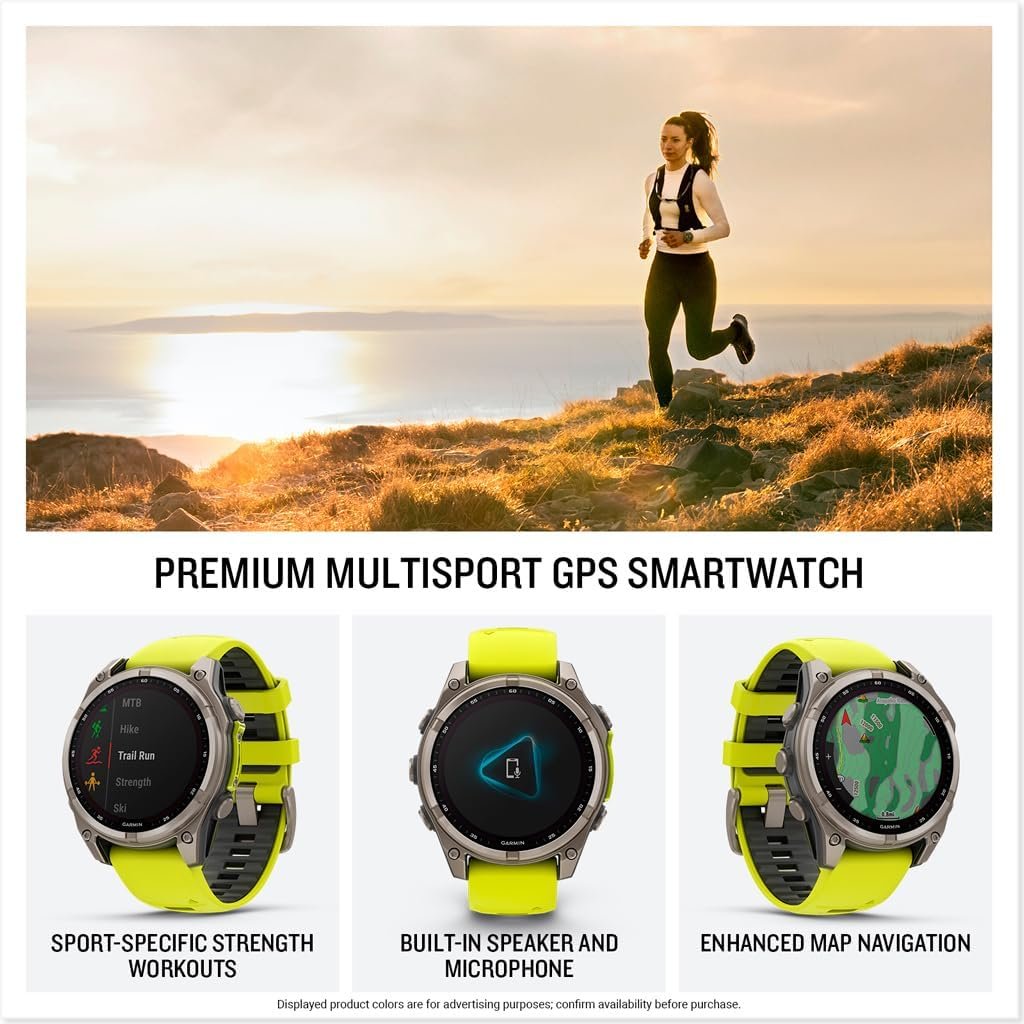
Where the Fenix 8 Solar separates itself from the Ultra 3 is the preloaded TopoActive European mapping. These are proper topographic maps — contours, trails, peaks, features — stored on 32GB of internal memory. You can load a GPX route onto the watch and navigate turn-by-turn from the wrist. On an unfamiliar ridge in the Brecon Beacons, you can check the topo without reaching for your phone. In conditions that compromise phone use — heavy rain, cold hands, flat phone battery — having the map on your wrist is a meaningful safety advantage.
The Fenix 8 Solar also has a built-in barometric altimeter, which provides more accurate elevation data than GPS altitude alone. On a day with changing weather — which is to say, most UK hiking days — the barometric altimeter tracks real elevation changes while GPS altitude can drift due to atmospheric pressure variation. For serious navigation where elevation reading matters, this is a tangible improvement over the Ultra 3.
Battery life
The headline figures: 52 hours in GPS mode (without solar), up to 92 hours with solar input. In smartwatch mode without GPS tracking: up to 28 days without solar, up to 90 days with solar.
The 52-hour GPS figure is the one that matters for most hikers. It means a full 14-hour hiking day leaves the Fenix 8 Solar at roughly 73% battery. A 25-hour hiking day across two days of a multi-day route still leaves you with a significant reserve. You could hike for three full 15-hour days without charging and still have meaningful battery remaining.
Compare that to the Apple Watch Ultra 3's 14-hour GPS figure and the difference is a different category of experience. The Ultra 3 requires active battery management on long days. The Fenix 8 Solar doesn't.
Real-world reports from independent reviewers confirm Garmin's GPS battery claims are accurate within a reasonable margin. The 52 hours assumes multi-band GPS, heart rate monitoring and typical screen interaction. Pushing all systems harder — more frequent GPS polling, always-on display — reduces battery. Running in a GPS-only reduced mode extends it. Most users report real-world GPS performance close to the stated figures.
Solar charging in the UK
This is the section where I need to be direct about what Garmin's solar specs actually mean in practice for a UK hiker.
Garmin's solar figures assume 50,000 lux of light intensity for three hours per day. That is direct midday sunlight in clear conditions — the kind of light you get on a cloudless summer day with the sun directly overhead. In those conditions, the solar lens adds meaningful runtime to the battery.
UK conditions are frequently not that. A February day in the Peak District runs at 10,000-20,000 lux at best. An overcast summer day on the South Downs might hit 25,000 lux. Cloud cover dramatically reduces lux levels. Your jacket sleeve over the watch face contributes nothing.
In practice, the solar advantage in the UK is most meaningful in summer, on exposed terrain, on clear days. It extends battery life — independent reviewers consistently note real battery improvement in good conditions — but the contribution is a supplement, not a transformation.
The right way to think about the Fenix 8 Solar in a UK context: buy it for the 52-hour base GPS battery, not for the solar extension. If the solar lens adds an extra day of smartwatch battery over the course of a sunny hiking week, that's a genuine benefit. Expecting the battery figures to meaningfully approach 92 hours on a standard UK hiking week requires conditions that the UK does not reliably deliver.
Build quality and durability
Independent reviews are consistent: this watch is built to take punishment that few users will realistically inflict on it.
The case is titanium — the Carbon Gray DLC variant has an additional diamond-like carbon coating for scratch resistance. The display is protected by sapphire crystal, which is meaningfully harder than mineral glass and largely scratch-resistant under normal outdoor use. The watch is 10ATM water resistant and dive-rated to 40 metres, which means it can handle any water encounter you're likely to have while hiking in the UK.
The build is not subtle. The Fenix 8 is a substantial watch — 47mm across, sapphire lens, raised crown and action button. It looks like what it is: a piece of field equipment. For some hikers this is entirely appropriate. For others who want a watch that reads as a dress watch at dinner as well as a trail watch, the Fenix 8 requires some tolerance for a certain aesthetic.
The strap ecosystem is wide. Garmin's QuickFit system lets you swap bands in seconds without tools. The range of bands from Garmin and third-party makers means the watch can be configured for different uses — UltraFit nylon for long hiking days, silicone for running, leather for daily wear.
Daily wearability
This is the section I'm most honest about from a position of research rather than experience: the Fenix 8 Solar is a larger, heavier, more purposeful device than the Apple Watch Ultra 3, and that affects daily wearability.
At 47mm and 65g (with the standard silicone band), the Fenix 8 is not small. Independent reviews consistently note that it reads as a serious sports watch on the wrist — no-one mistakes it for a fashion watch. If you're wearing it to work in an office context, it makes a statement about your priorities.
The MIP solar display is readable in direct sunlight and dim conditions, but it is not as visually polished as the Ultra 3's AMOLED Retina display. The menus and interface are Garmin's Connect IQ ecosystem, which is functional and deep but has a steeper learning curve than watchOS.
Garmin Pay is available on the Fenix 8 Solar, but UK bank support is less comprehensive than Apple Pay. Most major UK banks work with Garmin Pay — Barclays, HSBC, NatWest, Santander, Monzo — but the coverage is not universal. Check your bank before assuming contactless payments will work.
The watch has a built-in speaker and microphone for voice commands and Bluetooth calls. This capability is less mature than Apple's equivalent on the Ultra 3, but the speaker and mic are functional for basic voice interactions.
Value
At ~£870, the Fenix 8 Solar 47mm sits at the premium end of hiking GPS watches. It is broadly comparable in price to the Apple Watch Ultra 3 (from £749) and the Garmin Enduro 3 (~£769).
The Coros Apex 4 at £429 delivers similar GPS accuracy, comparable battery life (65 hours vs 52 hours), and offline topo maps at roughly half the price. The case for the Fenix 8 Solar over the Apex 4 is the Garmin ecosystem depth, the more mature software, the 10ATM dive rating, the built-in torch, and the brand confidence from a long track record in serious outdoor electronics.
For a hiker who wants the most established, most deeply supported, most fully-featured dedicated hiking GPS watch available, the Fenix 8 Solar justifies its price. For a hiker who wants excellent GPS performance and long battery at the lowest possible cost, the Coros Apex 4 is the honest answer.
Fenix 8 Solar vs Apple Watch Ultra 3
See the Apple Watch Ultra 3 review for the full comparison from the Ultra 3 side. Here is the Fenix 8 perspective:
What the Fenix 8 Solar wins:
Battery life, clearly and substantially. Preloaded topo maps for wrist-based navigation. Barometric altimeter for more accurate elevation data. 10ATM dive rating. Solar charging for extended battery in good conditions. No dependency on any phone ecosystem.
What the Apple Watch Ultra 3 wins:
Daily life integration — Apple Pay that works everywhere, phone calls via the watch, seamless iPhone notifications. Health monitoring breadth — ECG, crash detection, irregular rhythm alerts. App ecosystem. The ability to leave your phone at home. The 3,000-nit AMOLED display. The fact that if you're already an iPhone user, the Ultra 3 is the watch you already know how to use.
The honest summary:
For a hiker who wants the best hiking device and is prepared to lose some daily life convenience, the Fenix 8 Solar is the answer. For a hiker who wants the best daily device that also does excellent hiking GPS, the Ultra 3 is the answer.
Both cost around £750-870. Neither is the wrong choice for a serious hiker. They serve different primary purposes.
Should you buy it?
Buy the Garmin Fenix 8 Solar if:
- Multi-day battery without a charger is important — multi-day routes, remote terrain, extended expeditions
- You want proper topo maps navigable from the wrist
- You're not embedded in the Apple ecosystem, or you're willing to leave it
- You want the most capable dedicated hiking GPS watch available at this size
- You dive, or want the option to dive
Don't buy it if:
- You're an iPhone user who relies heavily on Apple Pay, ecosystem integration and phone independence
- Your walks are primarily day routes under 25km on well-signed paths — the Coros Apex 4 delivers the hiking essentials for £440 less
- Budget is a constraint — the Garmin Forerunner 970 gives you Garmin's GPS and map capability at ~£600
- You're deep in the Apple ecosystem — the Apple Watch Ultra 3 is the better daily device
Verdict
Based on the research and independent review consensus, the Garmin Fenix 8 Solar earns 4.7 out of 5 for hiking use. It is the most capable dedicated hiking GPS watch available in a wearable size. The battery life removes one of the main anxieties of serious hiking. The preloaded topo maps change what's possible from the wrist. The build quality is appropriate for the price.
The 0.3 deducted reflects the solar marketing that overstates real-world UK conditions, the premium price relative to the Coros Apex 4, and the daily life capability that trails the Apple Watch Ultra 3.
Once hands-on trail time has been logged, this review will update with real GPS comparisons, real battery numbers and real solar gain figures from UK conditions.
Buy Garmin Fenix 8 Solar on AmazonBuying guide
47mm vs 51mm: The 47mm is the right size for most wrists — large enough to be a proper navigation device, small enough to wear all day. The 51mm has longer battery (up to 92 hours GPS with solar on the 51mm vs the 47mm figures above) but is significantly larger. Unless battery runtime is a hard requirement, the 47mm is the more wearable option.
Solar MIP vs AMOLED: For hiking, buy the Solar. The AMOLED has a more vivid screen but battery life drops from 52 hours GPS to around 43 hours, and the MIP display is more readable in direct sunlight. If your walks are mainly day routes under 30km and you want the brighter screen at a lower price (~£750 vs ~£870), the AMOLED is a reasonable alternative.
Buy Garmin Fenix 8 AMOLED on AmazonGarmin Connect subscription: The Fenix 8's core features work without any subscription. Navigation, GPS tracking, topo maps, health monitoring — all on the device. Garmin Connect+ adds some AI analysis features and enhanced training plans but is not required for hiking use.
Band selection: The included silicone band is fine for trail use. For long hiking days, the UltraFit nylon band is more comfortable on the wrist during extended wear. The QuickFit system means swapping bands takes about ten seconds.
Navigation backup: The Fenix 8 Solar's topo maps are excellent, but no GPS device should be your only navigation tool. Carry an OS paper map for any serious route. For remote multi-day trips, the Garmin inReach satellite communicator adds two-way messaging and SOS capability — covered in the best hiking gadgets guide.
Colour options: Carbon Gray DLC Titanium is the most durable finish — the DLC coating adds scratch resistance. Slate Gray and Light Gold variants are titanium without the DLC coating. All are identical in function.