


Quick verdict
Garmin Forerunner 970: 4.5/5
Garmin's premium running watch with full topo maps and multi-band GPS — the lightest way to get Garmin's best navigation on your wrist.
The full review is below.
A note on this review
I haven't worn the Forerunner 970 on trail. This review is based on extensive research: manufacturer specifications, independent reviews from DC Rainmaker, TechRadar, Outdoor Gear Lab and others, and the context of researching Garmin's current GPS watch lineup in depth while deciding whether to add the Fenix 8 Solar to my own kit.
Where I have relevant first-hand context — comparing specs against the Apple Watch Ultra 3 I use daily, or understanding what Garmin's navigation features mean in practice — I'll note that. Where the review is research-based, I'll say so rather than presenting it as personal trail experience.
The full hands-on review will update this piece once I've spent time with the Forerunner 970 on UK trails.
Quick verdict
- 56g — the lightest watch in this roundup with full topo maps
- Multi-band SatIQ GPS — same accuracy class as the Garmin Fenix 8
- TopoActive topo maps preloaded — navigate directly from the wrist
- AMOLED display with 1.4-inch screen — clear and vivid
- Built-in LED torch, speaker and microphone
- Titanium bezel with sapphire crystal
- Meaningfully cheaper than the Fenix 8 Solar
- Garmin's full training analysis ecosystem
- 26 hours GPS / 21 hours all-systems — battery trails the Fenix 8 significantly
- 5ATM waterproofing vs 10ATM on Fenix 8 and Enduro 3
- AMOLED screen struggles in very bright direct sunlight vs MIP
- Designed as a running watch — hiking is a secondary use case
- No solar charging option
- Still expensive relative to the Coros Apex 4
Who is this for?
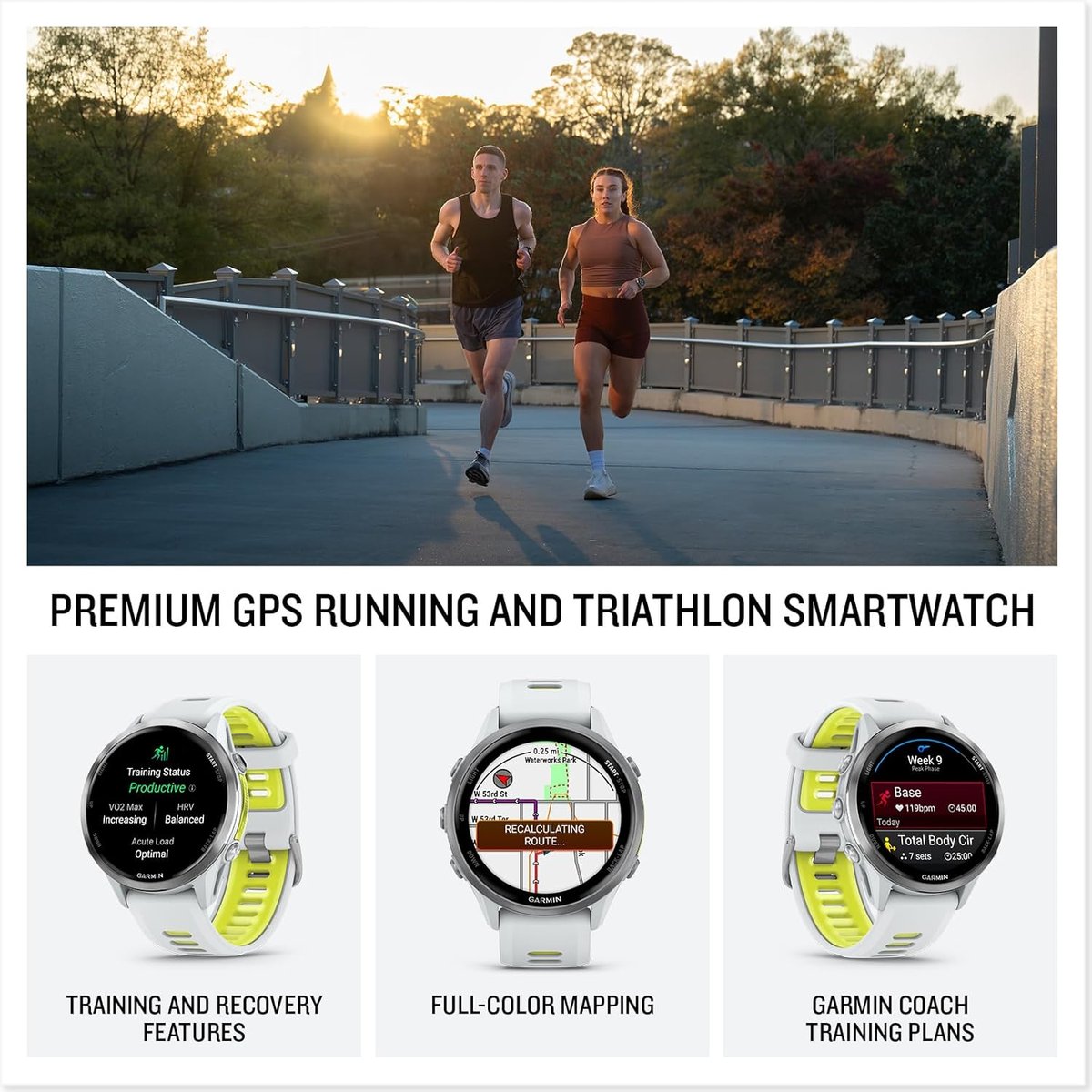
The Forerunner 970 sits in an interesting position. Garmin designed it as a premium running and triathlon watch. It's the deepest running analysis device Garmin makes. But they also gave it full offline topographic maps, multi-band GPS and a torch — features that make it a serious hiking device regardless of its stated purpose.
The people who should look seriously at the Forerunner 970:
Runners who also hike. If you do both activities seriously and want one device that handles elite running analysis and hiking navigation equally well, the Forerunner 970 is a genuine option. No other watch in this list handles the running side as well.
Day hikers who want Garmin's navigation without the Fenix 8's bulk and price. The Forerunner 970 costs around £270 less than the Fenix 8 Solar, weighs 9g less, and has the same navigation capability. If you're doing mainly day walks and the 26-hour GPS battery is sufficient for your longest routes, the Forerunner 970 is the more efficient way to get Garmin's best GPS and maps.
Weight-conscious hikers. 56g is notably lighter than the Fenix 8's 65g, and that 9g difference, on your wrist for eight or ten hours, is more noticeable than it sounds in a spec sheet.
The Forerunner 970 is the wrong watch for multi-day routes without charging access (the battery won't outlast three serious hiking days) and for anyone whose primary concern is the absolute best hiking watch regardless of other use cases.
Specifications
- Case
- 47mm titanium bezel, 56g
- Display
- 1.4-inch AMOLED, sapphire crystal
- Battery GPS
- 26h standard · 21h all-systems multi-band
- Battery watch
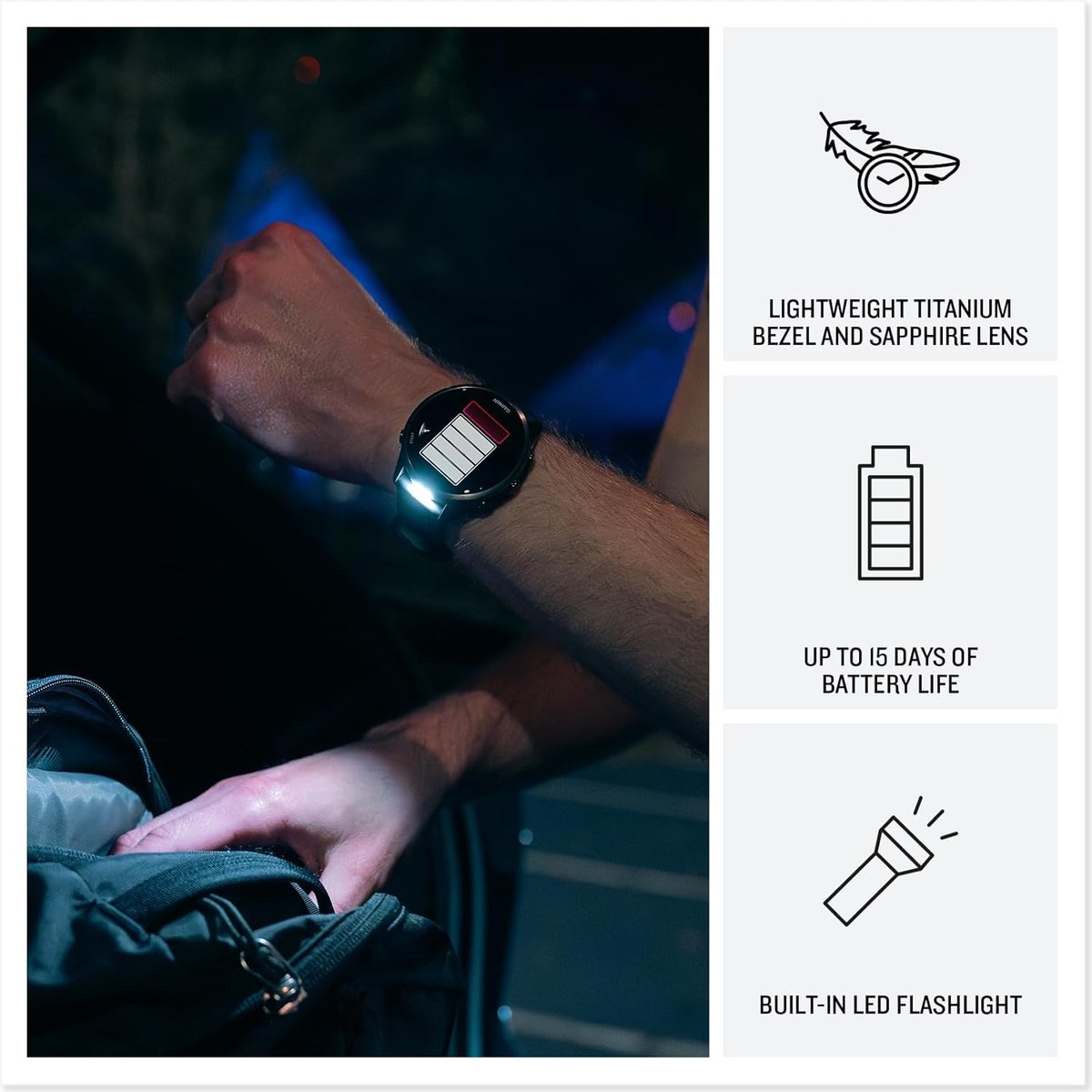
- Up to 15 days
- GPS
- Multi-band SatIQ — GPS, GLONASS, Galileo, QZSS, BeiDou
- Maps
- TopoActive topo maps preloaded
- Water resistance
- 50m (5ATM)
- Torch
- Built-in LED
- Payments
- Garmin Pay
- Speaker / Mic
- Yes — Bluetooth calls and voice controls
- UK price
- From ~£600
On the SatIQ system: Garmin's SatIQ automatically selects the optimal GPS mode for conditions — dropping to single-band in open terrain to extend battery, switching to multi-band in challenging environments. In practice this means the all-systems multi-band figure (21 hours) is a minimum: the watch is often running in a less battery-intensive mode and the actual GPS session length can be longer depending on terrain.
GPS accuracy and navigation
The Forerunner 970 uses Garmin's SatIQ multi-band GPS, which is the same technology stack as the Fenix 8 Solar. Independent reviews confirm accuracy that is competitive with any GPS watch available — the multi-band tracking produces tight, reliable traces in tree cover, built-up areas and valley terrain.
For navigation, the Forerunner 970 is the only watch in the Forerunner line with onboard topographic maps. Every other Forerunner relies on breadcrumb navigation — your recorded route plotted against a blank or simplified background. The 970 loads Garmin's TopoActive European maps and lets you navigate to waypoints, follow routes and check the topo from the wrist. This makes it the first Forerunner that can serve as a proper navigation device rather than just a GPS tracker.
The elevation data comes from both GPS and the barometric altimeter. Like the Fenix 8, the Forerunner 970 has a dedicated barometric altimeter for more accurate elevation data than GPS altitude alone. On a variable UK weather day, this makes a real difference to the accuracy of elevation gain and loss figures.
The LED torch is a practical addition for early starts and late finishes. DC Rainmaker's in-depth review notes the torch has real output rather than token brightness — meaningful output, not just an LED light with little practical illumination.
Battery life
This is where the Forerunner 970 makes a trade-off the Fenix 8 Solar doesn't.
26 hours in GPS-only mode, 21 hours in all-systems multi-band GPS mode. In real-world use — multi-band GPS, always-on display, background heart rate, notifications — expect around 20-24 hours of GPS recording.
That's enough for most UK day hiking. A 10-hour day on the South Downs Way, a full day circuit of the Purbeck ridge, a long New Forest walk — all comfortably within 20 hours. Even a 14-hour day in summer leaves comfortable margin.
Where it becomes a constraint: multi-day routes where you're hiking for 8-10 hours per day across several consecutive days without reliable charging access. On day three of a Pembrokeshire Coast Path section, charging the watch each evening is a practical requirement rather than an option. The Fenix 8 Solar's 52-hour GPS mode removes that dependency. The Forerunner 970 doesn't.
For day walkers and those with overnight charging access, the battery limitation is manageable. For expeditions and thru-hikers, it's a genuine limitation relative to the Fenix 8 and the Enduro 3.
Build quality and durability
The Forerunner 970 has a titanium bezel and sapphire crystal lens, which puts its glass and frame in the same durability category as the Fenix 8 Solar. Sapphire crystal is significantly harder than mineral glass — it will take knocks from granite and rock edges without the scratches that accumulate quickly on lesser lenses.
The 5ATM water resistance rating means the watch is waterproofed to 50 metres. For hiking in UK conditions — rain, river crossings, waterfall spray — 5ATM is sufficient. The limitation compared to the Fenix 8 Solar (10ATM, dive-rated) only matters if your hiking trips include diving or serious water sports.
Independent reviews report solid build quality with no notable complaints about materials or construction. The titanium bezel is lighter than steel while being comparably strong. At 56g the watch achieves its light weight without feeling flimsy — the materials are appropriate for the price and the use case.
The one area where the Forerunner 970 is more exposed than the Fenix 8: the AMOLED display. AMOLED screens can be more susceptible to damage from direct impacts than the MIP screens used in the Fenix 8 Solar. Sapphire crystal mitigates this substantially, but if you regularly put your watch through serious scrambling or rough terrain contact, the Fenix 8's MIP screen is a less fragile choice.
Daily wearability
At 47mm and 56g, the Forerunner 970 is a better daily wear proposition than the Fenix 8 Solar or the Enduro 3. It sits on the wrist more cleanly than either, reads more as a contemporary sports watch than a piece of field equipment, and the AMOLED display is visibly more polished than the Fenix 8's MIP screen.
The built-in speaker and microphone enable Bluetooth calls connected to your phone, and voice commands for the watch interface. This is less mature than the Apple Watch Ultra 3's native calling capability but functions well for basic call management from the wrist.
Garmin Pay is available for contactless payments. UK bank coverage includes Barclays, HSBC, NatWest, Monzo and others — check Garmin's compatibility list for your specific bank. Music storage is available for phone-free listening during workouts.
Reviewers consistently note the Forerunner 970 is a more daily-usable watch than the Fenix 8 — the form factor and display make it more appropriate for contexts where the Fenix 8's expedition aesthetic would feel out of place. That usability advantage is worth something for a watch you'll wear all day every day.
Fitness and training features
The Forerunner 970 is Garmin's best running watch, and this is where it pulls away from the hiking-focused Fenix 8 and Enduro 3 in a different direction.
Training load analysis, race predictor, running power, advanced interval programming, triathlon mode, swimming analysis, cycling dynamics — the Forerunner 970 has the most complete endurance sports analysis platform Garmin makes. The Elevate Gen 5 heart rate sensor with ECG capability is medically certified and more accurate than the previous generation.
For hiking specifically, these features translate into accurate heart rate zone tracking during long climbs, body battery monitoring across a multi-day walk, and elevation and gradient data that feeds into training load calculations. If you also run or ride, the Forerunner 970 builds a unified picture of your fitness load across all activities.
If you're purely a hiker with no interest in running analytics, this capability is unused value — you're paying for features you don't need. The Fenix 8 Solar's broader outdoor feature set (dive mode, skiing, kiteboarding) is arguably a better fit for a hiker's versatility needs than the Forerunner 970's running depth.
Value
From ~£600, the Forerunner 970 costs around £270 less than the Fenix 8 Solar and delivers:
- The same GPS accuracy
- The same preloaded topo maps
- The same torch
- A lighter 56g case
- A better AMOLED display
In exchange, you accept shorter GPS battery (26 hours vs 52 hours), lower water resistance rating (5ATM vs 10ATM), no solar charging option, and a running-focused feature set rather than a broader outdoor one.
For day hikers and runners who hike, this trade-off is rational. You're getting 70% of the Fenix 8's capability at roughly 70% of the price. The core hiking features — GPS accuracy, offline maps, durable construction — are not compromised.
Where the Fenix 8 wins clearly on value: battery life for multi-day use, dive capability, and the specific outdoor feature set of Garmin's flagship outdoor watch. If those matter, the extra £270 is justified. If they don't, the Forerunner 970 is the more efficient purchase.
Forerunner 970 vs Garmin Fenix 8 Solar
This is the decision most hikers weighing up Garmin's range will face. See the Garmin Fenix 8 Solar review for the Fenix 8 perspective. Here is the Forerunner 970's case:
Where the Forerunner 970 wins:
- 9g lighter (56g vs 65g) — noticeable over a long day
- Better AMOLED display in everyday use
- Meaningfully cheaper at ~£270 less
- Better daily wearability — less of a statement watch
- Superior running and training analytics
Where the Fenix 8 Solar wins:
- Nearly double the GPS battery (52h vs 26h) — the decisive advantage for multi-day use
- Solar charging for extended battery in good conditions
- 10ATM vs 5ATM water resistance
- Dive mode for water sports
- Broader outdoor feature set (skiing, kiteboarding, climbing)
- More established as a hiking-specific device
Who should choose the Forerunner 970 over the Fenix 8:
You're primarily a runner who also hikes. You do mostly day walks with overnight charging access rather than multi-day expeditions. You want the lightest Garmin with full navigation capability. Your budget is ~£600 rather than ~£870. You'll use the Forerunner 970's daily wearability advantage — the form factor works better in professional contexts.
Who should choose the Fenix 8 Solar over the Forerunner 970:
You do multi-day routes where charging access is uncertain. Battery anxiety is something you want to eliminate rather than manage. You need 10ATM waterproofing. You want solar charging as a battery top-up. You want the most capable outdoor watch Garmin makes at this size, full stop.
Should you buy it?
Buy the Garmin Forerunner 970 if:
- You run as well as hike, and want one watch that handles both at the highest level
- Your hiking is primarily day walks with overnight charging access
- You want Garmin's full topo map navigation in the lightest possible package
- Your budget is around £600 rather than £870
- Daily wearability and a more refined form factor matter to you
Don't buy it if:
- Your hiking regularly extends to multi-day routes without charging access — battery life is the hard constraint
- You need the full depth of outdoor-specific features the Fenix 8 provides: diving, climbing, skiing
- Budget is the primary factor — the Coros Apex 4 delivers comparable GPS and longer battery at £429
Verdict
The Garmin Forerunner 970 earns 4.5 out of 5 for hiking use. It delivers Garmin's best GPS technology and full topo map navigation in the lightest package available, at a price that's meaningfully below the Fenix 8 Solar.
The 0.5 deducted reflects the battery limitation relative to the Fenix 8 (a significant gap for serious multi-day hiking), the 5ATM vs 10ATM waterproofing, and the fact that it's primarily a running watch whose hiking capability is excellent but secondary to its core design purpose.
For a hiker who also runs, or a day hiker who wants Garmin's full navigation capability without the Fenix 8's price and bulk, the Forerunner 970 is the most efficient answer in Garmin's current lineup.
Buy Garmin Forerunner 970 on AmazonBuying guide
Forerunner 970 vs Forerunner 570: Garmin's Forerunner range scales significantly. The 570 delivers excellent GPS tracking and training analysis at a lower price point, but lacks the 970's topo maps, torch, sapphire crystal and titanium bezel. For hiking specifically, the 970's map capability is the decisive difference — without offline topo maps, the 570 is a GPS tracker rather than a navigation device. If topo maps matter to you, the 970 is worth the premium.
Colour options: Available in Carbon Gray DLC Titanium, Soft Gold Titanium and standard Titanium variants. The Carbon Gray DLC has the most durable surface finish. Colour choice doesn't affect function.
Software and updates: The Forerunner 970 received its initial mapping features via software update after launch. Garmin has a reasonable track record of adding capability to existing hardware via firmware updates — the 970 will likely gain additional features over its lifetime.
Garmin Connect and Connect IQ: The watch's companion ecosystem. Garmin Connect handles activity analysis, health tracking and map management. Connect IQ adds third-party apps and watch faces. Neither requires a paid subscription for core functionality — Connect IQ apps are an optional add-on, not a requirement.
Pairing with Garmin inReach: The Forerunner 970 pairs with the Garmin inReach Mini 3 satellite communicator, allowing you to send and receive satellite messages and trigger SOS from the watch face. For remote hiking, this combination — the 970 for navigation and the inReach Mini 3 for satellite safety — is a well-integrated setup. The inReach Mini 3 and other essential hiking gadgets are covered in the best hiking gadgets UK guide.