


Quick verdict
Apple Watch Ultra 3: 4.3/5
The best hiking smartwatch for iPhone users — leaves your phone at home on shorter hikes and handles GPS as well as any Garmin. Battery management is the skill you need to learn.
The full review is below.
I never wore a watch for most of my adult life. The habit never stuck — I couldn't see the point of something on my wrist that just told me the time. Then, years ago, I bought an early Apple Watch as an experiment. It seemed like the kind of thing worth understanding. Within six months I couldn't leave the house without it.
That original watch has been followed by several upgrades. When Apple launched the first Watch Ultra I was already looking at it. The rugged titanium build, the extended battery life over the standard Apple Watch, the action button, the loudest speaker ever put in a watch. I ordered one on launch day. Then the Ultra 2. Now the Ultra 3. Three years of wearing an Apple Watch Ultra on trail and off it, every day, in all conditions.
This is not a hands-off review written from a press release. I've used this watch on extended sections of the South Downs Way, along the Jurassic Coast cliffs, across the New Forest in mid-winter, and on hundreds of shorter walks in between. I know exactly what it does well and exactly where its limits are.
Quick verdict
- L1+L5 dual-frequency GPS — as accurate as the best Garmin models
- Complete iPhone independence on shorter hikes: calls, messages, Apple Pay, music
- Titanium case with 100m water resistance
- Always-on Retina display readable in direct sunlight
- Health features — ECG, blood oxygen, crash detection — that no Garmin matches
- Action button and 86dB siren are practical trail safety tools
- The best smartwatch ecosystem available, bar none
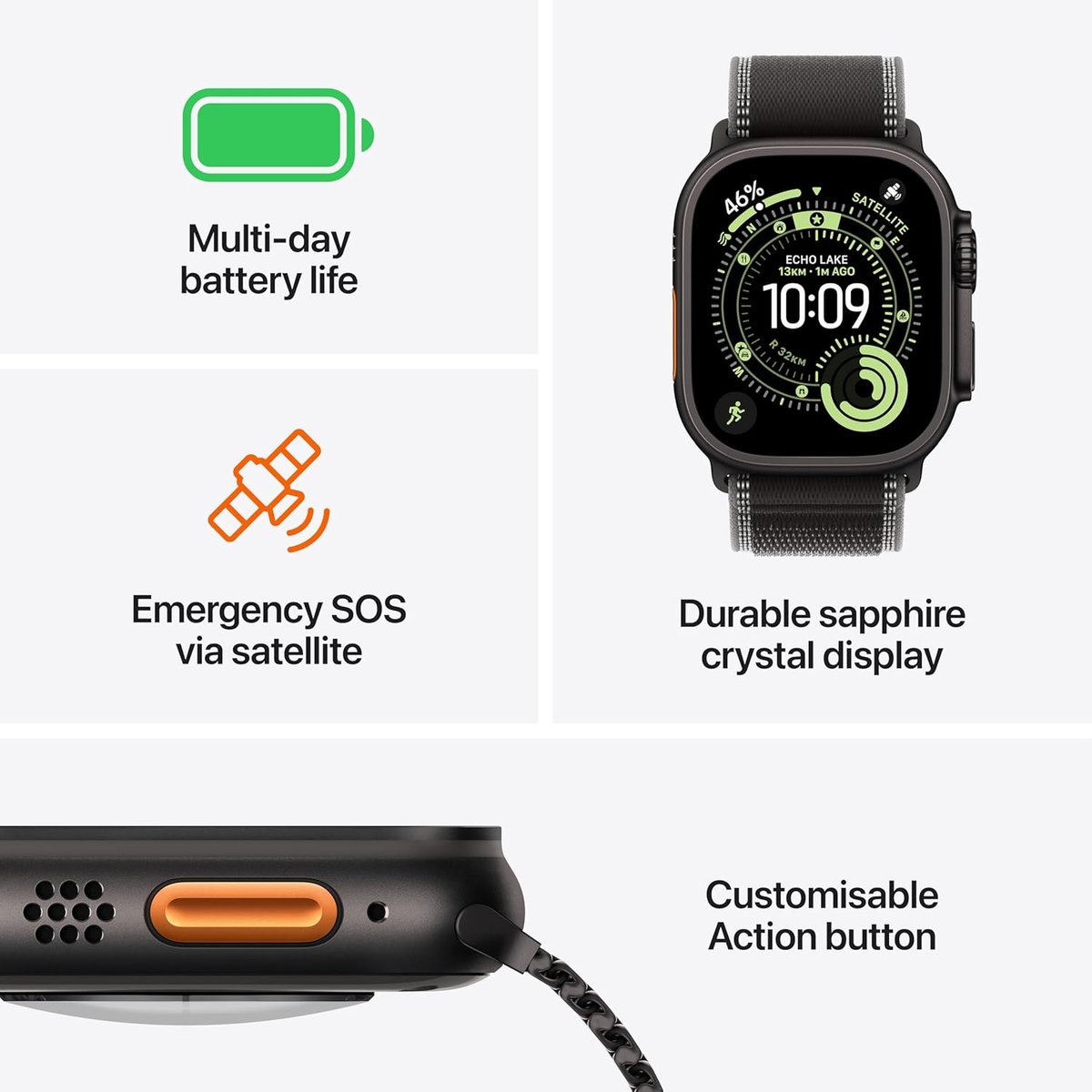
- 42h normal use, 14h with full GPS and heart rate — requires management on long days
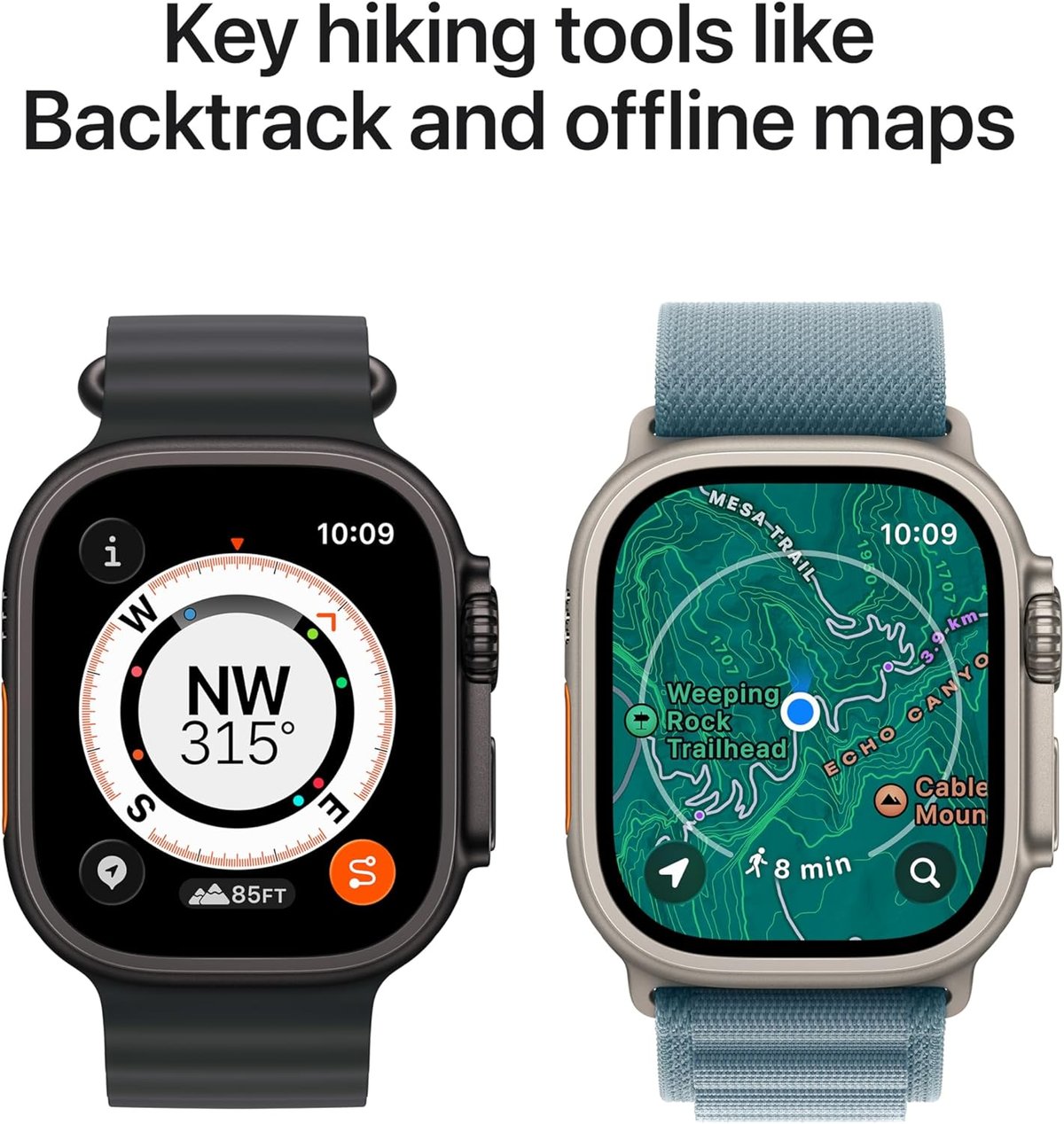
- No offline topographic maps — navigation is breadcrumb-based
- iPhone only — no value at all if you're on Android
- MagSafe charging rather than USB-C — a proprietary cable to remember
- From £749 — the most expensive entry point for a hiking smartwatch
Who is this for?
The Apple Watch Ultra 3 is the right hiking watch for one specific type of person: an iPhone user who wants a single wrist device that handles trail GPS, health monitoring, daily life notifications, contactless payments, and the ability to leave their phone at home.
If that's you — and it's a significant proportion of the UK hiking market — then the Ultra 3 is the most capable option available. There is no other watch that combines dual-frequency GPS accuracy with Apple Pay, phone-independent messaging, and an ecosystem refined over more than a decade.
If you're on Android, stop reading here. The Apple Watch Ultra 3 is entirely dependent on iPhone. It will not pair with any Android phone, will not use Google Maps, and cannot make calls without iOS.
If your primary concern is multi-day battery life — if you're planning routes where you cannot charge the watch for three or four days — then the Garmin Fenix 8 Solar or the Garmin Enduro 3 are the better answers. The Ultra 3 can reach 72 hours in Low Power Mode, but Low Power Mode significantly curtails the GPS functionality that makes it useful on trail.
For everyone else in the iPhone user camp: this is the watch.
Specifications
- Case
- 49mm titanium — 61.6g (natural) / 61.8g (black)
- Display
- 1.98-inch Always-On Retina LTAO OLED, 3,000 nits, sapphire crystal
- Battery
- 42h normal · 72h low power · 14h full GPS · 35h low-power GPS
- GPS
- L1+L5 dual-frequency — GPS, GLONASS, Galileo, QZSS, BeiDou
- Cellular
- 5G (separate plan required)
- Water resistance
- 100m (ISO 22810:2010)
- Storage
- 64GB
- Chip
- Apple S10
- Charging
- MagSafe — 15 minutes = up to 12 hours
- UK price
- From ~£749
GPS performance and navigation
The Ultra 3 runs dual-frequency L1+L5 GPS across all five major satellite constellations: GPS, GLONASS, Galileo, QZSS and BeiDou. On the spec sheet, this is identical to what Garmin puts in the Fenix 8 Solar and the Enduro 3. In practice, the GPS tracks produced by the Ultra 3 are tight, accurate and consistent.
On the South Downs Way sections I use for training — through the Meon Valley, along the chalk ridge above Butser Hill — the Ultra 3 holds a clean track. Under the tree cover of the New Forest, where cheap GPS devices start producing wandering, inaccurate traces, the Ultra 3 maintains reasonable accuracy. In the deep coastal undercliffs on the Jurassic Coast, where you lose satellite sight lines on multiple sides, multi-band GPS makes a visible difference compared to the single-band watches I've tested.
What the Ultra 3 cannot do is navigate from offline topographic maps. The watch records your route and plots it as a breadcrumb trail against a basic map background. If you upload a GPX file or a workout route from the Fitness app, you can follow it from the watch. But there are no preloaded OS-quality topo maps on the wrist. For that you need your phone running OS Maps, or a Garmin.
For the majority of UK day walking — routes you've planned in advance, paths that are clearly signed, terrain you know — this limitation is manageable. For genuine route-finding in complex terrain, or navigating in conditions where you need to read the contours to understand where you are, the lack of topo maps is a real gap.
Battery life
Let me be straightforward about this because it is the most important thing to understand before buying.
The Apple Watch Ultra 3 lasts 42 hours in normal use. Normal use includes wearing the watch all day, receiving notifications, tracking a workout or two, and monitoring heart rate. In real-world daily wear with a morning run and some workout tracking, 40 hours is a reasonable expectation — charge it every other night.
In outdoor workout mode with full GPS and heart rate running, that drops to around 14 hours. That is enough for a well-organised day walk. It is tight for a 12-hour day where you're also using cellular for messages, streaming music and making the occasional call.
Low Power Mode extends battery to 72 hours and GPS to around 35 hours. But Low Power Mode significantly reduces heart rate sampling frequency, turns off the always-on display, and throttles notifications. It's the right mode for a multi-day situation where you need the watch to last. It's not the mode you want for a single big day where you're using the watch actively.
My approach: on walks up to around 22-25km I don't think about battery. The Ultra 3 comfortably covers those days without management. For bigger days — 30km+ — I carry an Anker MagGo 10,000mAh — covered in the best hiking gadgets guide — in the lid pocket of my Osprey Talon 33. The MagSafe puck snaps onto the back of the watch case. I clip the pack, start walking, and the watch charges continuously via the case back. By the end of a 35km day it is typically at 80-90%. The arrangement weighs about 200g including the cable and adds nothing to pack management.
The reason I'm still considering switching to the Garmin Fenix 8 Solar is not that this system fails — it doesn't. It's that the Fenix 8 Solar doesn't require the system. If I'm doing a five-day route with no socket access, the Garmin is the answer. For everything else, the Ultra 3 and the Anker bank cover the ground.
Fitness and health tracking on trail
This is where the Ultra 3 separates itself from every Garmin on this list.
Heart rate monitoring during a long walk is standard on all of these watches. The Ultra 3 does that well. What it adds: ECG on demand, blood oxygen saturation readings, crash detection, fall detection, irregular heart rhythm notifications, and continuous temperature sensing. These are clinical-grade tools on a hiking watch.
The crash detection feature has practical trail relevance — a serious fall in remote terrain, a head injury that leaves you unable to call for help. The watch detects a hard fall, displays a prompt and calls emergency services if you don't respond within 60 seconds. Combined with the 86dB siren built into the case — loud enough to be heard at distance in most conditions — the Ultra 3 has meaningful trail safety capability beyond what any Garmin offers in this area.
Elevation and altimeter data come via GPS rather than a dedicated barometric sensor, which means the Ultra 3 is less precise for elevation tracking than the Garmin models in this list. On a day when barometric pressure is changing — incoming weather, significant altitude change — the GPS elevation figures can drift. For serious altitude tracking, the Garmin barometric altimeter is more reliable.
Daily wearability
This is the Ultra 3's argument in a sentence: I can leave my phone at home.
On shorter hikes — anything up to about 15km on familiar ground — my phone stays on the kitchen table. The Ultra 3 handles calls via the built-in speaker and mic. Messages come through and I reply from the watch using dictation or the preset replies. Apple Pay works at every cafe and car park. Navigation runs directly from the Workout app. Music streams from Apple Music over 5G or the watch's internal storage.
That is a meaningfully different hiking experience from any Garmin. Not better in every dimension, but specifically better in the dimension of leaving your phone in the car and walking freely.
The action button — the programmable orange button on the side of the case — becomes a tool. I have it set to start a hiking workout with a single press. One press at the trailhead, it's logging. One press at the end, it's done. The siren button on the other side of the case is harder to trigger accidentally and activates the emergency siren at 86dB if you hold it for five seconds.
The always-on display is readable in direct sunlight in a way that AMOLED screens sometimes aren't. On a bright summer day on the chalk downs, the Ultra 3 screen is legible without shading it with your hand. That matters when you're checking pace or distance while moving.
Build quality and durability
The Ultra 3 case is grade 2 titanium with a sapphire crystal face. It is a robust watch. In three years of daily wear including hundreds of trail days, scrambling, river crossings, and the general rough treatment of active outdoor use, mine has acquired some minor case scratches and the strap has needed replacing twice. The sapphire lens is unmarked.
The 100m water resistance rating means you can submerge it in a river or swim with it without any concern. The ISO 22810:2010 rating covers high-speed water activities, which in practical terms means heavy rain and stream crossings are nowhere near the limits of what this watch can handle.
The silicone Alpine bands that come with the Ultra are specifically designed for hiking and running use. They're not the most elegant bands — they're purpose-built for sweat and water — but they work in a way that the default sport bands on the standard Apple Watch don't.
The one durability concern with the Ultra 3 compared to the Garmin Enduro 3 or Fenix 8 Solar is the lack of 10ATM certification. The Ultra 3 is rated to 100m depth but does not carry the 10ATM designation. In practice this distinction matters more for diving than for hiking. For UK trail use, 100m is ample.
Value
From £749, the Apple Watch Ultra 3 is the most expensive entry point in this guide alongside the Garmin Fenix 8 Solar. Whether it represents value depends on what you're buying it for.
If you're buying a hiking GPS watch and only a hiking GPS watch, the Coros Apex 4 at £429 or the Garmin Forerunner 970 at around £600 deliver more trail-specific capability for less money. The Ultra 3's premium is substantially funded by features that aren't primarily about hiking — the Apple Pay integration, the health monitoring ecosystem, the phone independence, the cellular connectivity.
If you're buying a daily watch that also happens to be an excellent hiking GPS watch, the value calculation changes. The Ultra 3 replaces a standalone fitness tracker, a smartwatch, a cellular connectivity device and a GPS watch. At £749 for something you'll wear every day for two or three years before upgrading, the cost per day is reasonable.
That's the honest case for the Ultra 3 at this price. It's not the cheapest GPS watch. It's the most versatile watch — and if you want what it offers, nothing else offers it.
Apple Watch Ultra 3 vs Garmin Fenix 8 Solar
This is the comparison that most serious hikers considering either watch care about. I've used the Ultra 3 extensively. I haven't yet put the Fenix 8 Solar through trail time — the Garmin Fenix 8 Solar review is upfront about that. If you're weighing up Garmin's full range, the Forerunner 970 review covers the lighter, slightly cheaper option that still brings full topo maps. But having used the Ultra 3 for three years and researched the Fenix 8 Solar in depth before deciding which to buy next, the comparison is clear on most dimensions.
GPS accuracy: Comparable. Both use dual-frequency multi-constellation GPS. Real-world track quality is similar in most conditions.
Battery life: Fenix 8 Solar wins significantly. 52 hours GPS vs 14 hours for the Ultra 3. The Ultra 3 can extend to 35 hours in Low Power Mode, but that's a degraded experience. If multi-day battery without external power is important, the Fenix 8 is the answer.
Navigation: Fenix 8 Solar wins. Preloaded TopoActive European topo maps on 32GB vs no offline maps on the Ultra 3.
Daily life: Ultra 3 wins substantially. Apple Pay, phone calls, messages, crash detection, ECG, app ecosystem — the Fenix 8 is a better hiking device; the Ultra 3 is a better life device.
Build: Both excellent. The Fenix 8 Solar is 10ATM vs 100m for the Ultra 3, which matters for diving. For hiking, both are more than capable.
Price: Both cost around £750-870 in their standard configurations.
The question is what you want the watch to be. If it's primarily a hiking tool that you also wear day to day, the Fenix 8 is the better hiking tool. If it's a daily life device that also handles hiking well, the Ultra 3 is the better daily device. You lose relatively little on either side — but you lose something on both sides.
I've chosen to stay with the Ultra 3 for now because the daily integration is irreplaceable for me. The decision about the Fenix 8 Solar remains open.
Should you buy it?
Buy the Apple Watch Ultra 3 if:
- You're an iPhone user and want one watch that handles everything
- You want to leave your phone at home on shorter hikes
- Trail navigation is important but you're typically on pre-planned routes where breadcrumb GPS is sufficient
- Health monitoring — ECG, blood oxygen, crash detection — matters to you
- You're prepared to carry an external power bank on long days, or use Low Power Mode
Don't buy it if:
- You're on Android — it simply won't work
- Multi-day battery without charging is a hard requirement
- You need offline topographic maps on your wrist
- Your budget is below £700
Verdict
The Apple Watch Ultra 3 earns a 4.3 out of 5 for hiking use. The GPS accuracy is class-leading, the build is rugged, and the daily life capability is far ahead of any Garmin. The 0.7 points come from the battery limitation and the absence of offline topo maps.
For a serious hiker who is also an iPhone user and who doesn't need more than two days of GPS battery between charges, this is the best watch available. For a serious hiker whose priority is the deepest possible trail-specific capability regardless of ecosystem, the Garmin Fenix 8 Solar is the stronger answer.
Both are excellent. They serve different primary needs.
Buy Apple Watch Ultra 3 on AmazonBuying guide: what to consider before buying an Apple Watch Ultra
iPhone compatibility: The Ultra 3 requires iPhone XS or later running iOS 17 or later. Check your phone before buying.
Band choice: The Alpine Loop is the best hiking band — designed for one-handed fastening, durable in wet conditions. The Trail Loop is lighter and simpler. The Ocean Band is for water sports. The Milanese Loop is for daily wear rather than active use.
Cellular plan: The Ultra 3 has cellular built in, but it requires a separate paired plan with your network provider. Without an active cellular plan, the watch functions but cannot make independent calls or access data when away from iPhone.
MagSafe charger: The Ultra 3 uses MagSafe rather than USB-C. If you're hiking, this means a MagSafe cable to carry. The Anker MagGo travel charger is the right companion — it has a built-in MagSafe puck and USB-C. The best hiking gadgets guide covers power banks and satellite communicators for longer routes.
AppleCare+: For a watch you're hiking with, AppleCare+ is worth considering. It covers accidental damage for £79/year and brings the replacement cost of a cracked screen from several hundred pounds down to a single fee.
Comparing Ultra 3 vs standard Apple Watch Series 10: The Ultra 3 is heavier, bigger, pricier and more durable. The Series 10 has 18 hours of battery in standard mode vs 42 hours for the Ultra 3. For hiking, the Ultra 3's larger battery, titanium case, sapphire lens and action button justify the premium. For primarily urban daily wear with occasional walks, the Series 10 makes sense.