


Quick verdict
The NETTA 20L/Day dehumidifier is a compressor unit that we run every day through the damp half of the year to stop condensation turning into mould on our older windows, and to dry laundry indoors now the garden is out of action. It pulls a surprising amount of water (we sometimes empty the 4.5L tank every few days), costs only pennies an hour when it's actually running, and cuts off automatically when the tank is full. It's well built and efficient, slightly noisy at full tilt, and we wouldn't run it overnight, but as a daytime damp-and-laundry workhorse it has become one of the hardest-working things in the house.
NETTA 20L/Day Low Energy Dehumidifier: 4.6/5
The compressor dehumidifier on duty in our house: 20 litres a day of extraction, a 4.5L tank, digital humidistat, 24-hour timer and auto shut-off when full. It clears condensation and dries the washing for a fraction of a tumble dryer's running cost.
The full review is below.
Every autumn the same thing happens in our house. The weather turns, and overnight the windows start running with condensation. In our house we have a few small single-pane windows that need replacing, and until they are, they're the first place damp shows up. So I use a dehumidifier to help stop any mould or anything taking hold, and the one doing that job is the NETTA 20L. This is a review from a family that runs one every single day through the damp months, not a spec sheet.
Why we needed one
Two problems, one machine. First, those old windows: single panes are cold, cold glass pulls moisture out of warm indoor air, and that water sits on the frames and sills every morning. Left alone, that's exactly how mould starts, so the dehumidifier is cheaper and far less hassle than redecorating a windowsill every spring.
Second, the laundry. It is also really useful at this time of year for drying clothes, because we can't put our laundry outside any more after such a wonderful summer for drying clothes. From roughly October to April, the garden washing line is useless, and a house full of wet clothes on an airer is a house full of moisture looking for a cold surface to land on. The dehumidifier solves the drying and the damp in one go, which is the whole reason it earns its keep.
What it is
The NETTA 20L is a compressor dehumidifier: it draws damp air across a cold coil, the moisture condenses out and drips into the tank, and the drier air goes back into the room. That technology matters, because compressor units are at their best in heated indoor rooms (roughly above 15°C) and lose efficiency in cold spaces like unheated garages, where a desiccant model would be the better buy. For a normal lived-in house like ours, compressor is exactly right.
The headline specs, all verified from NETTA:
- 20 litres a day extraction, into a 4.5-litre tank
- 345W motor, R290 refrigerant
- Adjustable humidistat (30 to 80 percent), so it targets a humidity level rather than just running flat out
- 24-hour timer, auto shut-off when the tank is full, auto restart after a power blip, auto defrost
- Continuous drainage option via a hose if you'd rather never empty it
- Washable air filter, caster wheels, child lock, under 43dB
- 49.5cm tall, 12.5kg


Our daily routine with it
Ours is set to a humidity level which is shown on the display, and it frequently comes on and off again throughout the day as the room drifts above and below that target. That cycling is the humidistat doing its job, and it's also why the running cost stays low (more on that below).
The routine goes like this. I generally do a morning purge upstairs to clear the air after the night, windows open, fresh air through. Then I close all the windows again once I'm dressed and ready for the day, and the dehumidifier goes on and clears the air for us from there. It's a simple rhythm: ventilate briefly, then let the machine hold the humidity down for the rest of the day while the house is shut up against the cold.
It's also the thing we reach for after showers. As with many families, it's super helpful after showers, especially with kids who have multiple sports activities, just to make sure the moisture isn't hanging around for the night. A bathroom full of steam and a landing full of damp kit is a recipe for exactly the condensation we're trying to avoid, and half an hour of the NETTA afterwards clears it.
Drying laundry without the garden
This is the use that genuinely surprised me, and it's where a dehumidifier quietly saves you money. Stand an airer of wet washing in a closed room with the dehumidifier running, and it pulls the water out of the clothes and into the tank instead of into your walls. The clothes dry, the room doesn't get damp, and it costs a fraction of a tumble dryer.
The numbers back it up. A tumble dryer draws something like 2,000 to 3,000 watts; this NETTA draws 345W flat out, and less on average because it cycles. Credible UK comparisons put drying a load with a dehumidifier and airer at roughly 30 to 40p against 70p to nearly £1.50 for a tumble dryer load, and households that switch regular drying over report saving well into three figures a year. If you've no tumble dryer at all, as plenty of houses don't, it turns winter laundry from a damp, draped-everywhere misery into something manageable. It works even better paired with a heated clothes airer: the airer does the drying, the dehumidifier catches the moisture that would otherwise land on your walls.
What it costs to run
At the current Ofgem price cap (26.32p per kWh, October to December 2026), the NETTA's 345W motor costs about 9p an hour when it's actually running at full draw. But the important word is "running", because with the humidistat set sensibly it spends a good part of the day cycled off, having hit its target. Once a room has dried out, a realistic full day of use lands in the region of 40 to 60p, not the 70p-plus you'd get from assuming it runs flat out for eight hours.
That's the honest framing for any compressor dehumidifier: pennies per hour when the compressor is on, and it isn't on most of the time once the air is dry. Set the humidistat too low (chasing 30 percent in a normal house) and it'll run far more and cost more; set it to a sensible 50 to 55 percent and it does the job cheaply.
Noise, emptying and build
The build quality of the NETTA seems very good. It feels solid for the money, the panel is clear, and the casters make it easy to wheel from the landing to the kitchen to wherever the washing is.
It is a little noisy, but nothing too bad, the steady hum of the compressor and fan rather than anything harsh. It's fine as daytime background noise in a busy house. I wouldn't run it all night, though, partly for that reason and partly on general principle (see safety below).
The thing that still surprises me is how efficient it is, and just how much I have to empty it. Sometimes it's only a few days between emptying the 4.5L tank, which tells you how much water is coming out of the air, water that would otherwise be sitting on glass and plaster. And if I forget to empty it on my routine patrols of the house, it auto shuts off when the tank is full rather than overflowing, so a missed round doesn't become a puddle. If emptying ever got tiresome you could run the continuous-drainage hose to a drain and forget about it entirely.
Which size do you need? The NETTA range at a glance
NETTA makes this dehumidifier in several capacities and a quieter-running line, and the rule of thumb is simple: match the litres-per-day to the size of the space and how much damp you're fighting. We own and review the 20L here; the rest of the range below is for choosing the right size for your own house, not units we've each tested.
| Image | Product | Price | Buy |
|---|---|---|---|
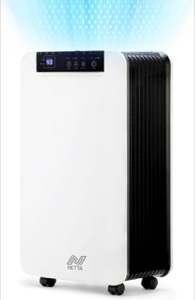 | NETTA 12L/Day | Check on Amazon | |
| 12L/day · the entry modelBest for Flats, single damp rooms, lighter condensation | |||
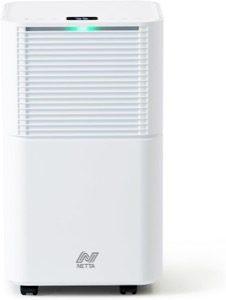 | NETTA 12L/Day Digital | Check on Amazon | |
| 12L/day · digital humidistat displayBest for Smaller spaces, with a set-and-forget humidity readout | |||
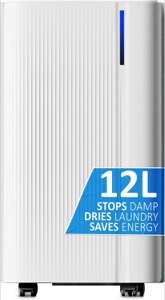 | NETTA 12L/Day Quiet | Check on Amazon | |
| 12L/day · quieter-running line, sleep modeBest for Bedrooms and quiet rooms, lighter duty | |||
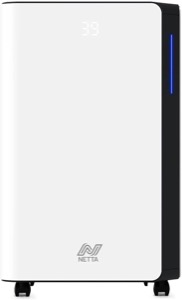 | The one we ownNETTA 20L/Day | £123.48 | |
| 20L/day · 4.5L tank · 345W · <43dB · humidistat, 24h timer, auto shut-offBest for Whole average-to-large house, damp plus laundry drying | |||
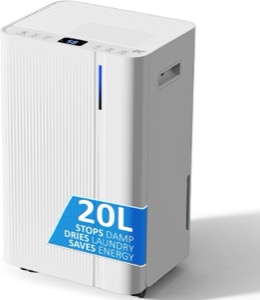 | NETTA 20L/Day Quiet | Check on Amazon | |
| 20L/day · quieter-running line, sleep modeBest for Whole-house duty where noise matters more | |||
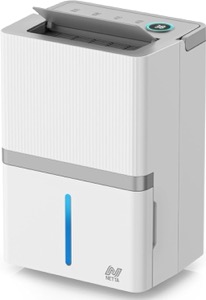 | BiggestNETTA 35L/Day | Check on Amazon | |
| 35L/day · the heavy-duty modelBest for Persistent damp, very large or multiple rooms | |||
For most family houses with some condensation and a winter's worth of indoor washing, the 20L is the sweet spot, which is why it's the one we own. Drop to a 12L for a flat or a single room, step up to the 35L only if you're fighting serious, persistent damp across a large space, and choose a Quiet-line model if the dehumidifier will live somewhere noise would bother you.
Running it safely
Dehumidifiers are low-risk appliances used sensibly, and modern ones like this have auto shut-off and auto-defrost built in, but a few habits from Electrical Safety First and fire services are worth keeping:
- Plug it straight into a wall socket, not an extension lead. Heating and motor appliances are happiest on their own socket.
- Give it space and keep the vents clear. Stand it on a flat, stable surface with room around it, away from curtains and furniture, so air moves freely.
- Don't leave it running unattended overnight or when you're out if you can avoid it. Ours is a daytime machine; the auto shut-off is a safety net, not a reason to leave it going while you sleep.
- Clean the filter regularly (roughly every couple of weeks with daily use) and empty the tank often, both of which keep it efficient as well as safe.
One honest accuracy point, because it matters: a dehumidifier stops new mould and condensation from forming and dramatically improves a damp room over days and weeks. It does not scrub existing mould off a wall, that still needs cleaning. Think of it as prevention, which in our house is exactly the job.
Verdict
The NETTA 20L has quietly become one of the most-used appliances we own from October onwards. It keeps the condensation off our old single-pane windows, it dries the washing the garden can't any more, and it clears the after-shower damp before it can settle in for the night, all for pennies an hour when it's running and nothing when it's cycled off. It's well made, genuinely efficient, empties more often than you'd expect (in a good way), and shuts itself off when full. The only marks against it are a bit of compressor hum and that I'd keep it to daytime use, neither of which stops it being an easy recommendation for any house fighting winter damp.
Check the NETTA 20L price on Amazon