


Quick answer
Our pick: Osprey Hydraulics 3L Reservoir
- Best reservoir: Osprey Hydraulics 3L (~£50)
- Best insulated bottle: Chilly's Series 2 (~£35)
- Best electrolytes: SIS Hydro / High5 Zero (~£6)
- Best cold-drink flask: Yeti Rambler 26oz (~£40)
- Best cleaning kit: TAGVO Bladder Cleaning Kit (~£10)
The full reasoning, and everything we ruled out, is below.
We are in the middle of another proper heatwave, and the trails do not stop being worth walking just because it is 30 degrees. They do get more dangerous though, and the thing that catches people out first is water. Not the lack of a river to filter from, not fancy kit, just failing to drink enough of the right stuff at the right pace.
This is how I stay hydrated on the trail in a heatwave. How much to drink, how to spread it across a hot day, why plain water on a long walk can actually work against you, and the reservoir, bottles and electrolytes I use week in and week out on the Jurassic Coast and the New Forest.
There is a section further down on why all of this matters more once you are past 40, because it does, and almost nobody in the hiking world writes about it. If you only take one thing from this piece, take that section.
How much to drink, and how to pace it
The rough number I work to on a hot day is 500ml to 750ml an hour of moving time, and more if I am climbing or the sun is full on. On a five-hour walk in a heatwave that is three to four litres, which is exactly why my default is a three-litre reservoir rather than a single bottle.
The number matters less than the pacing. The mistake I see most is people carrying plenty of water and then drinking it in big gulps at the top of a climb, when they finally feel wrecked. By then you are already behind. Your body absorbs a steady trickle far better than an occasional flood, and a flood mostly ends up as a full bladder and a stop behind a gorse bush.
Little and often is the whole game. A mouthful every ten or fifteen minutes, on the move, before you feel like you need it. That only happens in practice if the water is easy to reach, which is the single biggest argument for a hydration bladder with the hose over your shoulder. If the water is buried in your pack you will not drink it often enough, and no amount of good intention fixes that.
Pre-hydrate before you set off
The easiest litre of water to drink is the one you have before you leave the car park.
I drink around 500ml in the hour or two before a hot walk, on top of a normal morning. Starting properly topped up means the first hour is not spent playing catch-up, and playing catch-up in a heatwave is a game you tend to lose. If you have started a walk already behind on fluid and felt that thick-headed, slightly nauseous flatness by mid-morning, that is what pre-hydrating prevents.
It carries over from the night before too. A big walk in hot weather starts with a sensible evening: water with dinner, not four pints and a late night. Not glamorous advice, but it works.
A confession that belongs right here: I run on coffee. Early starts do not come naturally to me, and the people I hike with have worked out that everyone has a better morning if I have had a cup before we set off. So I make sure I have. I will drink a travel mug on the drive to the trailhead, sometimes pack a couple of iced coffees for the walk itself, and on a longer day I will brew one at a stop with my Fire Maple stove. Without it, by all accounts, I am a grump.
So does the coffee count towards your hydration or work against it? The old line is that coffee dehydrates you, because caffeine is a diuretic. The truth is gentler. Caffeine is a mild diuretic, but the water in a normal cup more than makes up for the little extra you pass, especially if you drink coffee regularly and your body is used to it. For most people, moderate coffee counts towards your daily fluids rather than draining them. I would not try to hit my whole hot-day target on flat whites, and I still get plain water and electrolytes in early, but that morning coffee is doing more good than harm. Have the coffee.
Why plain water is not enough: electrolytes
Here is the part people find counterintuitive. On a long, hot, sweaty hike, drinking large volumes of plain water can actually be dangerous.
When you sweat you lose salt as well as water. If you replace only the water, and you drink a lot of it, you dilute the sodium in your blood. Pushed far enough that becomes hyponatremia: low blood sodium, which brings on headaches, nausea, cramping and, in the worst cases, something a lot more serious. It is not common on a normal day walk, but it is exactly the kind of thing that creeps up on someone doing a long, hot, all-day effort and diligently drinking litre after litre of plain water because they have been told to stay hydrated.
Electrolytes are the answer to this. A tablet or a sachet puts back the sodium, potassium and magnesium you are sweating out, so the water you drink actually stays useful instead of thinning your blood down. On a cool, short walk I do not bother. On a hot all-day walk on exposed ground, they earn their place every time. There is more on the ones I actually use further down.
Why hydration changes after 40
This is the part I care most about, and it is the reason this article sits in the Hiking Over 40 section rather than the general gear pages.
One caveat first, because I want to be straight about it. Most of the hard research on this is done on adults in their sixties and beyond. The changes do not switch on at your fortieth birthday. What is fair to say is that they are already starting in your forties and fifties, gradually, quietly, and in ways that change how you should behave on a hot trail. Think of this as "this is already beginning", not "you fall apart at 40".
Your thirst signal weakens with age
This is the big one, the single most behaviour-changing point on the list. As we age, the sensation of thirst becomes a less reliable alarm. Older adults are measurably dehydrated before they feel thirsty. That completely undermines the standard advice to "drink when you are thirsty", because by the time thirst shows up you are already behind. The fix is simple and it is the reason pacing matters so much: drink to a schedule, not to thirst. A mouthful every fifteen minutes whether or not you fancy it.
Falling total body water and muscle loss
Muscle holds a lot of the body's water, and muscle mass starts declining from around 40 unless you actively work to keep it. Less muscle means less water in reserve, which means the same amount of sweat dehydrates you faster than it did in your twenties. Holding on to leg and core strength as you age is one of the best things you can do as a hiker, and it helps here too. I have a separate piece on leg strength for older hikers in the works.
Kidney changes mean you lose more water
Kidney function declines gradually from the thirties and forties. In practical terms your kidneys become a little less good at concentrating urine, so you lose more water clearing the same amount of waste. It is a small effect on any given day, but on a hot trail small effects add up.
Your body handles heat less well after 40
Sweat response and blood flow to the skin both drop with age, so you shed heat less efficiently than you used to. That is really the subject of a whole separate article, which is why I have written one. If overheating rather than dehydration is your main worry, read how to stay cool on the trail, where the thermoregulation side lives in full.
Why electrolytes matter more after 40
Between the sodium-dilution risk above and the medication point below, the case for electrolytes gets stronger with age rather than weaker. If you have moved to drinking on a schedule, you are drinking more water more consistently, which makes replacing salt more important, not less.
A word on medications
This is the bit the hiking world almost completely ignores, and it deserves saying plainly.
A lot of us in our forties, fifties and beyond are on regular medication. Blood pressure tablets, diuretics, and various others directly affect how your body handles fluid, salt and heat. Diuretics make you lose more water and sodium by design. Some blood pressure medications change how your body responds to heat and how quickly you feel the effects. None of that means you should not be out walking. It means the generic "just drink to thirst and you'll be fine" advice may not apply cleanly to you.
Heat exhaustion, heatstroke and the sachet in my first aid kit
Get your hydration and pacing right and you will very likely never need this section. But heat illness is worth understanding, because catching it early is easy and missing it is not.
Heat exhaustion is the warning stage: heavy sweating, headache, dizziness, cramp, feeling sick and generally washed out. The fix is usually simple. Stop, get into shade, cool down, and drink water with electrolytes. This is where a bit of extra kit earns its place. Alongside my electrolyte tablets I keep a sachet or two of Dioralyte in the first aid kit. If you have young children you probably already have some in a kitchen drawer. It weighs nothing, it is made precisely for rehydration, and it is a reassuring thing to have if someone starts to flag badly in the heat.
Heatstroke is the serious one, and it is a medical emergency that can be life-threatening. If someone stops sweating, goes confused or drowsy, or their skin is hot and they are clearly not themselves, treat it as heatstroke. Nothing in a first aid kit is a cure for it. Call 999, and while you wait, work to bring their temperature down fast: get them into shade, put ice packs or your frozen water bottles against the neck, armpits and groin, wet their skin and fan them. Give small sips of cool water or a sports drink only if they are fully alert, stay with them, and do not give paracetamol or ibuprofen, they do not help here. The British Red Cross has a clear guide to treating heatstroke that is worth two minutes before the hot months.
None of this is meant to put you off a sunny walk. The whole point of everything above is that a little planning keeps you well clear of it.
The reservoir I use, and how I keep it cold
My default for any long, hot day is a hydration bladder, and mine is the Osprey Hydraulics 3L Reservoir. The hose runs up through the pack and over my shoulder so I can drink on the move without stopping or digging around, which is what actually makes little-and-often happen.
The buying insight worth passing on is this: get the 3L rather than the 2L, even if you rarely need three litres. A 3L reservoir does not force you to carry three litres. You fill it to what the day needs. Full to the top for a long, hot, exposed walk, or part-filled for a short morning loop so you are not lugging water you will never drink. A 2L bladder simply cannot go bigger on the days you want it to. A 3L one can always go smaller. That flexibility is worth the couple of extra grams of empty weight.


If you want the smaller version, the Osprey Hydraulics 2L is the same reservoir in a lower capacity and suits shorter walks or smaller packs.
Buy the Osprey Hydraulics 2L on Amazon Or buy at BlacksTwo things I do with the bladder that make a real difference in the heat:
Chill it the night before. I fill it and leave it in the fridge overnight so it starts the day properly cold. On the trail that cold water sits against your back for the first hour and gives you a noticeable cooling effect as you set off, which is a small bonus you do not get from a warm bottle in a side pocket.
Rinse it and freeze it after. The hard-to-reach inside of a bladder is exactly where mould likes to grow. At the end of the day I rinse it out, then store it in the freezer. Freezing stops anything growing in the damp interior between walks, and it comes straight back into service next time. It is the single easiest habit for keeping a reservoir from turning furry and foul.
Blacks stock reservoirs from other brands too, including OEX, if you want to compare before you commit.
Bottles: insulated, frozen and cold all day
I do not always take the bladder. On shorter walks near towns or villages, where I can refill, I will take one or two bottles instead. There is no sense carrying three litres for a 10km loop with a pub at the turn.
Two bottle tricks keep the water drinkable in a heatwave.
Freeze a plain bottle solid the night before. By late morning it is ice water, and by mid-afternoon it is cold water with a little ice still floating in it, which on a baking day is the best drink you will have. As a side benefit it acts as an ice block that keeps everything else in the bag cold on the way there. For keeping drinks properly cold in the car before you set off, or at camp, that is a job for a cool box rather than a frozen bottle.
Carry one properly insulated bottle for the drink you want to stay cold. Mine is a Chilly's. I have used a lot of insulated bottles and the Chilly's is the one that keeps actual ice, not just cold water. I have set off with ice cubes in it and found actual ice still rattling around hours later on a hot day, which almost none of the cheap flasks manage. That is the difference between a lukewarm mouthful at kilometre 15 and a proper cold drink.
Buy the Chilly's Bottle on AmazonIf you want a vacuum flask built for cold drinks specifically, the Yeti Rambler range is the obvious one, and Blacks carry most of it. The 26oz is the everyday size, and there is a smaller 18oz with a straw cap for something more packable. Worth knowing: skip the non-insulated Yeti bottles for this. In a heatwave a single-wall bottle just delivers warm water, which defeats the whole point.
Electrolytes: what I use and how
I use SIS (Science in Sport) Hydro tablets and High5 Zero tablets, and have done for years. Both drop into a bottle of water and fizz out into a light, drinkable electrolyte drink.
I will be straight about the taste. They are all faintly artificial, every brand I have tried, and none of them taste like actual fruit. But none of them are undrinkable either, and you are drinking them for a job, not for pleasure. Pick the flavour you mind the least and get on with it.
A few things I have learned the hard way:
Do not trial a new electrolyte product for the first time on a big hike. They can upset your stomach, and 20km into a hot exposed walk is the worst possible place to discover that a particular brand does not agree with you. Try it on a short local walk first.
They do not need to be full strength. I often drop a tablet into a larger volume than the packet suggests, so it is a weaker mix I can sip steadily. A steady trickle of dilute electrolyte over an hour does more for me than one strong hit that sits heavy in the stomach.
Keep the bladder plain, dose a bottle. I keep the reservoir as plain water and put the electrolyte tablet in a separate bottle. Sugary or salty mixes are a nightmare to clean out of a bladder, and keeping them separate lets me control exactly how much electrolyte I am taking and when.
Use urine colour as your check. It is crude but it works, and it ties straight back to the weakened thirst signal. If your urine is dark, you are behind on fluid regardless of whether you feel thirsty. Pale straw is what you are aiming for. On a hot day it is a more reliable gauge than how you feel.
Exposed coast with the sun beating down and no shade for hours is exactly where electrolytes earn their keep. The Jurassic Coast is my home ground for this. Long open sections, hard reflected light off the sea, and nowhere to hide from the sun. That is a proper electrolyte day, not a plain-water day.
Buy SIS Hydro tablets on Amazon Or High5 Zero on AmazonKeeping a bladder clean
The freezer trick above handles most of it, but every so often a bladder needs a proper clean, and the inside of the tube is where it is hardest to reach.
I use a TAGVO bladder cleaning kit, which is about a tenner and comes with a big brush for the reservoir, a long thin brush for the hose, and a drying hanger to hold the bladder open so it dries out instead of sitting damp and closed. There is nothing clever about it and there does not need to be. You do not need to spend big on this, it just needs to do the job, and this one does. It is currently sitting at 4.6 stars across a few hundred reviews, which tells you it is not just me.
There is no Osprey-specific cleaning kit worth chasing, a generic one like this fits the Hydraulics fine.
Buy the TAGVO Cleaning Kit on AmazonA couple of optional extras if you want to go further. An insulated tube cover stops the water sitting in the exposed hose from going warm in the sun, which is worth it if you have ever taken a mouthful of hot bladder water on a hot day. And for shorter walks, a soft collapsible flask packs down to nothing when empty and is an easy way to carry an extra half-litre without a rigid bottle taking up space.
Water-heavy snacks that pull their weight
Some of your fluid can come from what you eat, and in a heatwave that is worth leaning into.
The one I never skip is frozen grapes. They go in the bag straight from the freezer, where they double as an ice block keeping everything else cold, and by mid-afternoon they have thawed into a cold, sweet, properly refreshing treat exactly when you want it. They are the best-value thing in the bag on a hot day and they cost nothing.
A few others worth a mention: oranges and clementines carry a lot of water and the peel makes them a tidy trail snack, cucumber is almost all water and survives being squashed better than you would think, and cherry tomatoes are the same idea in a smaller package.
Pair any of that with something salty, a handful of nuts or a few pretzels, so the sodium comes in alongside the water. That is the electrolyte principle again, just in food form. Water and salt together, not water on its own.
Pick a shaded route on the worst days
The best hydration tactic on the very hottest days is choosing a walk that keeps the sun off you in the first place. A shaded, tree-covered route is not a cop-out, it is the smart call when it is 30 degrees.
My go-to on a scorching day is the Brockenhurst tall trees trail in the New Forest. It is mostly under forest canopy with only a few open stretches in full sun, which keeps you noticeably cooler than an exposed coast path. Better still there is a river partway round where you can sit and dangle your feet in the cold water, which does more for your core temperature than you would expect, and a good spot to stop for a coffee or a cold drink. I have my own photos from that trail, feet in the river and all, in the full review.


That is the whole point of the trail reviews on this site. Real routes I have actually walked, with real photos and the kind of detail that tells you whether a walk will cook you or shade you.
Hydration-compatible daypacks
None of the bladder advice works if your pack cannot carry one properly. The good news is that most decent daypacks now have a dedicated reservoir sleeve and a hose port, so the hose can run out and over your shoulder.
Most of the Osprey packs in my best hiking backpacks guide take a bladder without fuss, including the ones I use myself. If you are buying a new pack and you know you will be running a reservoir in the heat, check for the bladder sleeve before anything else. It is the difference between drinking little and often and not drinking enough.
What I have deliberately left out
A few things I have chosen not to recommend, and why:
Cheap flasks. The very cheap own-brand flasks around the six-quid mark are not worth it. They do not hold cold, they leak, and in a heatwave a flask that does not keep things cold is pointless. If you want cold water to stay cold, spend a bit more once.
Water filters. LifeStraw and the wider filter-and-purify world is useful on some trips, but it is outside my own experience on UK day walks, where I carry what I need and refill from taps. I would rather say nothing than pretend to advise on kit I do not use.
Non-insulated bottles for hot days. A single-wall bottle, Yeti or otherwise, just serves you warm water in a heatwave. If cold is the point, insulated only.
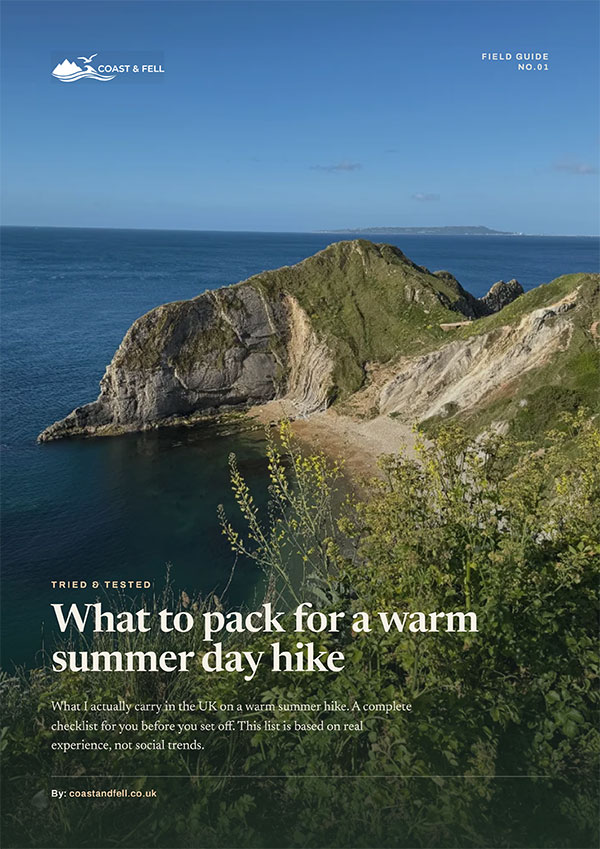
Free printable guide
What to pack for a warm summer day hike
My full warm-weather day-walk kit list as a printable PDF: what I carry, what I leave at home, and how to pack it. The honest article distilled onto a page you can take with you.
FAQ
How much water should I take hiking in a heatwave?
Do I really need electrolytes, or is water enough?
Why does hydration matter more as you get older?
Can hiking in the heat interact with my medication?
How do I stop my hydration bladder going mouldy?
Get the water right and most of a hot day looks after itself. Get it wrong and no view is worth how you will feel by the afternoon. Drink to a schedule, put the salt back, keep something properly cold in the bag, and pick a shaded route when the forecast turns silly. If overheating is your bigger worry than dehydration, the next piece covers exactly that: how to stay cool on the trail.