


Quick verdict
The Bluetti Elite 100 V2 is the portable power station to buy if you charge from solar: 1,024Wh of LiFePO4, 1,800W of output and a 1,000W solar input that Bluetti says refills it in 70 minutes, the fastest solar charging of any sub-£500 model we cover, for £469 at our September 2026 check. Buy it if a roof or a folding panel is your main power source. If you charge mostly from the mains and want more output and more sockets, the Anker SOLIX C1000 Gen 2 gives you 2,000W across four sockets and a 49-minute wall recharge for £499 instead.
Bluetti Elite 100 V2: 4.5/5
1,024Wh of LiFePO4 and 1,800W of output, with a 1,000W solar input Bluetti says refills it in 70 minutes, for £469 at our September 2026 check.
The full review is below.
Should you buy the Bluetti Elite 100 V2?
The Bluetti Elite 100 V2 is the portable power station to buy if you charge from solar: 1,024Wh of LiFePO4, 1,800W of output and a 1,000W solar input that Bluetti says refills it in 70 minutes, the fastest solar charging of any sub-£500 model we cover, for £469 at our September 2026 check. Buy it if a roof or a folding panel is your main power source. If you charge mostly from the mains and want more output and more sockets, the Anker SOLIX C1000 Gen 2 gives you 2,000W across four sockets and a 49-minute wall recharge for £499 instead.
That 1,000W solar figure is the whole story on this unit. Most 1kWh stations cap solar input at 400W to 600W, so they need a full sunny day to refill from panels; Bluetti built a bigger MPPT charge controller in and claims a 70-minute solar recharge at 1,000W as a result. Around it sits a standard 1kWh spec sheet: 1,024Wh of LiFePO4 rated for 4,000-plus cycles, 1,800W of continuous output, a 10ms UPS switchover and app control over Bluetooth and Wi-Fi. It is not expandable, and its wall charging is the one place it trails the Anker, which we come to below.
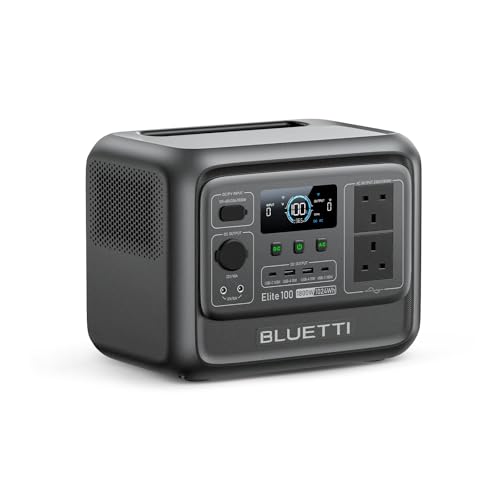
Bluetti Elite 100 V2 specs and buying options
Every spec below is verified against Bluetti's UK page and the EU user manual, with prices checked at our September 2026 pass.
Elite 100 V2, from £469
The solar bargain of the entire market we cover: a 1,000W solar input and built-in MPPT controller on a £469 unit, filling its 1,024Wh battery in a claimed 70 minutes of good light. Output is 1,800W, the battery is rated 4,000-plus cycles, and it takes Bluetti's Charger 1 alternator accessory for van charging. From the mains, Bluetti quotes 80% in 45 minutes with TurboBoost. If panels are how you plan to run the thing, nothing near this price gets close.
The base unit is £469. From there the ladder is about how you recharge it: the 200W solar bundle is £798 and the 350W solar bundle is £998, while a Charger 1 DC-to-DC alternator kit (for charging off a vehicle's engine on the move) brings it to £728 and a Charger 2 kit to £898. Pick by your power source, not by capacity, because the station itself is identical across all of them. One warning on the listings: there is a duplicate Amazon page for the bare unit priced at £799, some £330 above the real £469 listing for the same box, so buy through the link here rather than searching the model name blind.
What can the Bluetti Elite 100 V2 actually run?
The numbers below are calculated estimates, not lab tests: rated capacity multiplied by an 85% usable conversion efficiency, divided by each device's battery capacity, rounded down. On 1,024Wh that gives roughly 870Wh of usable energy.
- Phone (iPhone 17, 14.4Wh): around 60 full recharges
- LED lantern (4,800mAh, 17.8Wh): around 48 recharges
- Drone battery (DJI Mini 4 Pro, 19Wh): around 45 recharges
- Tablet (iPad 11-inch, 28.9Wh): around 30 recharges
- Laptop (MacBook Air 13-inch, 53.8Wh): around 16 recharges
For continuous loads, the same 870Wh estimate works as simple division: a steady 60W draw runs for around 14.5 hours, a 300W draw for just under three hours, and a full 1,800W load for roughly 29 minutes. On the output side, 1,800W of continuous power with a 2,700W surge (Bluetti's Lifting Power figure; some Amazon listings quote a higher 3,600W, which Bluetti's own UK page does not confirm) covers travel kettles, most microwaves, power tools and anything else rated at 1,800W or below. Note that AC and DC output share a 1,900W combined ceiling, so running the mains sockets flat out leaves little for the DC ports at the same time. Anything rated above 1,800W is out, and that includes plenty of full-size kettles, so check the rating plate before you plan your brews around it. The port set runs to nine: two UK three-pin sockets, a 140W and a 100W USB-C, two 15W USB-A, a 120W car socket and two 12V DC5521 outputs.
Check the Elite 100 V2 price on AmazonIs the 1,000W solar input the reason to buy it?
Here is the line on the spec sheet that decides this unit for you. Its solar input is rated at 1,000W, and Bluetti claims a full 0 to 100% solar recharge in 70 minutes at that wattage through a built-in MPPT controller. That is the fastest solar charging of any sub-£500 station we cover, and it comes from having roughly double the solar input ceiling of most rivals: the Anker SOLIX C1000 Gen 2 tops out at 600W, the EcoFlow Delta 3 Classic and Delta 2 at 500W.
If you power the unit from panels, whether a fixed roof array on a camper or a big folding kit at camp, that headroom is worth real money, because it means an afternoon of sun refills the battery instead of a full day, and you can size your panels up to match. Bluetti sells it bundled with a 200W panel (£798) or a 350W panel (£998), and neither comes close to the 1,000W the unit will actually accept, so there is room to add more.
The catch sits on the mains side. Bluetti publishes an 80% AC recharge in 45 minutes using its 1,200W TurboBoost mode, but does not publish a verified 0 to 100% wall-charging time for the UK model, so we do not quote one. If your normal routine is to top the unit up from a plug socket the night before a trip, the Anker's confirmed 49-minute full mains recharge is the safer pick. Buy the Bluetti for the solar; buy the Anker for the wall.
One more decision before you commit: the Elite 100 V2 is not expandable. There is no extra-battery port on the unit or in the manual, so the 1,024Wh you buy is the capacity you keep. For a devices-and-weekends machine that matters less than it sounds, but if you can already see home backup or off-grid use in your future, buy a unit built to grow instead, covered in the alternatives below.
Bluetti Elite 100 V2 alternatives
The Anker SOLIX C1000 Gen 2 is the closest rival and our overall top pick, at £499 to the Bluetti's £469. Same 1,024Wh capacity, but the Anker answers with more output (2,000W against 1,800W), more sockets (four against two), a confirmed 49-minute full mains recharge and a quieter noise claim. The Bluetti wins on solar: 1,000W of input against the Anker's 600W. We put the two head to head in the Anker C1000 Gen 2 vs Bluetti Elite 100 V2 comparison.
The EcoFlow Delta 3 Classic is the value play at £399 at our check, £70 less than the Bluetti. It matches the 1,024Wh capacity and adds a 60-minute full mains recharge and a 10ms UPS, but it carries just two AC sockets, has no 12V car output at all, and caps solar at 500W, half the Bluetti's input. Tight budget and mains charging, the EcoFlow; solar charging, the Bluetti.
The EcoFlow Delta 2 is the pick if you need room to grow. At £449 it matches the 1,024Wh capacity and expands to around 3kWh with an extra battery, something neither the Bluetti nor the Anker can do. It gives up solar speed to get there, with a 500W input against the Bluetti's 1,000W.
Bluetti Elite 100 V2 FAQs
How fast does the Bluetti Elite 100 V2 charge from solar?
How fast does the Bluetti Elite 100 V2 charge from the mains?
Is the Bluetti Elite 100 V2 expandable?
How many plug sockets does the Bluetti Elite 100 V2 have?
Can the Bluetti Elite 100 V2 run a kettle?
How long does the Bluetti Elite 100 V2 battery last?
Set on Bluetti? The Bluetti brand guide compares the Elite 100 V2 against the rest of the current range. Still weighing brands against each other, the complete portable power station buying guide ranks all the current models side by side, or answer a few questions in the finder and let it shortlist for you.