


Quick verdict
The Mammut Alnasca IV Low LTH GTX is a leather approach shoe built for rock and rough ground, and its strongest card is edging control: a FLEXTRON propulsion plate under a Vibram XS Trek Evo outsole with a smooth climbing zone at the toe. It uses a durable Mastrotto suede upper with a GORE-TEX membrane for waterproof, breathable protection, an EVA midsole and Ortholite insole for cushioning, at roughly 400g per shoe in a low-cut, moderately stiff build. It suits UK hillwalkers and scramblers who want precise footing on Snowdonia and Lakeland rock while staying dry on wet chalk, bog and coast-path mud, rather than long flat-mile comfort. At £190 it is a specialist tool, not a casual trainer.
Mammut Alnasca IV Low LTH GTX: 4.5/5
Leather approach shoe with a Vibram XS Trek Evo outsole, FLEXTRON edging plate and GORE-TEX membrane, tuned for rock and wet British ground at roughly 400g per shoe.
The full review is below.
The Mammut Alnasca IV Low LTH GTX is an approach shoe first and a walking shoe second, and it wears that priority on its sole. This is the leather (LTH) variant of the Alnasca IV Low, built on a durable Mastrotto suede upper with a GORE-TEX membrane, a Vibram XS Trek Evo outsole and a FLEXTRON propulsion plate that gives it the stiffness to stand on small edges. It sits in the same part of my rack as the shoes I reach for when a walk turns into a scramble.
If you spend your weekends on Welsh and Lakeland rock, on Purbeck's chalk edges after rain, or picking a line across greasy boulder fields, this is the sort of shoe the Alnasca is designed for. It is not a cushioned trail cruiser and it does not pretend to be. It trades a little all-day softness for control, and for the right hiker that is exactly the deal you want.


Who the Alnasca IV Low LTH is for
This shoe is for the hiker whose days include rock. Via ferrata, grade 1 scrambles, the approach to a crag, a ridge line where you want to trust your feet on small holds: that is home ground for the Alnasca. The FLEXTRON plate and the toe climbing zone are there so you can edge and smear with confidence, which a soft-flexing trainer simply cannot do.
The leather upper adds abrasion resistance over the standard textile Alnasca, which matters when you are dragging your feet across gritstone and granite. If your walks are rough on footwear, the Mastrotto suede earns its keep.
It is less suited to someone who wants a plush shoe for flat towpaths and long, mild miles. The build is firmer and more precise than a cushioned walking shoe, and that firmness is the point. If your ground is mostly soft trail and you rarely touch rock, look at something more forgiving in the best waterproof trainers roundup instead.
Waterproofing: GORE-TEX in a low-cut shell
The Alnasca IV Low LTH GTX uses a GORE-TEX membrane bonded into the leather upper. That gives you a genuinely waterproof, windproof and breathable barrier, which is what you want for the wet British half of the year. On chalk that turns to slurry, across bog, through wet heather and morning-soaked grass, the membrane keeps the water out while still letting sweat vapour escape, so your feet stay drier from both directions.
The leather helps here too. Suede holds a durable water repellent treatment well and sheds the first wetting before the membrane even has to work, so the shoe does not wet out and go heavy the way some textile uppers can.
The honest limit is the cut. This is a low shoe, so the waterproofing protects you only as high as the collar. Step into a puddle deeper than the ankle, or spend an hour crossing saturated moorland where water is over the top line, and it will come in over the cuff. That is true of every low-cut waterproof shoe, not a fault of this one, but it is the trade you accept for a light, agile approach shoe. For deep bog and sustained wet, a mid boot is the right tool. For everything short of that, the GORE-TEX build does its job. You can see how it stacks up against the rest in the waterproof trainers category.
Grip and outsole
The outsole is the heart of this shoe. Mammut uses a Vibram XS Trek Evo compound, which is a sticky rubber built for a mix of rock and trail rather than pure mud clearing. On dry rock the grip is excellent, and on wet rock it holds better than the harder compounds you find on general walking shoes. The tread has proper lugs through the heel and midfoot for loose ground and gravel, then flattens into a smooth climbing zone at the toe so you can stand on small edges and smear on slab.
That toe zone is what separates an approach shoe from a hiking shoe. It lets you place the front of the foot precisely on a hold and load it, which is exactly what you need when a walk steepens into a scramble. Paired with the FLEXTRON plate, the shoe stays stable underfoot when you are edging rather than folding and losing the hold.
On soft, claggy UK mud the picture is more mixed. The lugs are moderate depth, tuned for rock and firm trail, so in deep clay they will pack more than an aggressive fell-running sole. On chalk, gravel, stone and firm downland the grip is confident. Match the shoe to rock and rough ground and it is superb; ask it to be a bog specialist and it is only average.
Cushioning and fit
Underfoot you get an EVA foam midsole with an Ortholite insole, which gives step-in comfort and enough shock absorption for a full day out. This is not a maximalist, deeply cushioned platform, and it should not be: the FLEXTRON plate deliberately keeps the shoe stiff so it can edge, and a soft midsole would undo that. What you get is a firm, supportive ride that protects the foot on stony ground without turning to mush.
The fit runs on the precise side, as approach shoes tend to. The heel is locked and the midfoot is snug, which is what you want for control on rock, and there is enough room at the toe for a normal day's walking without your foot sliding forward on descents. I would size true to your usual Mammut fit and try them with the socks you actually hike in. If you are between sizes and plan long days, the larger of the two is the safer call.
Straight out of the box the leather is firmer than a textile shoe and wants a few walks to soften and mould to your foot. Once broken in, the upper holds its shape and supports the foot well over rough ground.
Colours
The Alnasca IV Low LTH GTX comes in a single colourway.
Mammut Red
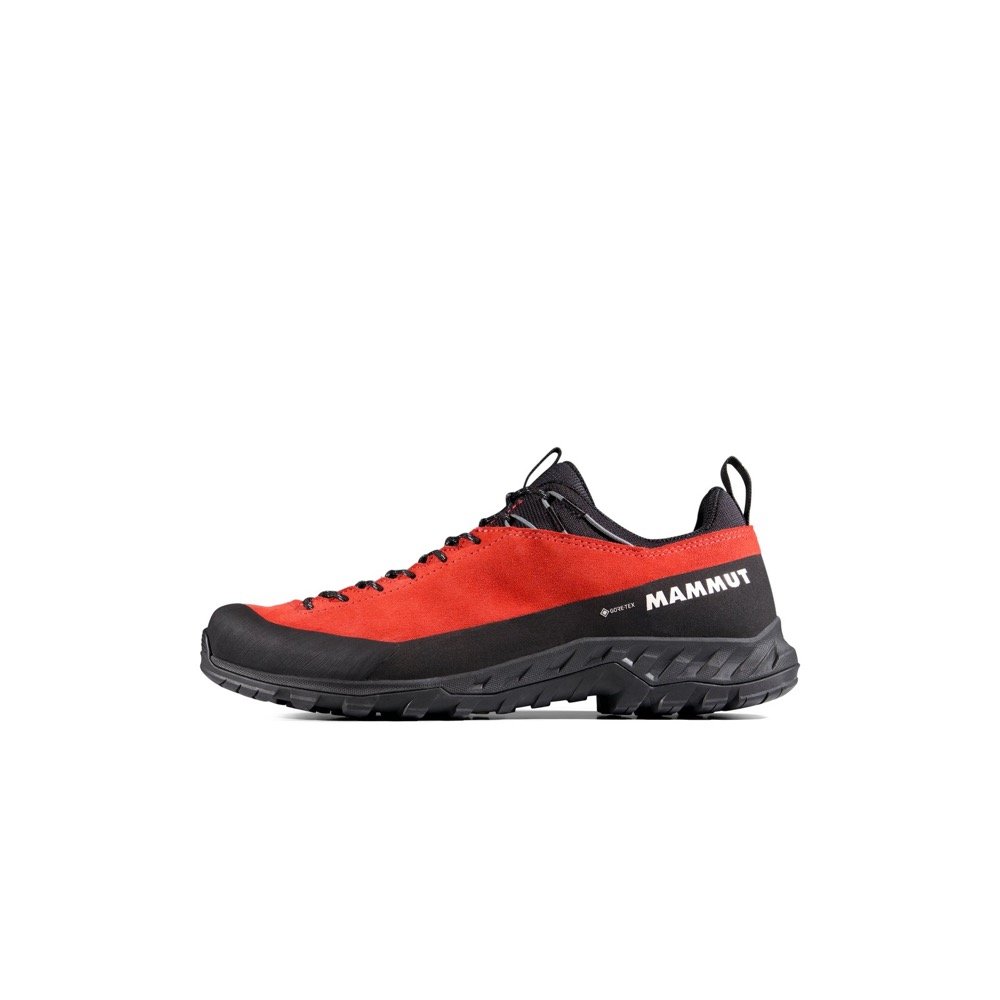 Buy the Mammut Alnasca IV Low LTH GTX (Mammut Red) at Mammut
Specs at a glance
| Spec | Detail |
|---|---|
| Membrane | GORE-TEX, waterproof and breathable |
| Upper | Mastrotto suede leather |
| Outsole | Vibram XS Trek Evo with toe climbing zone |
| Support | FLEXTRON propulsion plate for edging |
| Cushioning | EVA midsole, Ortholite insole (firm, stable ride) |
| Weight | Approx. 400g per shoe |
| Cut | Low |
| Price | £190 |
| Best for | Approach, scrambling, rock and rough ground |
Pros and cons
- Vibram XS Trek Evo outsole with a toe climbing zone grips rock, wet and dry, with real confidence
- FLEXTRON plate gives the stiffness to edge and stand on small holds
- Durable Mastrotto leather upper resists abrasion on rough rock and sheds the first wetting
- GORE-TEX membrane keeps feet dry and breathes well for wet British walking
- Locked heel and precise midfoot fit for control on technical ground
- Firm, stiff ride is less comfortable than a cushioned trainer on long flat miles
- Moderate lug depth packs in deep clay and soft bog
- Low cut lets water in over the collar in deep puddles or saturated ground
- £190 is a specialist price, not a casual-shoe price
- Leather upper needs a short break-in before it moulds to the foot
Verdict
The Mammut Alnasca IV Low LTH GTX earns 4.5 out of 5 as a focused, well-built approach shoe. If your walks involve rock, scrambling or via ferrata, the Vibram XS Trek Evo outsole, the toe climbing zone and the FLEXTRON edging plate give you control that a normal walking shoe cannot, and the GORE-TEX leather upper keeps you dry across wet British ground. It loses points only where it is asked to be something it is not: a plush all-day cruiser or a deep-bog specialist.
Buy it if you want a precise, rock-ready shoe that still copes with a wet weekend on the hill. If you mostly want soft-trail comfort, spend your money elsewhere. For a slightly softer, lower-priced Mammut option, the Sertig III Low GTX is worth a look, and if you want the textile version of this same last, see the Alnasca IV Low GTX.
Buy the Mammut Alnasca IV Low LTH GTX at Mammut


