


Quick answer
Buy the Anker SOLIX S2000 at £649 with the current Amazon voucher if you want 2kWh for home backup at the lowest price: 2,010Wh of LFP, four UK sockets rated 1,500W (3,000W peak surge), a sub-10ms UPS at 30dB and, the number that matters for backup, 314Ah cells rated at 10,000 cycles, around 15 years, in the lightest 2kWh body at 16.2kg. Buy the EcoFlow Delta 3 Max at £999 if you need more output and more ports: 2,048Wh, 2,400W of AC (3,200W X-Boost, 4,800W surge), a 12V car socket the S2000 lacks and 500W of solar against the Anker's 400W. Prices from our September 2026 check.
Our pick: Anker SOLIX S2000
S2000 or Delta 3 Max: which should you buy?
Buy the Anker SOLIX S2000 at £649 with the current Amazon voucher if you want 2kWh for home backup at the lowest price: 2,010Wh of LFP, four UK sockets rated 1,500W (3,000W peak surge), a sub-10ms UPS at 30dB and, the number that matters for backup, 314Ah cells rated at 10,000 cycles, around 15 years, in the lightest 2kWh body at 16.2kg. Buy the EcoFlow Delta 3 Max at £999 if you need more output and more ports: 2,048Wh, 2,400W of AC (3,200W X-Boost, 4,800W surge), a 12V car socket the S2000 lacks and 500W of solar against the Anker's 400W. Prices from our September 2026 check.
These two land within 38Wh of each other on capacity, so this is not a fight about how much energy you store. It is a fight about three things: how hard the unit can push (output), how long the battery lasts before it fades (cycle life), and what you pay. Anker built the S2000 as a portable unit that leans hard into home backup, and its 10,000-cycle rating and sub-10ms UPS are exactly where that shows. EcoFlow built the Delta 3 Max for raw output and port flexibility, and its 2,400W and 12V car socket are where that shows. The £350 gap at our check points one way; the extra 900W of output points the other.
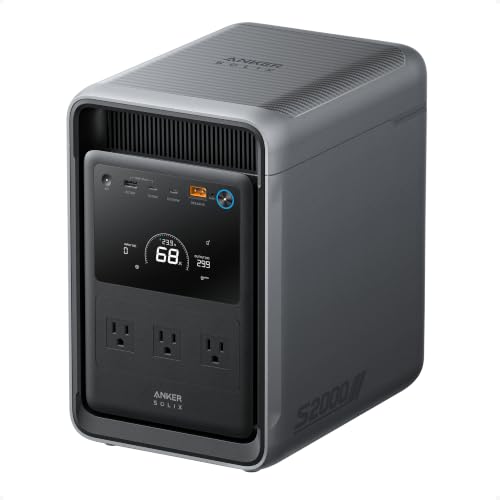
What the S2000 and Delta 3 Max share
Both run LFP (LiFePO4) chemistry, the long-life battery type, and both land at roughly 2kWh: 2,010Wh on the Anker, 2,048Wh on the EcoFlow. Both carry four UK three-pin AC sockets, so either one runs mains kit out of the box. Both charge a laptop over USB-C at up to 100W. Both offer app control, and both have a UPS mode that switches over in around 10 milliseconds, fast enough to bridge a power cut without a router or a desktop noticing.
They also share a limit worth stating up front: neither is expandable. On the EcoFlow, expansion is the Delta 3 Max Plus's feature, not the Max's; on the Anker, the S2000 range has no expansion battery listed. Whatever capacity you buy is the capacity you keep, on both units.
Where the S2000 and Delta 3 Max actually split
Same capacity, different priorities. The real differences, spec by spec:
- Output. The Delta 3 Max is rated 2,400W of AC, with a 3,200W X-Boost mode for high-draw resistive loads and a 4,800W surge ceiling. The S2000 is rated 1,500W, with 2,300W available in bypass (mains pass-through) mode and a 3,000W peak surge. For anything above 1,500W on battery, the EcoFlow is the only one of the two that copes.
- Cycle life. Anker rates the S2000's 314Ah cells at 10,000 cycles, around 15 years, and backs the unit with a 5-year warranty. EcoFlow does not publish a cycle count for the Delta 3 Max. For a unit that will sit on standby and cycle daily as home backup, that published longevity is the S2000's headline advantage.
- Weight and size. The S2000 is 16.2kg; the Delta 3 Max is 20.3kg. Anker calls the S2000 the smallest and lightest 2kWh portable station, around 30% smaller and 25% lighter than the class average. The EcoFlow is also a longer box: 49.4 x 23.9 x 30.5cm against the Anker's 20.8 x 28.2 x 32.3cm.
- Ports. The Delta 3 Max carries nine outputs: four AC, a 12V car socket (126W max), three USB-C (one 100W plus two 30W shared) and a USB-A. The S2000 has no 12V DC port at all, and pairs its four AC sockets with two USB-C (100W and 15W) and one USB-A. If you run 12V kit, only the EcoFlow feeds it directly.
- Solar. The Delta 3 Max accepts up to 500W of solar; the S2000 up to 400W (MPPT 11 to 60V). Anker quotes a 20 to 80% solar recharge in three to four hours at the full 400W.
- Mains charging. Anker quotes the S2000 at 138 minutes (2.3 hours) for a full 0 to 100% charge at its standard rate, with a faster UltraFast mode at 1,500W input. EcoFlow lists the Delta 3 Max charging at up to 2,300W of AC but does not publish a clean 0 to 100% time, so we are not quoting one.
- Noise. EcoFlow rates the Delta 3 Max at 25dB (measured at 600W); Anker rates the S2000 at 30dB. Both are quiet.
- Price. At our check the S2000 was £649 on Amazon with the current voucher (list £1,099), and the Delta 3 Max was £999 (17% off a £1,199 list).
One honest complication on the EcoFlow side: at our check the Delta 3 Max's own sibling, the Delta 3 Max Plus, delivered more (3,000W output, wire-free expansion to 10kWh, double the solar) and listed for less on EcoFlow's own UK store. On Amazon the Max was £999 against £1,099 for the Plus. Buy the plain Max only if you are certain you will never expand, never exceed 2,400W and never run more than 500W of solar.
Anker SOLIX S2000 and Delta 3 Max specs and buying options
Both units verified against the manufacturers' UK pages and spec sheets, with every priced Amazon configuration shown at our September 2026 check. The S2000 first:
SOLIX S2000, from £649
Anker's newest 2kWh unit, built for home backup: 2,010Wh, 1,500W (3,000W peak), a sub-10ms UPS at a quiet 30dB, and a 314Ah LFP battery rated at 10,000 cycles, around 15 years, in the smallest and lightest 2kWh body at 16.2kg. £649 on Amazon with the current voucher (list £1,099), which undercuts the expandable C2000 Gen 2 by £350. No 12V DC port and no expansion battery, so it trades flexibility for value and longevity.
- Anker SOLIX S2000 (2010Wh, base, Home Backup)£649Buy now
- Anker SOLIX S2000 + car charger£928Buy now
- Anker SOLIX S2000 + car charger & cable£958Buy now
- Anker SOLIX S2000 + waterproof bag£693Buy now
- Anker SOLIX S2000 + car charging cable£669Buy now
- Anker SOLIX S2000 + 100W solar panel£753Buy now
- Anker SOLIX S2000 + 200W solar panel£862.92Buy now
- Anker SOLIX S2000 + PS400W solar panel£1,048Buy now
- Anker SOLIX S2000 + 400W solar panel£1,048Buy now
Note the S2000 ships with the unit and an AC charging cable only, so the car chargers and solar panels above are separate bundles. And the EcoFlow Delta 3 Max:
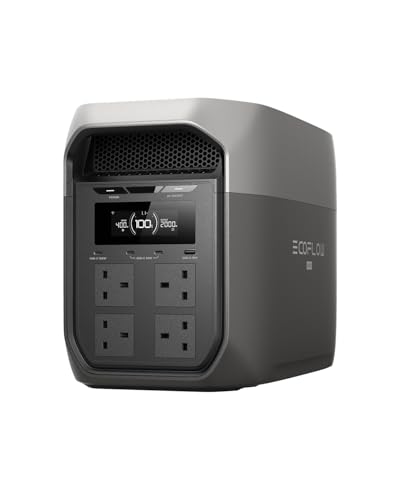
Delta 3 Max, from £999
2,048Wh and 2,400W of output in a 20.3kg box, with a quiet 25dB rating at 600W and nine ports including a 12V car socket. The problem is its own sibling: the Max Plus delivers 3,000W, expands to 10kWh, takes double the solar and charges USB-C at 140W, and on EcoFlow's own UK store it listed £100 cheaper than this at our check. On Amazon the Max was £999 against £1,099 for the Plus. Buy the Max only if you're certain you'll never expand, never pass 2,400W and never run more than 500W of solar.
What can 2kWh actually run?
The stored energy is close to identical, so the runtimes are too. The numbers below are calculated estimates, not lab tests: rated capacity multiplied by an 85% usable conversion efficiency, then divided by a device's draw. That gives roughly 1,708Wh usable on the S2000 and 1,740Wh on the Delta 3 Max, a difference of minutes across a full discharge:
- Wi-Fi router (50W): around 34 hours on either
- Full-size fridge (100W average draw): around 17 hours on either
- Television (150W): around 11 hours on either
- Laptop and monitor (120W): around 14 hours on either
Where they diverge is the ceiling, not the runtime. The S2000's 1,500W rated output covers a fridge, a TV, a laptop, a CPAP machine and most power tools, but it will not run a 2kW kettle or a large microwave on battery. The Delta 3 Max's 2,400W rating, with 3,200W X-Boost for resistive loads, does stretch to a kettle, a toaster or a microwave. If your backup plan includes boiling water or heating food, that gap decides it; if it is fridge, router, lights and devices through a power cut, both clear the bar and the S2000 does it for £350 less.
Buy the EcoFlow Delta 3 Max on AmazonWho buys which?
Choose the Anker SOLIX S2000 if your main job is home backup and value. Its 314Ah cells rated at 10,000 cycles and around 15 years, its sub-10ms UPS, its 30dB quiet running and its app extras (Time-of-Use scheduling and Storm Guard auto-charge before a storm) are all aimed squarely at a unit that lives plugged in and cycles for years. At £649 with the voucher it is £350 cheaper than the Delta 3 Max, it is the lighter and smaller box at 16.2kg, and Anker rates its idle draw at just 10W (2W on standby). If your loads stay under 1,500W and you have no 12V kit, this is the more sensible buy, and the longevity rating is the reason.
Choose the EcoFlow Delta 3 Max if you need output and ports the Anker cannot match. Its 2,400W of AC (3,200W X-Boost, 4,800W surge) runs a kettle, a microwave or heavier tools that the S2000's 1,500W will not; its 12V car socket feeds 12V kit the S2000 has no port for; it takes 500W of solar to the Anker's 400W; and it edges the noise rating at 25dB. You pay £350 more and carry 4kg more for that headroom. Before you commit, though, weigh it against its own Max Plus sibling, which at our check offered more for a similar price.
If your needs sit in the middle, the deciding question is simple: do you ever need to push past 1,500W? Yes, and the Delta 3 Max is the only one of the two that can. No, and the S2000 gives you the same 2kWh, a longer-rated battery and a lighter body for £350 less.
Anker SOLIX S2000 vs EcoFlow Delta 3 Max FAQs
What is the difference between the Anker SOLIX S2000 and the EcoFlow Delta 3 Max?
Is the Anker SOLIX S2000 good for home backup?
Which has more power output, the S2000 or the Delta 3 Max?
How long does the Anker SOLIX S2000 battery last?
Does the EcoFlow Delta 3 Max have a 12V car socket?
Are the S2000 and Delta 3 Max expandable?
Both units sit in the crowded 2kWh tier. The Anker SOLIX brand guide and the full Anker SOLIX S2000 guide put the S2000 alongside the rest of Anker's range, while the EcoFlow brand guide covers the Delta 3 Max next to its Max Plus sibling. Across brands, the complete portable power station buying guide ranks every current model, or let the finder shortlist for you.