


Quick verdict
The Anker SOLIX F3000 is the Anker to buy when you want home-backup-scale power rather than a portable: 3,072Wh of LiFePO4, 3,600W of output big enough to run a full-size UK kettle, dual solar inputs taking up to 2,400W and an expansion port that grows it to 12kWh with up to three BP3000 batteries, for £1,899 at our September 2026 check. It is a wheeled 41.5kg unit built to stand in for the mains, not something you carry. Buy it if you want whole-home backup or long off-grid runs with room to grow. If you want this much capacity in a unit you can still lift, look at the lighter Jackery Explorer 3000 v2; if you only need a movable 2kWh unit, the Anker C2000 Gen 2 costs far less.
Anker SOLIX F3000: 4.6/5
3,072Wh of LiFePO4 that expands to 12kWh, 3,600W of output and dual solar to 2,400W, in a wheeled home-backup build, for £1,899 at our September 2026 check.
The full review is below.
Should you buy the Anker SOLIX F3000?
The Anker SOLIX F3000 is the Anker to buy when you want home-backup-scale power rather than a portable: 3,072Wh of LiFePO4, 3,600W of output big enough to run a full-size UK kettle, dual solar inputs taking up to 2,400W and an expansion port that grows it to 12kWh with up to three BP3000 batteries, for £1,899 at our September 2026 check. It is a wheeled 41.5kg unit built to stand in for the mains, not something you carry. Buy it if you want whole-home backup or long off-grid runs with room to grow. If you want this much capacity in a unit you can still lift, look at the lighter Jackery Explorer 3000 v2; if you only need a movable 2kWh unit, the Anker C2000 Gen 2 costs far less.
Two things separate the F3000 from everything smaller in Anker's range. The first is scale: 3,072Wh out of the box, a 3,600W inverter that clears the 3kW bar most full-size UK kettles sit at, and expansion to 12kWh (Anker's UK page describes it as "3-12kWh") by stacking up to three BP3000 batteries. The second is what that scale is built into. This is an EasyTow suitcase design with wheels and a pull handle, weighing 41.5kg, so Anker has stopped pretending you carry it and built a unit you park and wheel. Around that sits a 4,000-cycle LiFePO4 pack, a 20ms UPS switchover, and an EV-charging adapter that lets it recharge from a wall at up to 3,600W where the standard AC input runs at 1,800W.
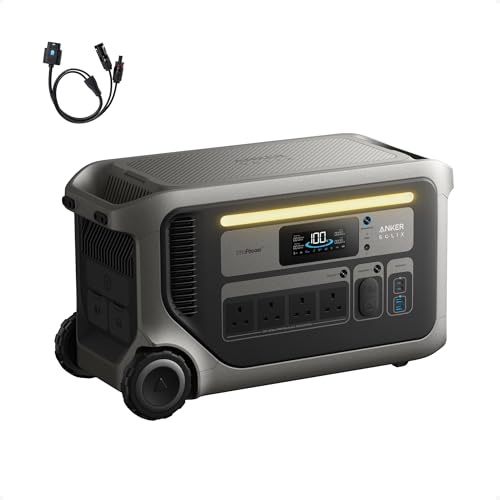
Anker SOLIX F3000 specs and buying options
Every spec below is verified against Anker's UK pages, with all Amazon buying configurations and prices checked 24 September 2026.
SOLIX F3000, from £1,899
A home-backup unit that's portable in the suitcase sense: 3,072Wh, 3,600W of output, 41.5kg on built-in wheels with a towing handle, and expansion to 12,288Wh with up to three BP3000 batteries. It swallows 2,400W of solar across dual inputs for a claimed 90-minute refill, and with the right adapter it recharges at up to 3,600W from an EV charger. £1,899 at our September 2026 check. Buy it for power cuts and off-grid bases, not for anything you plan to lift.
The base F3000 is £1,899. From there the range climbs by two axes: solar and capacity. A single 400W solar panel takes it to £2,198, and two 400W panels to £2,597, both well within the unit's 2,400W solar ceiling. On the capacity side, the F3000 plus one BP3000 expansion battery doubles the pack to 6,144Wh for £3,048, and the same pairing with a 400W panel is £3,447. Anker's own UK listing sells that BP3000 bundle as the 6,144Wh configuration and describes the full ladder as 3kWh to 12kWh, so plan the growth path around stacking BP3000 batteries rather than mixing in anything else.
What can the Anker SOLIX F3000 actually run?
The numbers below are calculated estimates, not lab tests: rated capacity multiplied by an 85% usable conversion efficiency, divided by each device's battery capacity, rounded down. On 3,072Wh that gives roughly 2,610Wh of usable energy.
- Phone (iPhone 17, 14.4Wh): around 181 full recharges
- LED lantern (4,800mAh, 17.8Wh): around 146 recharges
- Drone battery (DJI Mini 4 Pro, 19Wh): around 137 recharges
- Tablet (iPad 11-inch, 28.9Wh): around 90 recharges
- Laptop (MacBook Air 13-inch, 53.8Wh): around 48 recharges
For continuous loads, the same 2,610Wh estimate works as simple division: a steady 60W draw runs for around 43 hours, a 300W draw for just under nine hours, and a full 3,600W load for roughly 43 minutes. The output side is where the F3000 pulls clear of Anker's portables. 3,600W of continuous output covers most full-size UK kettles, which sit around 3,000W, alongside microwaves, power tools, space heaters and the sort of appliances that trip a 2,000W unit like the C1000 Gen 2. That is the practical case for a unit this size: it runs the things a smaller station cannot, not just more of the small things. The rest of the output list runs to two 100W USB-C ports, two USB-A ports, a 12V car socket and a high-current Anderson DC output rated 13.4V/30A for heavier 12V loads.
Check the F3000 price on AmazonIs the F3000 more than you need?
Here is the decision to make before you buy, because the F3000 is a different kind of purchase from the units below it. It weighs 41.5kg. Anker builds in wheels and a pull handle precisely because this is not a lift for one person into a car boot, and once it is somewhere it tends to stay there. And at £1,899 it costs nearly twice the C2000 Gen 2 and close to four times the C1000 Gen 2.
Both of those are the right price to pay for one job. If you want a unit that stands in for the mains during a power cut, runs high-draw appliances for hours, or covers a long off-grid or cabin stay, 3kWh with a 3,600W inverter is the sensible entry point, and the path to 12kWh means it grows with the load rather than capping out. Anker positions the F3000 as a home-backup unit, and the wheeled build, the EV-charging adapter and the expansion ladder all point the same way.
It becomes more than you need in one specific case: you want to move the thing. If the power station has to travel between the house, the car, the caravan and the campsite, 41.5kg on wheels is a lot to manage, and you are paying for capacity a portable would cover. That is a C2000 Gen 2 job at 2,048Wh and 18.9kg, or a C1000 Gen 2 job at 1,024Wh and 11.29kg. Buy the F3000 for the house; buy one of the smaller units for the road.
How fast does the Anker SOLIX F3000 recharge?
This is the one figure to be clear-eyed about. Anker does not publish a 0 to 100% mains recharge time for the F3000 on its UK pages, so unlike the C1000 Gen 2 (49 minutes) and the C2000 Gen 2 (58 minutes), there is no headline wall-charging number to quote. What Anker does publish is the inputs: standard AC charging runs at 1,800W, and the F3000 accepts up to 3,600W from a wall when you use its EV-charging adapter, which is the fast route.
The recharge figure Anker does put a time to is solar. The F3000 carries dual PV inputs, a high-voltage input rated to 1,600W and a lower-voltage input to 800W, for 2,400W of solar in total, and Anker claims a full recharge in 1.5 hours at that wattage. That is a genuinely strong solar figure for a 3kWh unit, and it is the number to plan an off-grid setup around. For mains charging, judge it on the inputs rather than a published time until Anker states one.
Anker SOLIX F3000 alternatives
The Jackery Explorer 3000 v2 is the closest direct rival: the same 3,072Wh and the same 3,600W output, for £1,599 at our check, £300 less than the F3000. It is lighter too, at 27kg against 41.5kg, and it publishes a full mains recharge of 108 minutes where Anker gives no 0-100% figure at all. The F3000 answers with the one thing the Jackery cannot do: expand. The Explorer 3000 v2 has no expansion input, so 3,072Wh is where it stops, while the F3000 grows to 12kWh. If you want the most 3kWh for the least money and weight, the Jackery; if you want a unit that can grow into whole-home backup, the Anker.
The Bluetti Apex 300 is the other home-backup expandable option: 2,764.8Wh and 3,840W of output for £1,499, cheaper than the F3000 and rated for a longer 6,000 charge cycles against Anker's 4,000. It also expands much further, to 19,353.6Wh with six B300K batteries on one unit. The catch is the base unit has no USB or 12V ports at all, so it needs Bluetti's Hub D1 accessory to charge gadgets directly, where the F3000 has USB-C, USB-A and DC outputs built in. Buy the Apex 300 for the deepest, cheapest home-backup expansion; the F3000 for a unit that also works as a big all-in-one out of the box.
The Anker SOLIX C2000 Gen 2 is the step down within Anker's own range: 2,048Wh expandable to 4,096Wh, 2,400W output and a movable 18.9kg, for £999. It is the one to choose if you want serious capacity you can still carry to the car and the caravan, and it publishes a 58-minute mains recharge. The F3000 is the pick only if you have committed to home-backup scale and the extra weight that comes with it.
Anker SOLIX F3000 FAQs
How fast does the Anker SOLIX F3000 charge?
Is the Anker SOLIX F3000 expandable?
Can the Anker SOLIX F3000 run a kettle?
How heavy is the Anker SOLIX F3000 and can you carry it?
How many plug sockets does the Anker SOLIX F3000 have in the UK?
How long does the Anker SOLIX F3000 battery last?
Set on Anker? The Anker SOLIX brand guide compares the F3000 against the whole current range, from the £189 C300 DC to the movable C2000 Gen 2. Still weighing brands against each other, the complete portable power station buying guide ranks all 25 current models side by side, or answer a few questions in the finder and let it shortlist for you.
For a direct head-to-head, see the Anker SOLIX F3000 vs Jackery Explorer 3000 v2 comparison.