


Quick answer
Our pick: Salomon Wayfarer Warm Pants
- Best overall: Salomon Wayfarer Warm (~£110)
- Best for winter mountains: Rab Torque Vapour-Rise (~£165)
- Best softshell: Mammut Courmayeur SO (~£170)
- Best budget fleece lined: EKLENTSON Fleece Lined (~£33)
- Best layering bottoms: Mammut Aconcagua ML Tights (~£120)
The full reasoning, and everything we ruled out, is below.
The best winter hiking trousers in the UK are not the product you probably think you are shopping for. I went looking for a proper fleece lined winter hiking trouser from a serious outdoor brand this year and found the category barely exists at quality level. The big brands make lined and brushed softshells. True fleece linings live almost entirely in budget Amazon brands with names you have never heard of.
That is not a reason to give up on warm legs. It is a reason to understand what is actually on the market, because the answer for a cold Purbeck ridge in January is different from the answer for a dog walk on a frosty morning, and neither is the answer the search results suggest.
This guide covers the lined trousers worth buying, the budget fleece linings and the jobs they are actually right for, and the layering system that serious winter walkers use instead.
Buy the top pick direct from SalomonEvery winter trouser in this guide, compared
The whole guide in one table. Tap a name to jump to the full write-up, or the buy button to check today's price.
| Product | Price | Buy |
|---|---|---|
| Best overallSalomon Wayfarer Warm Pants | ~£110 | Salomon |
| 4-way stretch softshell with brushed back · DWR treatment · knee articulation, three leg lengthsBest for The winter version of a standard hiking trouser, for cold-weather walking most UK days | ||
| Best for winter mountainsRab Torque Vapour-Rise Pants | £165.00 | Amazon |
| Vapour-Rise zoned lining · Matrix stretch outer with fluorocarbon-free DWR · thigh vents, ankle zips, reinforced kneesBest for Winter hill days and mountain routes where warmth and moisture management both matter | ||
| Best softshellMammut Courmayeur SO Pants | ~£170 | Mammut |
| Double-weave recycled nylon softshell · ripstop reinforcement at knees and lower leg · boot hooks, harness-compatible pocketsBest for Cold, windy, technical terrain where you generate your own heat | ||
| Best budget fleece linedEKLENTSON Fleece Lined Trousers | £33.13 | Amazon |
| Softshell exterior with true fleece lining · 5 zip pockets · part-elastic waistBest for Dog walks and short local winter walks, not mountain days | ||
| TACVASEN Fleece Lined Trousers | £31.43 | Amazon |
| 92% polyester 8% elastane softshell with fleece lining · articulated knees · 4 zip pocketsBest for The near-identical alternative if the EKLENTSON is out of stock in your size | ||
| Best layering bottomsMammut Aconcagua ML Tights | £130.53 | Amazon |
| Polartec Power Stretch Pro fleece · 220g · drop-in leg pocketBest for Wearing under your existing hiking trousers, the most adaptable winter system | ||
Amazon prices refresh automatically with the site’s nightly build, so they can lag a day and can change at any time. The price at checkout is the one that applies.
Why true fleece lined hiking trousers barely exist
Search for fleece lined trousers and you will find hundreds of results. Look for a pair from a brand you would trust on a mountain and the list collapses almost to nothing.
Here is what I found when I went shopping for exactly this product. Salomon's Wayfarer Warm has a brushed back, not a fleece lining. Rab's Torque Vapour-Rise has a technical zoned lining designed as much for moisture management as warmth. Mammut's winter-weight options are double-weave softshells. Across the serious brands, the pattern repeats: lined softshells and brushed interiors, not the thick fleece lining the search term promises.
The true fleece linings are almost all budget Amazon brands: EKLENTSON, TACVASEN and a rotating cast of near-identical labels selling what is clearly similar or shared manufacturing.
The reason is not a conspiracy, it is physiology. Hiking generates heat. A trouser with a heavy fleece lining is superb for standing around in the cold and quickly becomes a mobile sauna on a climb. Serious brands design for people moving uphill with a pack on, so they build in just enough warmth to take the edge off and spend the rest of the budget on breathability, stretch and durability. The budget brands design for the much larger market of people walking the dog, watching football on a Sunday morning and working outdoors at low intensity, where maximum warmth is exactly right.
Once you see the category that way, choosing gets much easier. Buy a lined softshell if you hike properly in winter. Buy the budget fleece lining for low-intensity cold. Or layer, which is what most experienced winter walkers do anyway and which I cover at the end.
Insulated hiking trousers, lined softshells and thermal walking trousers: what the labels mean
The terminology in this category is a mess, so here is a working translation.
Lined or brushed softshells are what the quality brands sell as winter hiking trousers. A wind-resistant stretch woven outer with either a brushed inner face or a light bonded lining. Warmer than a standard hiking trouser, far more breathable than fleece, and the right tool for actual hiking in UK winter conditions. The Salomon, Rab and Mammut options below are all variations on this.
Fleece lined trousers have a separate fleece layer inside a shell fabric. Maximum standing-around warmth, limited breathability. At quality level this construction has largely migrated to ski and workwear categories. For walking, it survives in the budget brands.
Insulated hiking trousers in the down-jacket sense, with synthetic fill between two fabric layers, are a mountaineering and belay product. For UK hillwalking they are overkill and you will overheat in them on any sustained ascent. None made this guide for that reason.
Thermal walking trousers is mostly a retail search term rather than a distinct product. In practice it means either of the first two constructions, or a normal trouser worn over thermal leggings. That last option is the one this guide takes seriously in the layering section.
One thing no winter trouser on this list does: keep you dry in sustained rain. For that you still want overtrousers on top, and our waterproof hiking trousers guide covers those.
1. Salomon Wayfarer Warm Pants
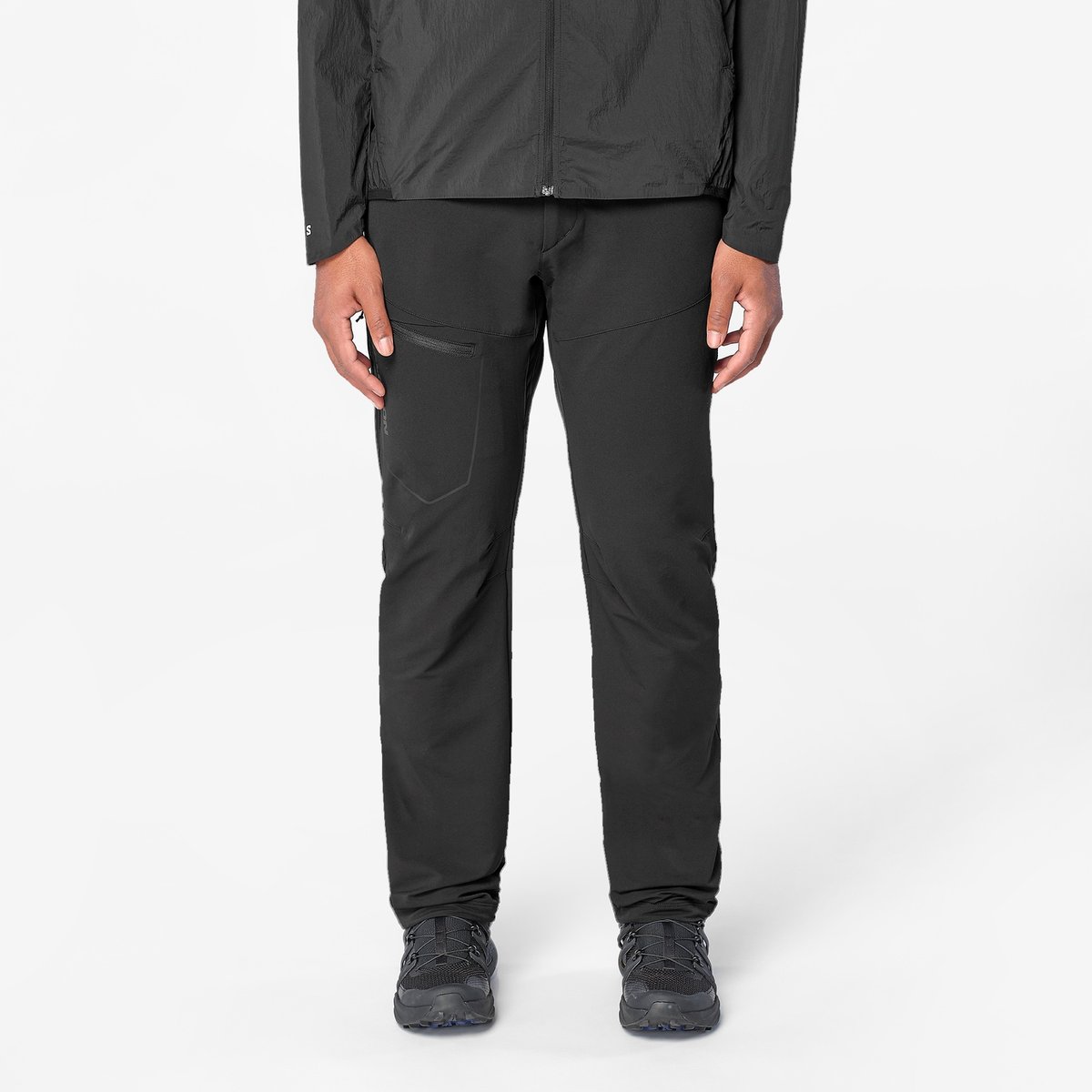
The Wayfarer is Salomon's standard hiking trouser and the Wayfarer Warm is exactly what the name says: the same idea built for cold weather. That lineage is the reason it takes the top spot. This is not a specialist winter product you wear six days a year, it is a hiking trouser that happens to be warm, which for most UK walkers is the far more useful thing.
The fabric is a four-way stretch double weave with a brushed back, so the warmth comes from a soft brushed interior rather than a separate fleece layer. Salomon lists it at 385g, adds a DWR treatment for light rain and dew, and includes UPF 50 protection under its AdvancedSkin Shield label. Knee articulation keeps the movement free on step-ups and stiles, and the straight fit is clean enough that Salomon markets it as a city pant that performs like a mountain pant. Pockets are two zipped plus a rear pocket, with belt loops at the waist.
The detail that matters more than any of that: it comes in short, regular and long leg lengths. Winter trousers ride up over boots and a proper leg length stops cold ankles becoming the day's defining memory.
At around £110 it sits at the sensible middle of this guide. Warm enough for cold Dorset and South Downs days, breathable enough for proper walking, and normal-looking enough to wear to the pub afterwards.
A women's version exists with the same lined construction: the Wayfarer Warm W at Salomon.
2. Rab Torque Vapour-Rise Pants
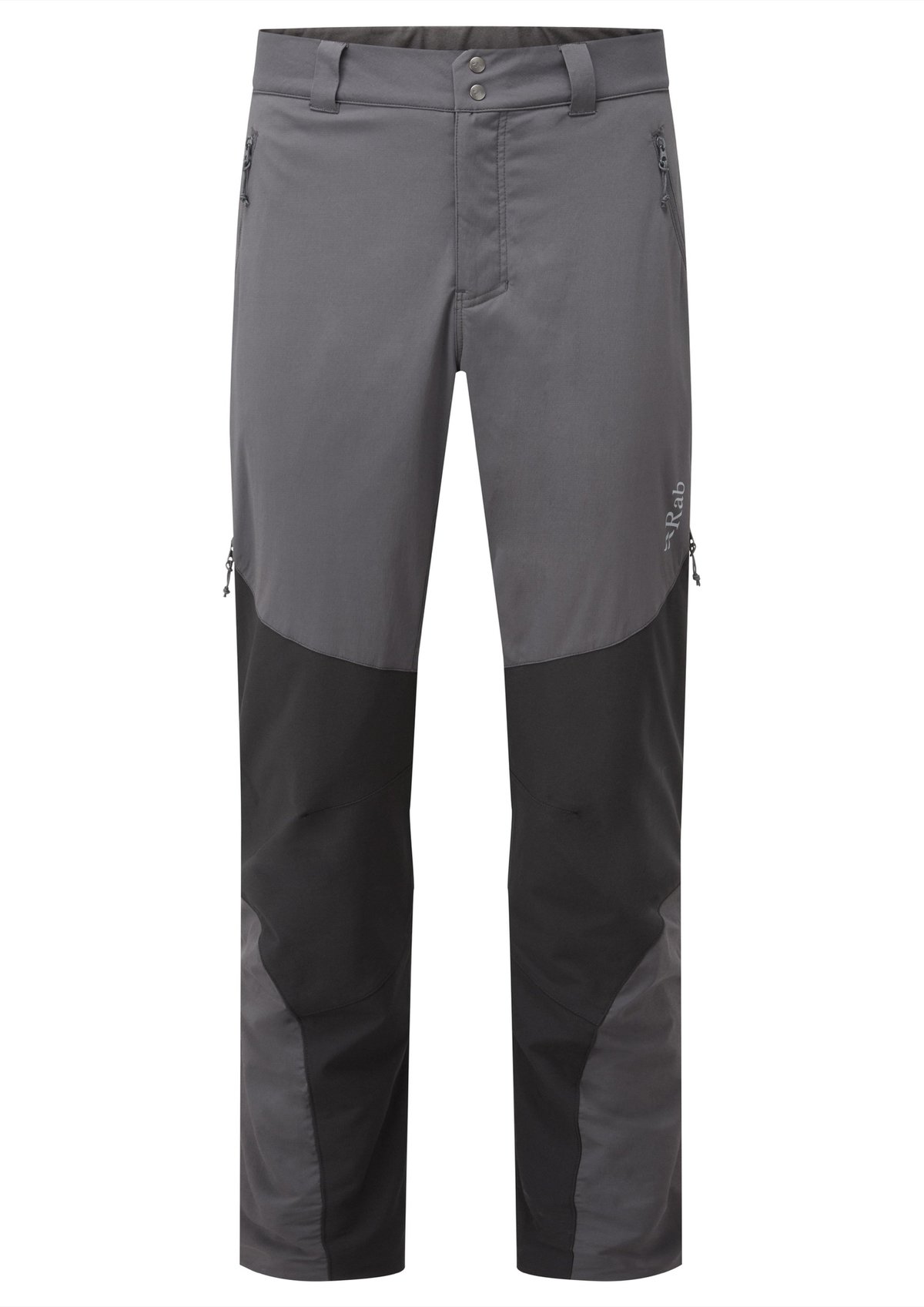
If the Wayfarer Warm is a hiking trouser adapted for winter, the Torque Vapour-Rise is a winter mountain trouser from the ground up. Rab designed it for winter walking, scrambles and fast-moving ascents, and every feature on it exists to solve a specific cold-weather problem.
Vapour-Rise is Rab's lined softshell system: a Matrix stretch double weave outer with a fluorocarbon-free DWR, over a lining zoned to put warmth where you need it and move moisture away from high-heat areas. That zoning is the intelligent answer to the fleece-lining problem described above. Legs working uphill produce serious heat, and a lining that manages moisture rather than just trapping warmth is what stops you finishing a climb damp and then freezing on the descent.
The supporting details are proper mountain kit. Zipped thigh vents dump heat quickly when the gradient bites. Matrix RX reinforcements at the knees and kicker patch protect against rock and crampon scuffs. Ankle zips with an expansion gusset fit over mountaineering boots, the crotch is gusseted, the knees articulated, and the part-elasticated waistband carries belt loops. Two zipped hand pockets. Rab lists the weight at 473g in a medium.
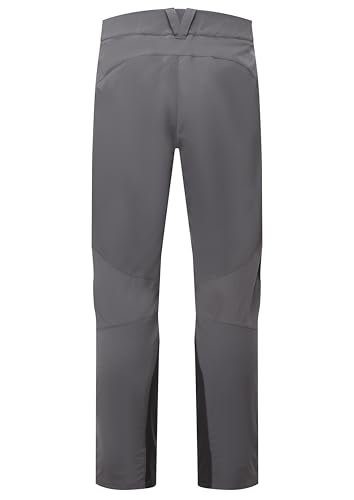
At £165 this is the pair for people whose winter includes the Brecon Beacons in proper conditions rather than just cold-weather versions of their summer walks. For that user it is the strongest option in this guide.
3. Mammut Courmayeur SO Pants
The Courmayeur SO is the softshell answer to winter legs: no fleece, no heavy lining, just a dense double-weave recycled nylon that blocks wind and relies on your own effort for warmth. Mammut rates it top of its range for mountaineering, with hiking and trekking well within its remit, and the construction reads like a brief written by someone who spends winter on technical ground.
The main fabric is 89% recycled polyamide with 11% spandex for four-way stretch, backed by a light recycled polyester lining rather than any insulation. Ripstop reinforcement covers the knees and lower legs, exactly where winter terrain and the occasional crampon spike do their damage. The hem has a gusset and zipper with an asymmetric shape to sit properly over mountaineering boots, plus a stowable attachment hook to lock it down. The waist adjusts with hook-and-loop tabs, the crotch is gusseted, and the pockets are all zippered: two front, one back, and a leg pocket positioned to stay usable with a climbing harness on. It weighs 460g and carries both bluesign and Fair Wear certification.
Where this trouser fits in a UK winter: cold, windy, hard-moving days. On an exposed winter ridge where the wind is the enemy and you are working hard, a softshell like this outperforms a fleece lining comfortably because it never overwhelms you with heat. For low-intensity walks in still cold it will feel thin, and that is by design.
At £170 it is the most expensive trouser here and the most specialist. Pair it with thermal leggings from the layering section on the coldest days and it covers everything a UK winter can offer.
4. The budget fleece lined pairs: EKLENTSON and TACVASEN
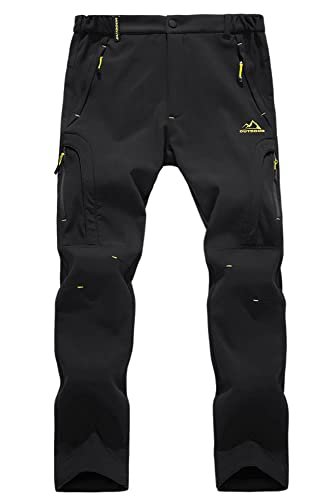
Here are the trousers the fleece lined search actually leads to, and the two names that dominate it. Say the quiet part first: the EKLENTSON and TACVASEN pairs are near-identical products, almost certainly rebrands from similar or shared manufacturing, and choosing between them mostly comes down to price and size availability on the day.
EKLENTSON Fleece Lined Trousers (~£33). A softshell polyester exterior with a true fleece lining, five zipped pockets (two slant hand pockets, two thigh, one rear), and a part-elastic waist. The listing claims waterproofing and windproofing, which at this price you should read as a wind-resistant DWR softshell rather than anything sealed. The listing also promises the fabric does not hold dog hair, which tells you precisely who this trouser is for.
TACVASEN Fleece Lined Trousers (~£31). A 92% polyester, 8% elastane softshell with a fleece lining, articulated knees with reinforced panels, four zipped pockets and a mid-rise waist with elastic side panels. Functionally the same proposition.
And the proposition is genuine, within limits. For dog walks, school runs across frosty fields, and short local winter walks at ambling pace, a £33 fleece lined trouser is a warm, comfortable answer that no £165 breathable mountain trouser improves on. The lining that would cook you on a Beacons ascent is exactly right at two miles an hour in still, cold air.
What these are not is mountain kit. The breathability is not there for sustained climbing, the fabric quality will not survive years of bramble and rock the way the trousers above will, and the waterproofing claims deserve heavy scepticism. Buy them for what they are.
We cover this end of the market properly in the best budget walking trousers guide, and I have bought the EKLENTSON pair to put through a full winter test, so a complete review is coming.
5. The layering alternative: thermal leggings under your existing trousers
The cheapest good answer to cold legs is not a new trouser at all. It is thermal leggings under the hiking trousers you already own, and it is the system I use myself: merino base layer leggings under a standard trouser has covered Pen y Fan in January without a lined trouser in sight.
Layering beats a dedicated winter trouser on adaptability. A fleece lining is warm all day whether you want it or not. A base layer goes on for the frozen early start and the trousers work alone once you have warmed up on the first climb. One pair of trousers covers the whole year, and the leggings you buy for hiking also do skiing, camping and cold touchline duty.


The premium option for the job is the Mammut Aconcagua ML Tights (~£120). These are Polartec Power Stretch Pro fleece tights at 220g, combining two fleece materials to balance warmth against moisture management, with an elastic waistband, a drop-in leg pocket and a mid-rise, close fit that disappears under a hiking trouser. Mammut rates them top of its range for hiking, mountaineering and trekking, and Power Stretch Pro is the fabric serious cold-weather users default to for exactly this layer. They are the bottoms half of a proper winter system rather than an accessory.
Buy the Mammut Aconcagua ML Tights on AmazonYou do not need to spend £120 to run this system. A merino or quality synthetic base layer legging from £25 to £60 does the same job at lower intensity, and our base layers guide covers the options at every price.
If your outer layer needs upgrading too, the main hiking trousers guide has the pairs worth putting over the top.
What you need to know before buying winter hiking trousers
Match the warmth to the effort, not the temperature. This is the single decision that sorts this whole category. High effort in cold conditions wants a breathable lined softshell or a plain softshell. Low effort in cold conditions wants fleece lining or a base layer underneath. Buying maximum warmth for a high-effort activity is the classic mistake and it ends with wet, cold legs from your own sweat.
Wind matters more than air temperature on UK hills. A 2C day in still air is comfortable in almost anything. A 6C day in a 40mph wind on an exposed ridge will cut through an unlined summer trouser completely. Every quality option in this guide uses a dense woven softshell face for exactly this reason, and wind resistance is worth more than an extra millimetre of lining.
None of these are waterproof. DWR treatments shed drizzle and dew, and the budget listings claiming full waterproofing are optimistic. In sustained winter rain you want overtrousers on top of whichever trouser you choose. The waterproof hiking trousers guide covers the options, and an overtrouser plus a lined softshell is the complete UK winter leg system.
Size for the layer underneath. If you plan to run leggings under a softshell on the coldest days, make sure the trouser is not skin-tight through the thigh. Most winter trousers are cut with this in mind, but if you are between sizes and intend to layer, go up.
Leg length matters more in winter. A trouser that rides up over a boot cuff exposes exactly the gap that lets wind and spindrift in. The Salomon's three leg lengths are a real advantage here, and boot hooks or ankle zips on the Rab and Mammut solve the same problem from the other direction.
Care keeps the DWR alive. Wash lined trousers less often than you think you need to, and tumble dry on low heat after washing to reactivate the water repellency. When beading stops entirely, a reproofing spray restores it.
For everything else on the legs, the full range is on the trousers category page.